
A 4-point inspection and a wind mitigation inspection are two different reports, and Florida homeowners often get asked for both in the same week. The 4-point tells an insurer what condition your roof, electrical, plumbing and HVAC are in. The wind mitigation report documents how well your home is built to resist wind, and it can lower the windstorm part of your premium. On an aging asphalt shingle roof, the roof section of both reports matters most, and it is the part you can do something about before you spend $15,000 to $30,000 on a replacement.
TL;DR
- A 4-point inspection covers the roof, electrical, plumbing and HVAC. Insurers use it to decide whether they will cover an older home.
- A wind mitigation inspection records construction features such as roof shape, roof-to-wall connections and opening protection. It can earn discounts on the windstorm portion of your premium.
- They are separate reports. A 4-point does not replace a wind mitigation, and a wind mitigation does not tell an insurer your roof's condition.
- Roofs older than about 15 years with shingles may need documentation of at least five years of remaining life. That is where roof condition decides your outcome.
- If your shingles are aging but still maintainable, call us before you call a roofer. Our free roof assessment tells you whether the roof qualifies for preservation.
Table of Contents
- What each inspection is for
- Does a 4-point include wind mitigation?
- When you will need each one
- What the inspections cost
- Where the roof decides the outcome
- How to prepare for both inspections
- Wind mitigation and your shingles
- Our view
- Get the roof assessed before the inspector does
- FAQ
- Sources
What each inspection is for
The simplest way to separate them: one answers "is this house a risk to insure?" and the other answers "how well will this house handle wind?"
| 4-point inspection | Wind mitigation inspection | |
|---|---|---|
| Question it answers | What condition are the major systems in? | What storm-resistant features does the home have? |
| What it covers | Roof, electrical, plumbing, HVAC | Roof covering, roof deck attachment, roof shape, roof-to-wall connection, secondary water resistance, opening protection |
| Who asks for it | Insurers, usually on older homes | You, to claim premium discounts |
| Result | Underwriting decision on coverage | Possible discount on the windstorm premium |
| Looks at roof condition? | Yes | No, it records construction features |
The 4-point inspection
The Florida Department of Financial Services explains that a four-point report assesses the roof, electrical, plumbing and HVAC systems so an insurer can judge insurability. It is a condition snapshot. The inspector notes the age and state of each system, and the insurer decides whether to write or renew the policy, ask for repairs, or change terms.
For the roof, the same state guide says an insurer may require documentation of at least five years of remaining roof life when the roof is older than 15 years (shingles) or 20 years (tile or metal). We cover that rule in detail in our guide to roof age and insurance in Florida.
The wind mitigation inspection
A wind mitigation inspection looks at how the house is built, not how worn it is. Florida lets homeowners use the uniform mitigation verification form to document those features. The state says wind-resistant improvements may qualify you for discounts on the windstorm portion of your insurance premium.
A few points on the form that matter:
- Since July 1, 2008, admitted insurers must accept a valid uniform mitigation form signed by an authorized professional.
- Authorized signers include qualifying home inspectors, building code inspectors, licensed general, building or residential contractors, professional engineers and architects, per the same state page.
- The revised form (OIR-B1-1802, Rev. 04/26) applies to inspections on or after April 1, 2026. Earlier inspections may use the Rev. 01/12 version.
- Citizens Property Insurance's April 2026 guide states that the mitigation form concerns construction features and is not proof of roof condition or roof replacement.
That last point is the one homeowners miss. A roof can earn good marks for its shape and attachment and still be an aging, brittle roof that an underwriter worries about.
Does a 4-point include wind mitigation?
No. They are two documents with two different purposes, even though one inspector often does both in a single visit. Some inspection companies price the pair as a bundle for that reason. Ask for both reports by name when you book, so you get each form.
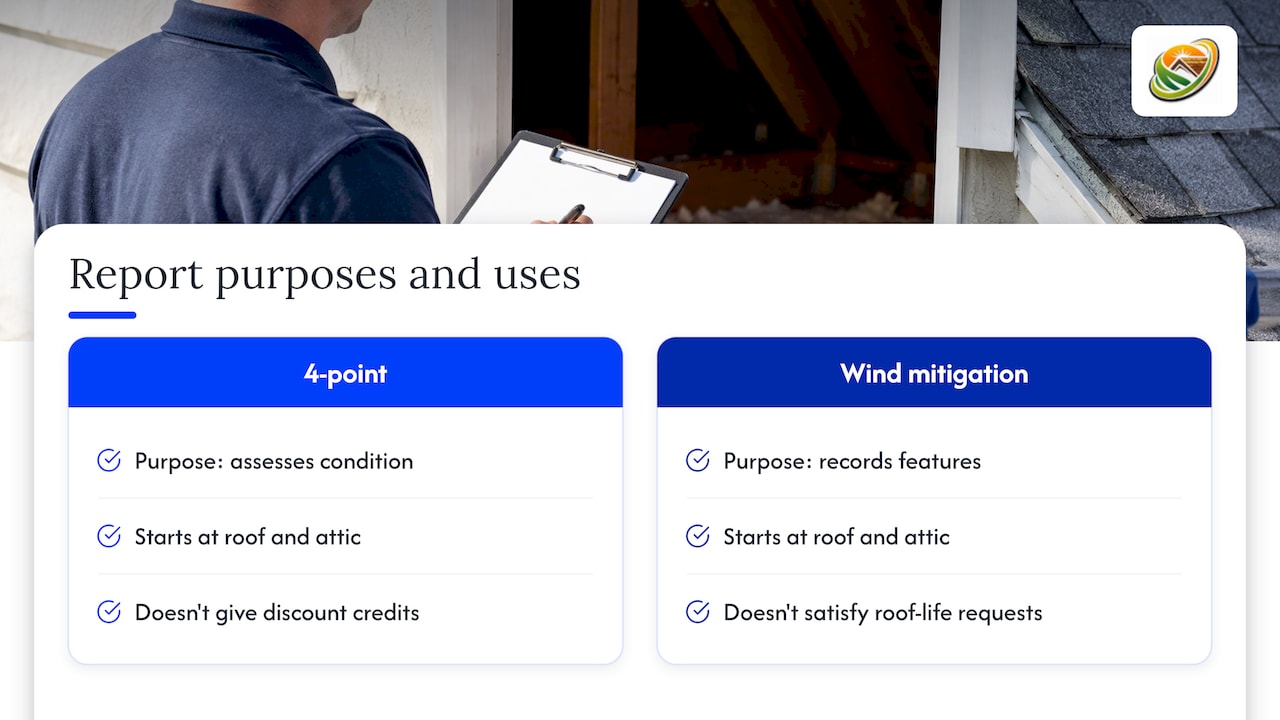
There is overlap in what the inspector looks at, because both start on the roof and in the attic. But the 4-point judges condition and the wind mitigation form records features. A 4-point report will not give you discount credits, and a mitigation form will not satisfy an insurer asking about roof life.
When you will need each one
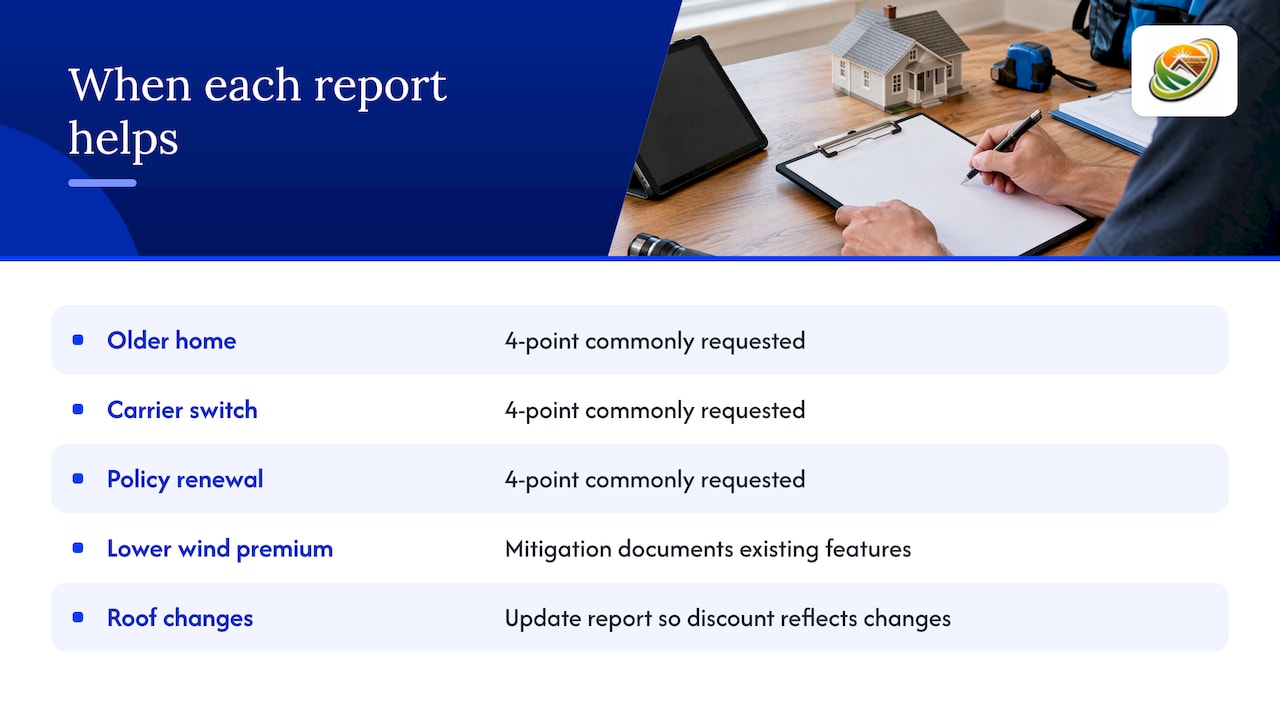
You are buying or insuring an older home. Insurers commonly ask for a 4-point when the home is older, when you switch carriers, or at renewal. Your agent will tell you what your carrier requires.
You want to lower your windstorm premium. Florida law (section 627.711) requires insurers to notify residential applicants and policyholders about available wind-mitigation discounts and their ranges at issuance and at each renewal. If you have never documented your home's features, a wind mitigation inspection is how you show what you already have.
You changed something on the roof. A new roof covering, added straps or storm shutters can change what the form records. Updating the report makes sure the discount reflects the home as it is now.
How long a wind mitigation report lasts
The state says a completed form stays valid for up to five years if there are no material structural changes and no inaccuracies in the report. The 4-point has no state-set shelf life in that guidance, so ask your insurer how recent it must be.
What the inspections cost
Prices vary by company and home size. One South Florida inspector's November 2026 price check found other companies publishing about $120 to $250 per inspection and $200 to $300 for both. Bundling both in one visit usually costs less than booking them separately. Compare quotes on what is included: whether you get the report the same day and whether it is on the current form.
The inspection fee is small next to what it can trigger. A 4-point that flags an old roof can lead to a request for repairs, proof of remaining life, or a replacement demand. That is where the real money sits.
Where the roof decides the outcome
Of the four systems on a 4-point, the roof is the one that most often becomes a $15,000 to $30,000 question. Florida sun, heat, rain and storms dry out asphalt shingles over time, and they turn brittle, crack, curl and lose granules. An inspector sees those signs and writes them down.
Here is what homeowners get wrong. They assume an old roof means a new roof. Roof age is a number on a form, but the condition behind it is what we assess. A roof at 14 or 16 years can still be flexible and well-granulated, or it can be past saving. You find out by having it looked at before the 4-point, not after.
The practical order is:
- Get the roof assessed first. Know whether the shingles are still maintainable.
- Address what can be preserved. If the roof qualifies, preservation restores flexibility and slows further deterioration.
- Then schedule the 4-point and wind mitigation. The reports describe the roof you actually have, with the maintenance on record.
For more on documenting remaining roof life, see how to prove five years left on your Florida roof, and our walkthrough of how to pass the 4-point roof inspection with preservation instead of a tear-off.
How to prepare for both inspections
The inspector wants access and information. A little preparation avoids a second visit.
- Roof: Know the install year and have any permit, invoice or warranty paperwork ready. Clear access to the attic hatch.
- Electrical: Make sure the panel is reachable. Clear storage from in front of it.
- Plumbing: Clear under sinks and around the water heater so supply lines and the tank are visible.
- HVAC: Know the age of the air handler and condenser, and where they are.
- Wind mitigation: Locate any permit records for shutters, impact windows or doors, and roof work. Photos from past work help.
- Walk the roof's edges from the ground. Look for curling tabs, bare spots and piles of granules in gutters. If you see them, get it assessed before the report is written.
After a storm, check the roof again. Our post-storm roof inspection checklist shows what to look for.
Wind mitigation and your shingles
Two roof features on the mitigation form often decide the discount: the roof covering and how the roof deck is attached. If you are considering a new roof only to earn wind credits, check what the form actually records before you commit. Our article on three checks before you qualify wind rated shingles walks through it, and we break down cost, savings and process for wind mitigation inspections in a separate guide.
Our view
Homeowners tend to treat these two inspections as paperwork. We see the roof as the part of them that can cost real money, and the part you can still influence.
A 4-point tells an insurer how old and how worn your roof is. A wind mitigation form tells them how it is built. Neither one tells you whether your shingles can be maintained instead of torn off, and that is the question that saves thousands.
That is why we say: call us before you call the roofer. We are not roofers or roof cleaners. We inspect the roof, assess its condition and tell you honestly whether it qualifies for renewal with our certified Green Soy Technology. Our process is designed to restore flexibility, lock in granules and extend the life of qualifying asphalt shingle roofs. If the roof is a good candidate, you could save up to 80% compared to full replacement, backed by a 6-year transferable warranty.
Tear-offs also send a lot of shingles to landfill. Preserving a roof that still has life in it is better for your budget and for the environment.
Daniellison
Get the roof assessed before the inspector does
If your shingles are aging, the smart time to learn their condition is before an insurer asks. Our free roof assessment covers the inspection, the condition assessment and a recommendation on whether your roof qualifies for preservation and renewal. We serve homeowners in Broward and Palm Beach counties, including Boca Raton, Delray Beach and Plantation.

See how our Shingle Roof Renewal service works or schedule your free roof assessment.
FAQ
Is a wind mitigation inspection the same as a 4-point?
No. A 4-point reviews the roof, electrical, plumbing and HVAC to help an insurer judge insurability. A wind mitigation inspection records wind-resistant construction features that may earn discounts. Many inspectors do both in one visit, but you receive two separate reports.
Do I need both inspections?
It depends on your situation. Insurers typically ask for a 4-point on older homes, while a wind mitigation inspection is something you request to document discounts. Ask your insurance agent which your carrier requires and whether you already have a current mitigation form on file.
How long is a wind mitigation inspection good for in Florida?
Florida's Department of Financial Services says a completed form stays valid for up to five years, as long as there are no material structural changes and no inaccuracies in the report. If you replace the roof or add protection, a new inspection can capture the change.
What does a 4-point inspection cost?
South Florida companies publish roughly $120 to $250 for a single inspection, and less per report when you book both together, according to a November 2026 price check. Get two or three quotes and confirm the report is on the current form.
Can an old roof pass a 4-point without being replaced?
Sometimes. Insurers focus on condition and remaining life, not age alone. Having the roof assessed first shows whether it is a candidate for preservation instead of replacement.
Sources
- Florida DFS Four-Point Inspection Guide
- Florida DFS: Mitigation
- Florida DFS: Mitigation Notices, Inspections and Forms
- Citizens Property Insurance Wind Loss Mitigation Guide, Rev. 04/26
- Florida Statutes 2025, section 627.711
- Wind mitigation and 4-point inspection cost in South Florida