
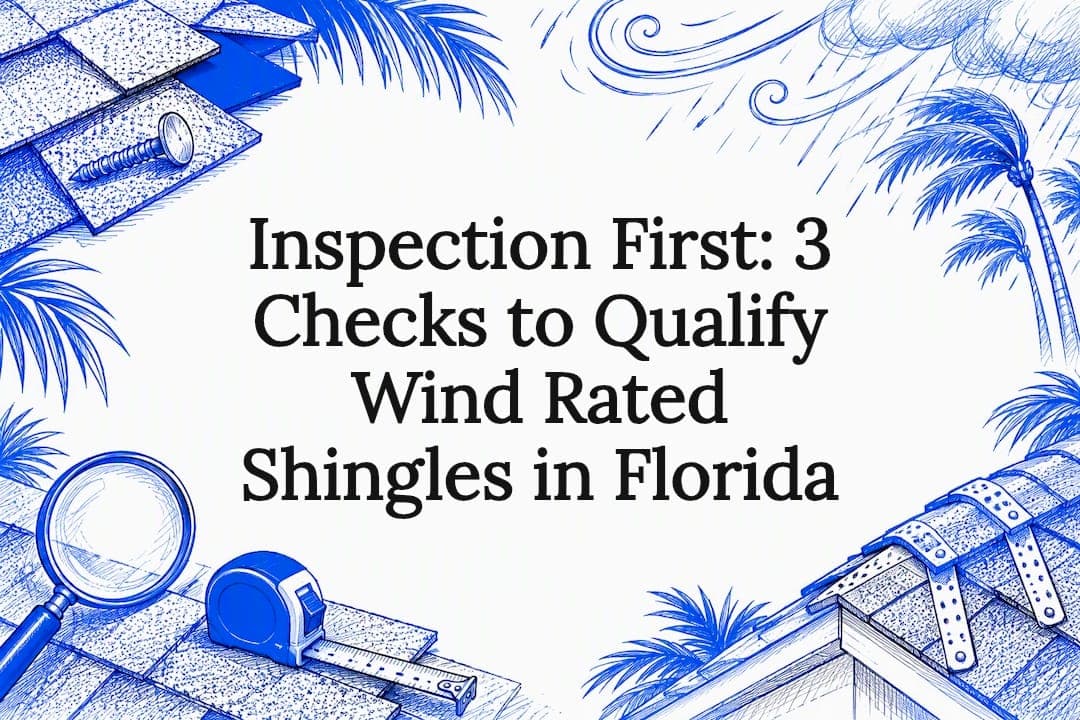
For most Florida homes, a wind-rated asphalt shingle installed to Florida Building Code attachment standards, backed by proper secondary water resistance, delivers the strongest mix of hurricane resistance and insurance savings. The proof lives in three places: the wind class printed on the product wrapper or spec sheet, the nailing pattern on the installation invoice, and a completed wind mitigation inspection form. Check those three things before anything else.
TL;DR:
- Laminated or architectural shingles rated Class G or H offer better wind resistance and durability in Florida, especially when installed with proper fastening patterns.
- Wind mitigation forms must document roof shape, deck attachment, secondary water resistance, and opening protection, with completion valid for up to five years for insurance discounts.
- Proper re-nailing, adding secondary water resistance, and upgrading roof-to-wall attachments during re-roofing significantly increase hurricane resilience and insurance savings.
- Insurance discounts for mitigation features range from about 6% for re-roofing alone to nearly 20% when combining re-nailing, water resistance, and opening protection, depending on the insurer.
- Conducting a visual roof self-check and scheduling a licensed inspection before upgrades can identify necessary repairs and ensure maximum mitigation benefits.
Table of Contents
- 1. Which shingles handle Florida wind the best
- 2. What a wind mitigation inspection actually documents
- 3. Installation details that determine whether shingles stay put
- 4. How these upgrades translate into insurance discounts
- 5. Quick self-checks before you call anyone
- 6. When preservation makes more sense than replacement
- A straight answer on where to start
- Free roof assessment: a practical first step before any repair decision
- FAQ
- Sources
1. Which shingles handle Florida wind the best
Shingle wind performance in Florida is governed by three testing standards: ASTM D3161, ASTM D7158, and TAS 107. These standards determine the class letter printed on a shingle's packaging, and that class letter is what the Florida Hurricane Retrofit Guide ties to specific wind speeds. Class A starts around 60 mph gusts, while Class H correlates to roughly 150 mph gusts, which is the range most relevant to coastal Florida homes facing hurricane-force winds.
Laminated, or architectural, shingles generally outperform older 3-tab shingles in wind resistance and in how long they hold up under Florida's sun. The extra layer of material adds weight and rigidity, which helps the shingle resist lifting at the edges, a common failure point during storms. Three-tab shingles tend to carry lower wind-class ratings and age faster under constant UV exposure, which shortens the window where they perform as tested.
Before you assume a higher rating solves your wind problem, remember that a shingle only performs to its tested class when it is installed exactly the way the manufacturer specifies. A Class H shingle nailed with the wrong pattern or too few fasteners will not hold to its rated wind speed. In many cases, correct fastening and deck attachment matter more than chasing the highest number on the package.
To verify what you actually have on your roof, check these sources:
- Product wrapper or spec sheet: lists the ASTM class and testing standard used.
- Installation invoice: should specify the shingle product name and nailing pattern used.
- Product evaluation report: filed with the Florida Building Code, it details installation requirements tied to the wind rating, including nail count and underlayment type, as shown in manufacturer evaluation reports filed for Florida compliance.
- Age and color: darker shingles absorb more heat and tend to show brittleness sooner, even when the original wind class was high.
If your invoice does not list a wind class, that is a gap worth closing before your next inspection. Our roof protection guide for South Florida walks through cost-effective steps that pair well with verifying your shingle's rating.
2. What a wind mitigation inspection actually documents
A wind mitigation inspection is the document that turns your roof's physical condition into an insurance discount. As of April 1, 2026, inspections must use the updated OIR-B1-1802 (Rev. 04/26) form, which replaced earlier versions and tightened some of the documentation requirements. The form records your roof shape, roof deck attachment method, the presence of secondary water resistance, and whether your openings (windows, doors, garage) are protected against wind-borne debris.
A completed form is typically valid for up to five years, provided no material changes occur to the roof or openings in that time. Here is how the process generally unfolds:
- Schedule the inspection with a licensed inspector, engineer, or qualifying contractor who is authorized to sign the form, such as those offering professional roof insurance inspections in Miami.
- Prepare documentation ahead of time: gather shingle invoices, prior re-roof records, and any photos from past attic or roof work.
- Clear attic access so the inspector can verify deck attachment and truss-to-wall connections without delay.
- Review the completed form for accuracy before it leaves your hands.
- Submit the form to your insurer and ask your agent to confirm which discounts apply to your policy.
Pro Tip: Talk to your insurance agent before paying for any mitigation upgrade. Some improvements qualify for larger discounts than others, and your agent can tell you which ones matter most for your specific policy before you spend a dollar.
Our post-storm inspection checklist covers the documentation steps in more detail, which is useful prep work whether you are scheduling your first inspection or renewing an older one.
3. Installation details that determine whether shingles stay put
The shingle itself is only half the equation. How it is attached to the roof, and how the roof is attached to the house, often decides whether a roof survives a hurricane intact. Ring-shank nails hold better than smooth-shank nails because the ridges resist pull-out under repeated wind uplift. Manufacturers typically specify a minimum nailing pattern for their rated wind class, and that pattern sometimes exceeds what local code requires as a baseline, so it pays to ask your contractor which standard they are following.

Re-roofing is also the best opportunity to re-nail the sheathing itself. Older homes often have roof decks fastened with fewer nails than current standards call for, and adding fasteners during a re-roof closes that gap without added demolition cost.
Secondary water resistance (SWR), typically a self-adhering tape or a synthetic underlayment, keeps water out of the structure if shingles are lost during a storm. According to FEMA's technical advisory on wind and water mitigation, pairing re-roofing with attachment and SWR upgrades produces far better results than re-roofing alone, and protecting openings alongside strengthening roof-to-wall connections tends to deliver some of the strongest benefit-to-cost outcomes for homeowners in high wind zones.
Roof-to-wall connections, whether single wraps, double wraps, or metal clips, and the roof's shape also affect performance. Hip roofs generally handle wind better than gable roofs because they present fewer flat surfaces for wind to catch.
If you are planning a re-roof anyway, these retrofits add the most value per dollar:
- Re-nail the sheathing while the roof is open, since labor cost is already covered by the re-roof.
- Add SWR at the same time rather than as a separate project.
- Upgrade roof-to-wall clips if an inspection shows only toe-nailed connections.
- Protect openings with code-rated shutters or impact screens, which FEMA data points to as a high-value pairing with roof work.
4. How these upgrades translate into insurance discounts
Florida law requires insurers to notify policyholders about available wind mitigation discounts, and those discounts apply only to the wind portion of your premium, according to the Florida CFO's hurricane mitigation guidance. Discounts are not simply additive. Each insurer applies its own actuarial tables, and most cap the total credit regardless of how many features you document.
The Florida Hurricane Retrofit Guide lists example discount ranges tied to specific combinations of work:
- Re-roof only: up to approximately 6%.
- Re-roof plus re-nailing the sheathing: up to approximately 19%.
- Re-roof plus re-nailing plus SWR: up to approximately 20%.
- Adding opening protection to the above: can push combined savings into a higher range.
**The potential combined savings from stacking mitigation features can run within defined ranges depending on which apply to your home, based on example ranges in state guidance. On a policy with a typical wind premium, these savings could amount to meaningful annual discounts, though your actual number depends entirely on your insurer's own rate filing.
The practical order of operations: talk to your agent before you spend money on upgrades, confirm which combination applies to your policy, then submit your completed OIR form once the work is done and documented.

5. Quick self-checks before you call anyone
A few minutes on a ladder, or even from the ground with binoculars, tells you a lot about whether your roof needs attention. Look for curling or cupped tabs, visible cracking, broken or missing tabs, bald spots where granules have worn away, and any shingle older than 10 years, since that is typically when flexibility starts to drop off noticeably.
- Scan the roof from the ground for curling, cracking, or color inconsistency across slopes.
- Check gutters and the ground below downspouts for loose granules, a sign of accelerated wear.
- Photograph any problem areas for your records and for an inspector or insurance agent to review later.
- Gather your invoices for the original installation and any repairs.
If a tab lifts easily when you gently press on it, or several tabs show the same wear pattern, it is worth scheduling a professional assessment rather than guessing. Never walk directly on brittle or aged shingles; call a professional for anything beyond a visual check from a stable vantage point.
6. When preservation makes more sense than replacement
Not every aging roof needs full replacement. A roof with shingles that are still flexible, with limited granule loss and an intact deck and attachment, is often a good candidate for preservation rather than tear-off. Our process follows three steps: inspect the roof, assess its condition, and determine whether it qualifies for renewal.
- Good candidates: shingles that are aging but not yet brittle, minimal granule loss, solid decking underneath.
- Benefits: restored flexibility, better granule retention, and extended roof life for qualifying roofs.
- Limits: preservation does not replace re-nailing or structural upgrades that some insurers require for specific mitigation credits.
- What to request: documentation of the assessment and a clear explanation of warranty terms before any work begins.
Preservation fits into a mitigation plan as one piece, not a replacement for attachment upgrades that your wind mitigation inspection might call for separately. Our article on why Florida asphalt roofs fail goes deeper into how sun and heat shorten shingle life here.
A straight answer on where to start
If we had to rank the priorities, attachment and secondary water resistance come first, a documented wind mitigation inspection comes second, and roof preservation comes third, reserved for roofs that still have flexibility left to save. Skipping the documentation step is the most common mistake we see, since it leaves real savings on the table even after the physical work is done. Start with a self-check, schedule your inspection, then call your agent before you commit to any upgrade, and always confirm your contractor is licensed.
— Daniellison
Free roof assessment: a practical first step before any repair decision
Before you commit to a full re-roof, it is worth finding out whether your existing shingles still have life left in them. Our free roof assessment gives you a clear, honest answer: we inspect the roof, assess its condition, and tell you whether it qualifies for preservation through a certified Green Soy Technology application. For roofs that qualify, the goal is restored flexibility, better granule retention, and extended life, backed by a 6-year transferable warranty.
Preservation is not a substitute for the structural upgrades some insurers require for specific mitigation credits, like re-nailing the deck or adding roof-to-wall clips. What it does well is extend the usable life of a roof that still has flexibility to recover, which can delay a $15,000 to $30,000 replacement decision while you plan your next steps.
| Service | What it addresses | Fits best for |
|---|---|---|
| Free Roof Assessment | Confirms whether your roof qualifies for preservation | Any homeowner unsure if replacement is necessary yet |
| Fresh Roof Application | Restores shingle flexibility and granule retention | Aging shingles that are not yet brittle or cracked |
| Shingle Roof Renewal | Full preservation service with 6-year transferable warranty | Roofs with intact decking and limited wear |
We focus on homes in areas where constant sun, heat, and storm exposure dry out shingles faster than in most other parts of the country. Whatever you decide, confirm any contractor's license before signing a contract. Schedule your free roof assessment to find out if your roof qualifies before you spend a dollar on replacement.
FAQ
What type of shingles are best for Florida weather?
Laminated, architectural shingles rated Class G or Class H under ASTM D7158 generally hold up best against Florida's wind and heat. These classes correspond to higher tested gust resistance than older 3-tab products, though correct installation still determines real-world performance.
What are the wind mitigation requirements in Florida?
A Florida wind mitigation inspection documents roof shape, deck attachment, secondary water resistance, and opening protection using the current OIR-B1-1802 (Rev. 04/26) form. The inspection must be performed by a licensed inspector, engineer, or qualifying contractor, and the completed form is typically valid for up to five years absent material changes.
How much discount for wind mitigation in Florida?
Discount ranges vary by insurer and by which features your home has, but the Florida Hurricane Retrofit Guide gives examples ranging from roughly 6% for a re-roof alone up to around 20% when re-roofing is paired with re-nailing and secondary water resistance. Combined measures including opening protection can reach the higher end of that range.
What is the 15 year roof rule in Florida?
There is no single statewide "15 year rule" that applies uniformly; roof age limits for insurance purposes vary by insurer and are typically addressed through individual underwriting guidelines rather than one fixed law. Homeowners with older roofs should check with their agent directly, since some insurers require inspections or limit coverage options once a roof passes a certain age threshold.
Do I need a new roof to get a wind mitigation discount?
No, a wind mitigation discount is based on documented features of your existing roof, not on having a brand-new one. A roof with proper attachment, secondary water resistance, and opening protection can qualify for credits even if it is several years old, as long as those features are verified on the inspection form.
Sources
- Hurricane mitigation — Florida CFO
- Wind mitigation resources — Florida Office of Insurance Regulation (FLOIR)
- Shingle roof guidance — Florida Hurricane Retrofit Guide
- FEMA technical advisory on wind and water mitigation