
The qualities of long-lasting shingles come down to five verifiable factors: multi-layer lamination, high asphalt content with a quality binder, a strong fiberglass mat, heavy granule adhesion, and verified wind, impact, and fire ratings matched to your local climate. Get those five right, pair them with a healthy roof system, and you can realistically expect 25–50+ years of service life. Skip one, and you may face the need to replace your roof significantly sooner than expected.
Here's a quick checklist to use when evaluating any shingle:
- Look for lamination. Two- or three-layer construction resists tearing and wind uplift far better than single-layer 3-tab.
- Check the weight per square. Heavier shingles (240+ lbs per square for architectural, 350+ for premium) carry more asphalt and last longer.
- Verify UL/ASTM marks. Look for ASTM D3161/D7158 (wind), UL 2218 (impact), and UL 790/ASTM E108 (fire) on the product label or spec sheet.
- Review installation notes. A shingle rated for Class F or H wind performance only delivers that rating when installed per manufacturer specs, including nailing pattern and starter strip.
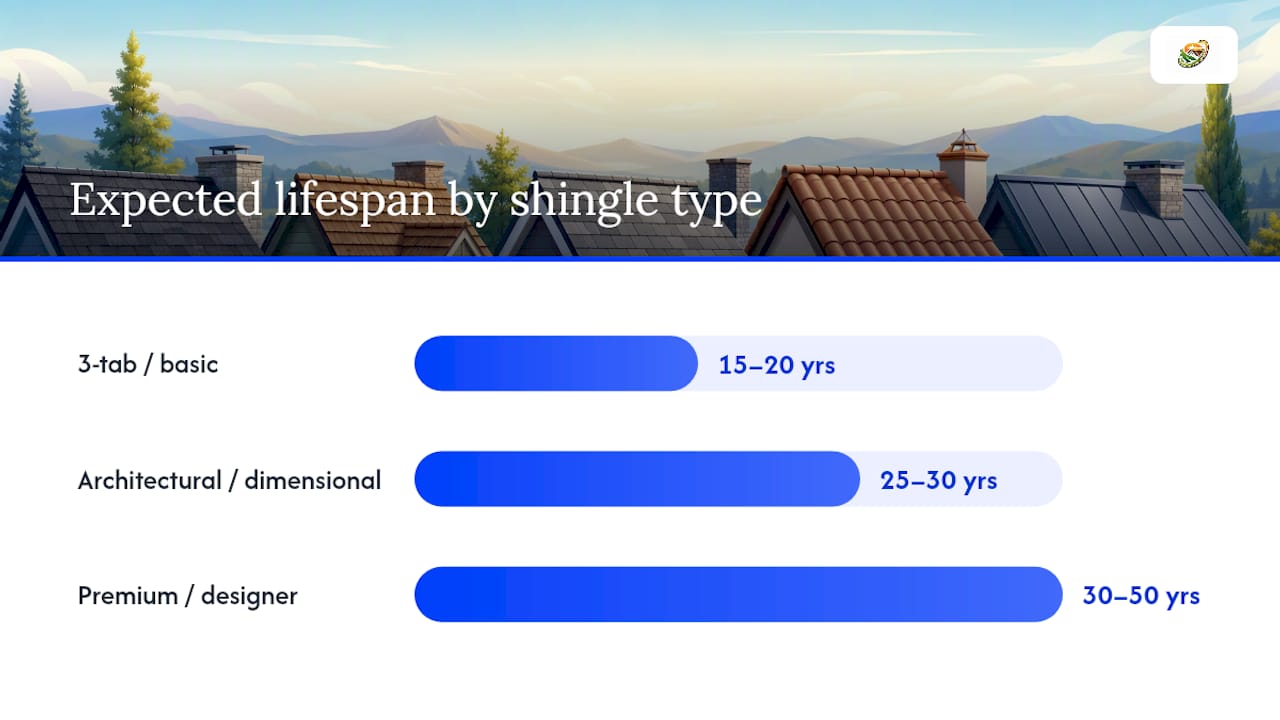
Typical lifespan ranges: basic 3-tab shingles last around a decade to two decades; architectural/dimensional shingles usually last two to three decades; premium and designer shingles may reach several decades under ideal installation and ventilation conditions.
Key Takeaways
The most durable shingles combine verified ratings (ASTM D3161/D7158, UL 2218, UL 790), multi-layer lamination, and high asphalt content, but installation quality and attic ventilation are the two factors that most determine whether those shingles reach their rated life.
| Point | Details |
|---|---|
| Shingle type sets the ceiling | Architectural shingles last 25–30 years; premium/designer shingles reach 30–50 years under correct installation. |
| Ratings tell you what to verify | Look for ASTM D7158 Class H (wind), UL 2218 Class 4 (impact), and CRRC verification (solar reflectance) on the spec sheet. |
| Installation and ventilation dominate | Poor ventilation can cut shingle life by 20%–30%; installation defects cause 30%–50% of premature failures. |
| Warranties are not lifespan guarantees | "Lifetime" and "30-year" labels carry prorated payouts and exclusions for ventilation failures, wind, and installation errors. |
| Shingleroofrenewal offers a preservation path | For qualifying South Florida roofs, preservation using Green Soy Technology can extend life and save thousands versus full replacement. |
Table of Contents
- What shingle type actually matches your longevity goals?
- Which construction details actually make shingles more durable?
- What do ASTM, UL, and CRRC ratings actually tell you?
- Why the roof system matters more than the shingle brand
- A seasonal maintenance plan that actually extends shingle life
- What "30-year" and "lifetime" warranties actually cover
- How to choose shingles based on your climate and budget
- When does roof preservation make more sense than replacement?
- What actually moves the needle on longevity
- Your roof may qualify for preservation, not replacement
- Sources
What shingle type actually matches your longevity goals?
Not all asphalt shingles are built for the same lifespan, and the difference between a 15-year roof and a 40-year roof often starts at the product selection stage. According to field data from The Roofing Brief, the five compounding factors that explain the spread in real-world performance are shingle tier, installation quality, attic ventilation, climate exposure, and maintenance history.
3-tab shingles are the lightest and thinnest option. They use a single asphalt layer and typically weigh 200–250 lbs per square. Their flat, uniform appearance is recognizable, and their price is the lowest. The tradeoff: they're the most vulnerable to wind uplift, granule loss, and UV degradation. Expect 15–20 years under average conditions, less in high-UV or hurricane-exposed climates.
Architectural (dimensional) shingles use a laminated two-layer construction that creates a textured, wood-shake appearance. They weigh 240–350 lbs per square, carry more asphalt, and resist wind and impact noticeably better. Fine Homebuilding documents that laminated shingles dominate the market because thicker construction and improved materials translate directly into longer field life. Realistic range: 25–30 years.
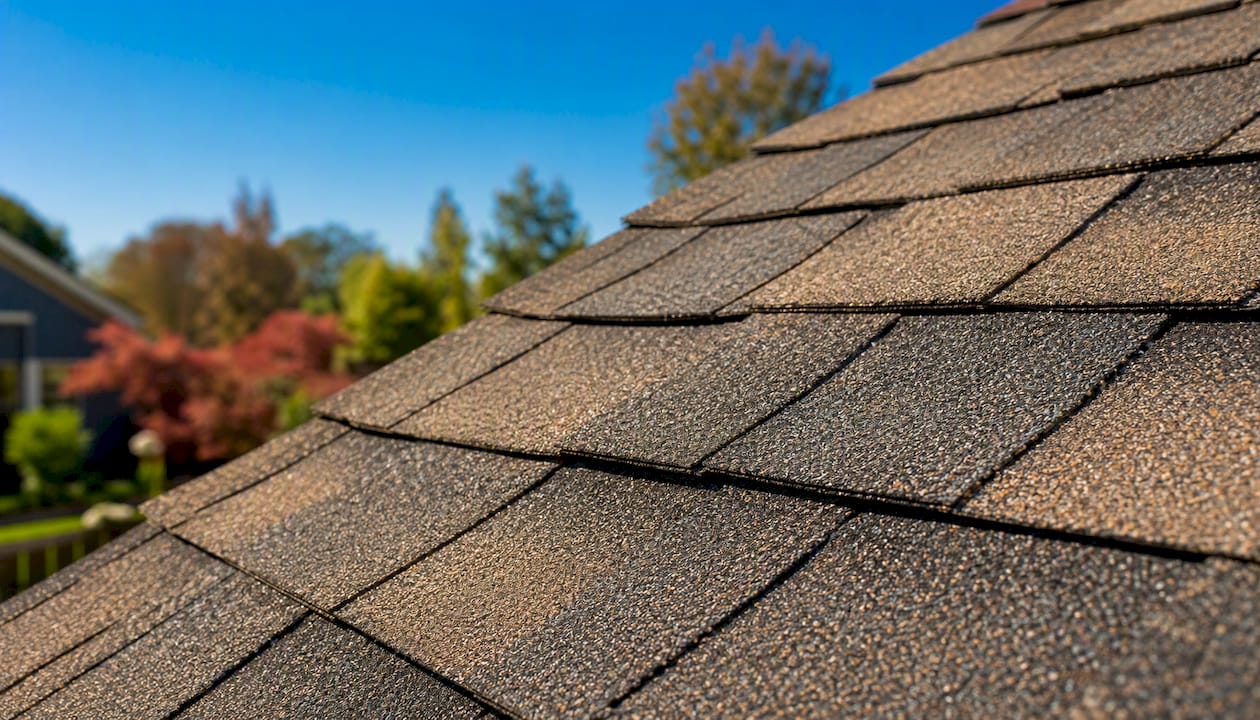
Premium and designer shingles (sometimes called luxury shingles) are the heaviest category, often exceeding 400 lbs per square. They mimic slate or cedar shake and use three-layer lamination with the highest asphalt content. Under ideal installation and ventilation conditions, 30–50 years is achievable. These are the shingles where a manufacturer's "lifetime" warranty claim has the most credibility, though that claim still comes with conditions.
| Shingle Type | Expected Lifespan | Typical Weight per Square | Relative Cost |
|---|---|---|---|
| 3-tab / basic | About a decade to two decades | Moderate weight | Lowest |
| Architectural / dimensional | Two to three decades | Heavier | Moderate |
| Premium / designer / luxury | Several decades under ideal conditions | Heaviest | Highest |
Warranties are marketing tools, not performance guarantees. A "30-year" label on a 3-tab shingle does not mean it will perform for 30 years in South Florida heat. More details are in the warranty section below.
Which construction details actually make shingles more durable?
Brand names matter less than you think. What predicts durability is what's inside the shingle bundle, and those details are readable on a spec sheet before you spend a dollar.
Fiberglass mat vs. organic mat. Modern asphalt shingles use a fiberglass mat as the structural core. Fiberglass is dimensionally stable, resists moisture absorption, and holds up better under thermal cycling than the older organic (cellulose) mat. If you encounter organic-mat shingles in an older home, that's a durability red flag. NIST laboratory testing confirms that UV exposure, temperature cycling, and humidity alter the mechanical and chemical properties of asphalt shingles over time, reducing flexibility and adhesive effectiveness. A strong fiberglass mat slows that process.
Lamination and layer count. A laminated shingle bonds two or more asphalt layers together. That extra thickness does three things: it resists tearing when wind gets under a tab, it adds mass that absorbs impact energy, and it creates a thicker granule bed that takes longer to erode. Single-layer 3-tab shingles have none of those advantages.
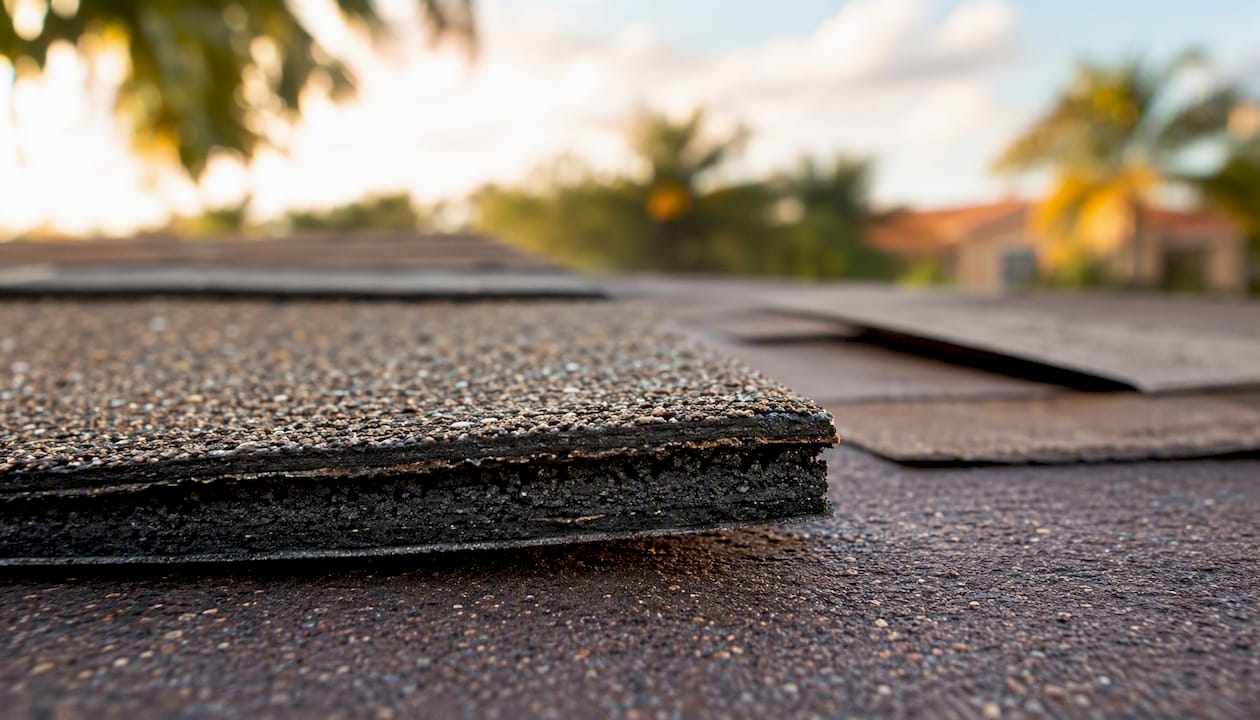
Asphalt content and binder quality. More asphalt means more protection for the fiberglass mat and better granule adhesion. Premium shingles use polymer-modified asphalt (SBS or APP modifiers) that stays flexible at low temperatures and resists softening in heat. This matters enormously in climates with wide temperature swings.
Granule adhesion and coverage. Granules protect the asphalt from UV degradation. Heavy, tightly bonded granules extend shingle life; sparse or loosely bonded granules accelerate aging. Granule loss at downspouts is one of the first visible signs that a roof is aging faster than expected.
Sealant strip integrity. The factory-applied sealant strip bonds adjacent shingles together once activated by heat. A compromised or improperly activated sealant strip is a direct path to wind uplift failure.
Key features to look for on a product label or spec sheet:
- Weight per square (heavier = more asphalt = longer life)
- Number of laminate layers
- Polymer-modified asphalt designation (SBS or APP)
- Wind resistance class (ASTM D3161 or D7158 class)
- Impact resistance class (UL 2218 class)
Pro Tip: Ask your contractor for the manufacturer's Technical Data Sheet (TDS) before signing anything. It lists weight per square, mat type, and test certifications. If a contractor can't produce it, that's worth noting.
What do ASTM, UL, and CRRC ratings actually tell you?
Ratings aren't just compliance checkboxes. They tell you how a shingle performs under the specific stresses your roof will face. ARMA's guidance identifies wind, impact, fire, and solar reflectance as the four core performance dimensions, each tied to a specific test standard.
Wind resistance: ASTM D3161 and D7158. D3161 tests shingles at three wind speeds; Class F (110 mph) is the minimum worth specifying in most of the US. D7158 is a more rigorous test that accounts for real-world uplift forces; Class H (150 mph) is the target for hurricane-prone regions. A shingle rated D7158 Class H installed with the correct nailing pattern gives you meaningful wind protection. Without the correct nailing pattern, that rating is void.
Impact resistance: UL 2218. This test drops steel balls of increasing size onto shingles and grades the result Class 1 through Class 4. Class 4 is the highest rating and is the standard to request in hail-prone areas. Many insurers offer premium discounts for Class 4 shingles. For impact-resistant roofing details, the UL 2218 Class 4 designation is the benchmark that matters.
Fire resistance: UL 790 / ASTM E108. Class A is the highest fire rating and is required by many building codes. Asphalt shingles with a fiberglass mat typically achieve Class A without additional treatment. Organic-mat shingles often require a fire-retardant coating to reach Class A.
Solar reflectance: CRRC verification. The Cool Roof Rating Council (CRRC) independently verifies solar reflectance and thermal emittance values. Shingles with CRRC-verified solar-reflective granules reduce peak surface temperatures, which slows asphalt oxidation and can extend service life in hot climates. They also reduce cooling loads inside the home.
The rating only holds when installation matches the test conditions. A D7158 Class H wind rating requires a specific nailing pattern, a starter strip, and proper sealant activation. Deviate from those conditions and the shingle's real-world wind performance drops to whatever the underlying construction supports, not the rated value.
Why the roof system matters more than the shingle brand
You can buy the best shingles on the market and still have a roof that fails in 12 years. The shingle is only one component. The system around it, ventilation, underlayment, flashing, fasteners, and deck condition, determines whether those shingles ever reach their rated life.
Industry analysis from The Roofing Brief puts installation defects as a cause of 30%–50% of premature shingle failures, with poor attic ventilation cutting field life by 20%–30%. Those numbers explain why two identical shingle products on two neighboring houses can perform very differently.
Here's what to verify before or after installation:
- Nailing pattern. Manufacturer specs define nail placement precisely. For higher wind ratings, six nails per shingle (rather than four) may be required. Verify this is in the contractor's scope of work.
- Starter strip. A factory-made starter strip with a pre-applied sealant goes along the eaves and rakes. Cutting regular shingles as a starter is a shortcut that reduces wind resistance.
- Underlayment. Synthetic underlayment outperforms traditional felt in moisture resistance and durability. Ice and water shield should cover the first two feet from the eave and all valleys.
- Step flashing. Every wall-to-roof transition needs individual step flashing pieces, not caulk. Caulk fails; metal flashing lasts decades.
- Ridge cap shingles. Hip and ridge caps take the most wind exposure. Use manufacturer-specified ridge cap product, not cut-down field shingles.
- Attic ventilation balance. Intake vents (soffit) and exhaust vents (ridge or gable) must be balanced. Excess heat and moisture in an unventilated attic degrades shingles from below, warps the deck, and voids most manufacturer warranties.
- Deck condition. Soft spots, delaminated plywood, or rot must be replaced before new shingles go down. Shingles fastened to a compromised deck will fail regardless of their rating.
Pro Tip: Ask your contractor for a written installation checklist tied to the manufacturer's specs. Reputable installers who participate in certified installer programs (Owens Corning Platinum, GAF Master Elite, CertainTeed SELECT ShingleMaster) are required to follow those specs to maintain certification.
A seasonal maintenance plan that actually extends shingle life
Maintenance doesn't prevent aging, but it does slow it. The homeowners who get 30 years out of a 25-year shingle are usually the ones who catch small problems before they compound.
Spring and fall are your two critical inspection windows. After winter and after hurricane season, those are the times when damage accumulates and goes unnoticed until it becomes a leak.
Seasonal tasks that protect your roof:
- Clean gutters and downspouts twice a year. Blocked gutters back water up under shingles and accelerate edge rot.
- Trim overhanging branches to at least 6 feet from the roof surface. Branches deposit debris, hold moisture, and can puncture shingles in a storm.
- Inspect and replace pipe boot flashings. Rubber boots around plumbing vents crack in UV exposure, typically within 10–15 years. A failed boot is one of the most common sources of attic leaks.
- Treat algae growth with a zinc- or copper-based treatment. Algae (the black streaking you see on many Florida roofs) doesn't immediately destroy shingles, but it holds moisture and can accelerate granule loss over time. Many premium shingles now include copper-infused granules that resist algae.
- Clear debris from valleys and low-slope areas. Debris holds moisture and creates conditions for moss and algae growth.
Granule loss at the downspout is your early warning system. A small amount of granules in gutters is normal, especially on a new roof. Accelerating granule loss, visible bare patches on shingles, or granule accumulation that increases year over year signals that the asphalt is oxidizing faster than expected. That's the moment to call for a condition assessment, not a replacement quote.
Watch for these signs that your roof needs professional attention:
- Shingles that cup, curl, or crack visibly from the ground
- Blistering or bubbling on shingle surfaces (a ventilation symptom)
- Shingles that lift or shift after moderate wind events
- Soft or spongy areas when walking the roof (deck damage below)
- Granule accumulation in gutters that increases each season
For South Florida homeowners, the degradation timeline is compressed by constant UV exposure, salt air, and storm cycles. What takes 20 years in a mild climate can happen in 10–12 years here.
What "30-year" and "lifetime" warranties actually cover
Warranty language is one of the most misunderstood aspects of shingle selection. A "30-year" shingle does not come with a 30-year guarantee that your roof will perform. InspectApedia's analysis of shingle properties cautions that "lifetime" warranty language is often a marketing term with exclusions that can leave homeowners without coverage precisely when they need it.
Most manufacturer warranties have two phases. The first is a non-prorated period, typically 5–10 years, during which the manufacturer covers full replacement cost. After that comes a long prorated period where the payout decreases each year based on the shingle's age. A 25-year-old shingle on a "30-year" warranty might yield a reimbursement that covers only a fraction of replacement cost.
Common exclusions to read carefully:
- Ventilation failures. If your attic isn't properly ventilated and shingles degrade faster as a result, most warranties won't cover it.
- Wind damage. Many warranties cap wind coverage at 60–70 mph unless you paid for an enhanced wind warranty and the shingles were installed with the required nailing pattern.
- Acts of nature. Hail, hurricane, and storm damage are typically excluded from the product warranty and fall under your homeowner's insurance policy instead.
- Installation errors. If the contractor didn't follow manufacturer specs, the warranty may be void, regardless of who made the error.
Quick warranty reading checklist:
- How many years are non-prorated?
- What is the wind speed coverage, and does it require a specific nailing pattern?
- Is workmanship coverage available (requires a certified installer)?
- Does the warranty transfer to a new owner, and at what cost?
In South Florida specifically, regulatory reporting has flagged that asphalt shingle roofs can lose meaningful wind resistance within a decade in high-exposure climates. A roof that still looks intact may not perform structurally in a hurricane. Treat roof age as a performance metric, not just an appearance metric.
How to choose shingles based on your climate and budget
The right shingle for a homeowner in Minnesota is not the right shingle for a homeowner in South Florida. Climate risk should drive your feature priorities before you look at price.
Hot, sunny climates (Florida, Southwest US): Solar reflectance is your first filter. Look for CRRC-verified shingles with solar-reflective granules. Lighter colors reflect more heat and slow asphalt oxidation. Energy-efficient roofing options for Florida homes show that reflective shingles can reduce peak attic temperatures meaningfully, which extends shingle life and lowers cooling costs. Pair that with a Class A fire rating and D7158 Class H wind resistance for hurricane zones.
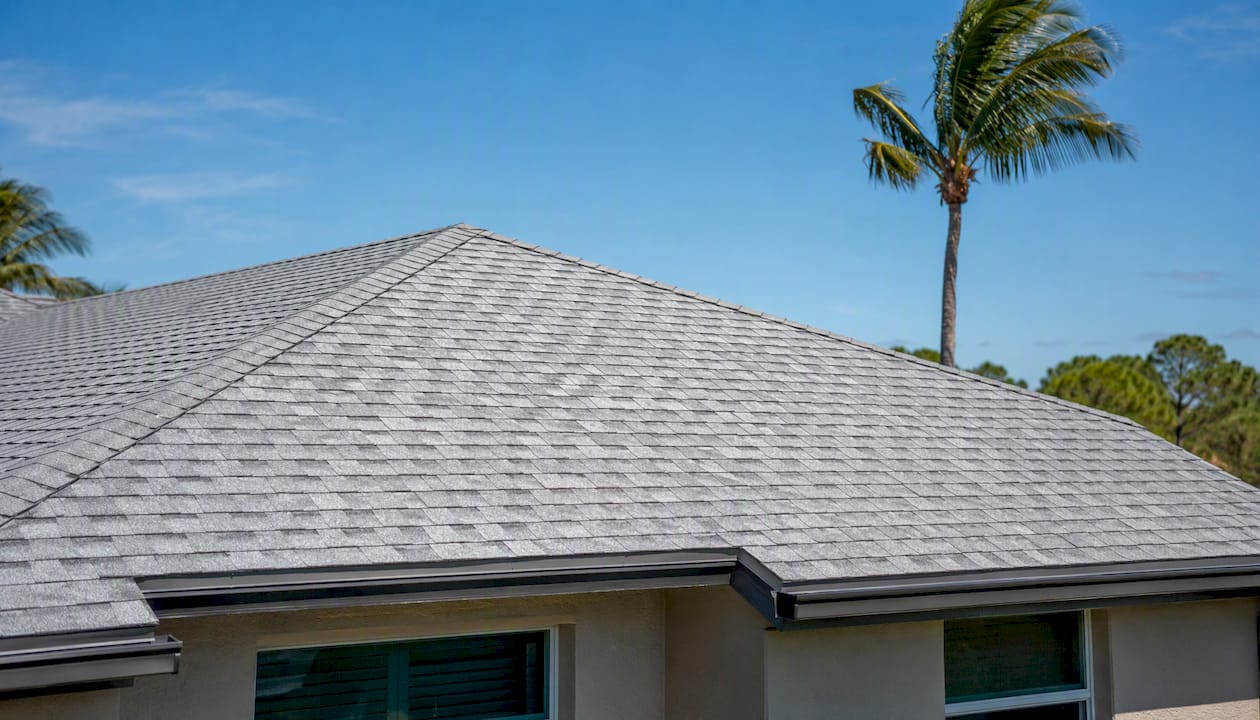
Hail and wind-prone climates (Great Plains, Southeast): UL 2218 Class 4 impact resistance is non-negotiable. Heavier laminated shingles absorb hail energy better than thin 3-tab products. Many insurers in hail-prone states offer premium discounts for Class 4 shingles, which can offset the higher product cost over time.
Budget vs. longevity tradeoff: Premium shingles cost more per square, but the cost-per-year calculation often favors them. A 3-tab roof replaced every 15 years costs more over 45 years than one architectural roof that lasts 30. The bigger variable, though, is installation and ventilation quality. A premium shingle on a poorly ventilated roof will underperform a mid-grade shingle installed correctly. Spend on installation before you spend on product tier.
| Shingle Category | Typical Lifespan | Best Climate Fit | Wind/Impact Performance | Relative Cost |
|---|---|---|---|---|
| 3-tab / basic | 15–20 years | Mild, low-wind | Lowest | $ |
| Architectural / dimensional | 25–30 years | Most climates | Moderate to high | $$ |
| Premium / designer | 30–50 years | All, especially severe | Highest | $$$ |
For South Florida homeowners, the combination of solar-reflective granules, D7158 Class H wind rating, and a certified installer is the minimum specification worth considering. Anything less is a compromise that the climate will expose within a decade.
When does roof preservation make more sense than replacement?
Not every aging roof needs to be replaced. Some roofs, particularly those in the 5–20 year range with intact shingles and a sound deck, are strong candidates for preservation and rejuvenation rather than a full tear-off.
Eligibility criteria for preservation:
- Shingles are largely intact. No widespread missing pieces, no active leaks, no sections of bare mat.
- Deck is structurally sound. No soft spots, no delamination, no visible rot.
- Granule loss is present but not severe. Some granule loss is normal aging; widespread bare patches indicate the shingle is past the preservation window.
- No active water intrusion. Preservation treats the shingle surface and restores flexibility. It cannot seal an active leak or replace failed flashing.
- Age range is appropriate. Rejuvenation treatments that replenish shingle oils (maltenes) show measurable results in lab testing on suitably aged, intact shingles. Field guides from trade sources confirm that preservation makes sense only when the substrate and flashings are sound.
The science behind this is straightforward. NIST laboratory research documents that UV, thermal cycling, and humidity deplete the oils in asphalt binder over time, reducing flexibility and adhesive effectiveness. Treatments that restore those oils (maltenes) have a credible lab basis when applied to shingles that still have structural integrity.
Cost is the other factor. A full replacement in South Florida typically runs $15,000–$30,000. Preservation, when a roof qualifies, can cost a fraction of that while adding meaningful years of service life and reducing landfill waste from unnecessary tear-offs.
Pro Tip: Always get a documented inspection before committing to preservation. A reputable preservation company should provide a written condition assessment, third-party test data on the treatment product, a transferable warranty, and a clear explanation of what the treatment will and will not address. If a company skips the inspection and goes straight to a quote, walk away.
What actually moves the needle on longevity
Most homeowners spend their energy comparing brand names: Owens Corning vs. GAF vs. CertainTeed. Those are all reputable manufacturers with strong product lines, and the differences between their top-tier products are real but narrow. What moves the needle far more is the combination of shingle specification, installation quality, and ongoing maintenance.
Here's the honest priority order:
- Installation quality first. A mid-grade shingle installed by a certified contractor with correct nailing, proper underlayment, and balanced ventilation will outlast a premium shingle installed carelessly.
- Ventilation second. Attic heat and moisture are silent killers. Fix ventilation before you spend on product upgrades.
- Ratings matched to local hazards. In South Florida, that means D7158 Class H wind and CRRC-verified solar reflectance. In hail country, it means UL 2218 Class 4.
- Preservation before replacement. If your roof is aging but structurally sound, a condition assessment is worth the call before you commit to a $20,000 replacement.
The "lifetime" warranty on a premium shingle is a useful signal about product confidence, but it's not a substitute for the four priorities above. Roofs that last are built and maintained, not just purchased.
Your roof may qualify for preservation, not replacement
If your South Florida roof is showing signs of aging, brittleness, granule loss, or minor cracking, the first call shouldn't be to a roofer. Shingleroofrenewal specializes in roof preservation and preventative maintenance for homeowners in Broward and Palm Beach County, and the process starts with a free inspection.
Shingleroofrenewal is certified to apply Fresh Roof's Green Soy Technology, which works at the molecular level to restore shingle flexibility, lock in granules, and slow the deterioration that South Florida's sun, heat, and storms accelerate. Qualifying homeowners can save significantly compared to a full replacement, and every job is backed by a 6-year transferable warranty. Preservation isn't right for every roof. That's exactly why the inspection comes first.
If you're in Delray Beach, see how local homeowners are extending their roof life before spending $15,000–$30,000 on replacement. Schedule your free roof assessment today and find out if your roof qualifies.
Sources
The following sources informed this article and are worth reading directly for primary technical detail.
NIST — Long-term durability of asphalt shingle roof covers: laboratory degradation characteristics Laboratory evidence that UV, thermal cycling, and humidity alter asphalt shingle chemistry and mechanics, providing the scientific basis for understanding why shingles age and why oil-restoration treatments have a credible lab rationale. Read the NIST publication
ARMA — A simple guide to understanding your asphalt shingle roofing system: Industry-standard primer on wind, impact, fire, and solar reflectance performance dimensions and the test standards behind each. Read the ARMA guide
The Roofing Brief — Asphalt shingle roof lifespan: Real 2026 numbers: Practical field lifespan ranges by shingle tier and a clear breakdown of the five compounding factors that explain performance variation. Read The Roofing Brief analysis
InspectApedia — Asphalt shingle properties and best practices: Detailed technical guidance on warranty exclusions, installation requirements, and the gap between warranty language and real-world roof performance. Read the InspectApedia guide
Fine Homebuilding — Will your next asphalt roof last a lifetime?: Synthesis of how laminated dimensional and designer shingles achieve longer field life through thicker construction and improved materials. Read the Fine Homebuilding article
The Advertiser — Florida: Shingle roofs don't protect against hurricanes after 10 years: Regulatory and insurance reporting on wind performance decline in high-exposure climates, directly relevant to South Florida homeowners evaluating roof age as a structural risk. Read the Advertiser report
- Long‑term durability of asphalt shingle roof covers: laboratory degradation characteristics — NIST
- Asphalt shingle roof lifespan: Real 2026 numbers | The Roofing Brief
- Asphalt shingle properties and best practices — InspectApedia
- Will your next asphalt roof last a lifetime? — Fine Homebuilding
- Florida: Shingle roofs don't protect against hurricanes after 10 years — The Advertiser