
Every asphalt shingle on your roof is built from three core materials: a fiberglass mat for strength, filled asphalt for waterproofing, and mineral granules for protection, as detailed in the asphalt vs metal roof overview for Canadian homeowners. Each layer has one job, and when any of them breaks down, your roof ages faster than it should. The two things worth watching are granule loss and brittleness, because both signal that the shingle's protective system is failing.
TL;DR:
- Granule loss in gutters and bald patches on southern or western slopes warn of accelerated asphalt exposure and faster roof aging.
- Shingles with higher asphalt, filler, and polymer content typically last longer and withstand environmental stress better than standard 3-tab options.
- Manufacturing defects like uneven granule adhesion or sealant strip application can cause premature wear and early blow-off in high winds.
- Visual inspections from the ground can reveal critical signs such as brittleness, cracking, or leakage that indicate whether preservation or replacement is needed.
- Ultraviolet light causes chemical deterioration of asphalt over time, making granule loss a key early indicator of roof degradation despite looking intact.
Table of Contents
- What Is Asphalt Shingle Composition, Exactly?
- How Shingle Types Differ in What They're Made Of
- How Asphalt Shingles Are Actually Manufactured
- Why Composition Determines How Fast Your Roof Fails
- How to Check Your Roof's Condition Before You Call a Roofer
- What to Do Next With What You Now Know
- The Overlooked Truth About Shingle Aging
- Sources
What Is Asphalt Shingle Composition, Exactly?
Asphalt shingle composition refers to the layered materials that make up a single shingle, and understanding it tells you what's actually failing when your roof starts showing wear. Industry documents from the Asphalt Roofing Manufacturers Association list five core materials found in nearly every shingle: a fiberglass mat, asphalt, mineral fillers, granules, and back surfacing.
The fiberglass mat is the structural backbone. Before fiberglass became standard, manufacturers used organic mats made from recycled paper soaked in asphalt. Those mats absorbed moisture, warped, and burned more easily. The ARMA notes fiberglass mats resist cracking under thermal stress and handle mechanical stress better, which is why they replaced organic bases in nearly all US residential roofing. The mat itself doesn't waterproof anything. It just holds the shingle together while everything else does the work.
Asphalt and its modifiers handle waterproofing and act as the binder that holds granules in place. Here's something most homeowners don't know: the "asphalt" in your shingles isn't pure asphalt at all. It's asphalt mixed heavily with mineral fillers, usually powdered limestone, that stabilize and strengthen it. According to Roof Online, fillers make up enough of the mix that raw asphalt alone would perform worse than the filled version on your roof. Some manufacturers add polymer modifiers to improve flexibility and cold-weather performance, which matters if you live somewhere with real freeze-thaw cycles.
Mineral granules are ceramic-coated crushed rock embedded into the shingle's top surface. They're not decorative, even though they give shingles their color. Roof Online's breakdown confirms granules block ultraviolet rays, add fire resistance, and cushion the shingle against hail and foot traffic. Once granules wear away, the asphalt underneath is exposed directly to the sun, and that's when aging accelerates fast.
Back surfacing and sealant strips finish the shingle. Back surfacing keeps shingles from sticking together in the bundle during shipping and storage. Sealant strips are asphalt adhesive bands that activate under heat and bond each shingle to the one below it, which is what keeps your roof from lifting in high wind. CertainTeed's anatomy breakdown confirms this is standard across manufacturer designs, not a premium add-on.
Here's a qualitative description of the material proportions in a typical shingle:
Mineral fillers (limestone, etc.) form the largest share, providing stabilization and strength. Granules are the next largest, providing UV, fire, and impact protection. Asphalt (binder) is smaller than the combined mineral content but provides waterproofing and adhesion. Fiberglass mat is the smallest by weight but critical for structural reinforcement and shape.
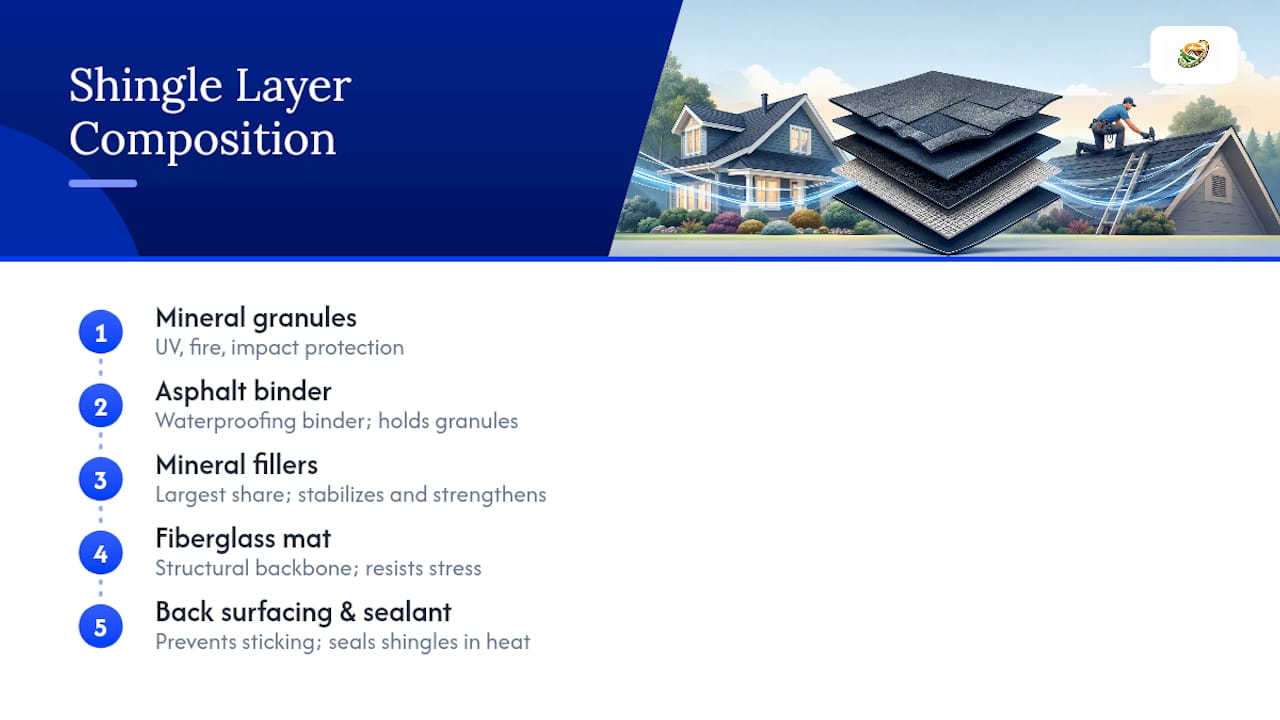
That mineral content matters more than most people assume. ARMA's technical documentation points out that in many standard shingles, actual bitumen content is lower than the combined mineral content, meaning stabilizers and granules provide much of the shingle's rigidity and fire performance, not the asphalt itself.
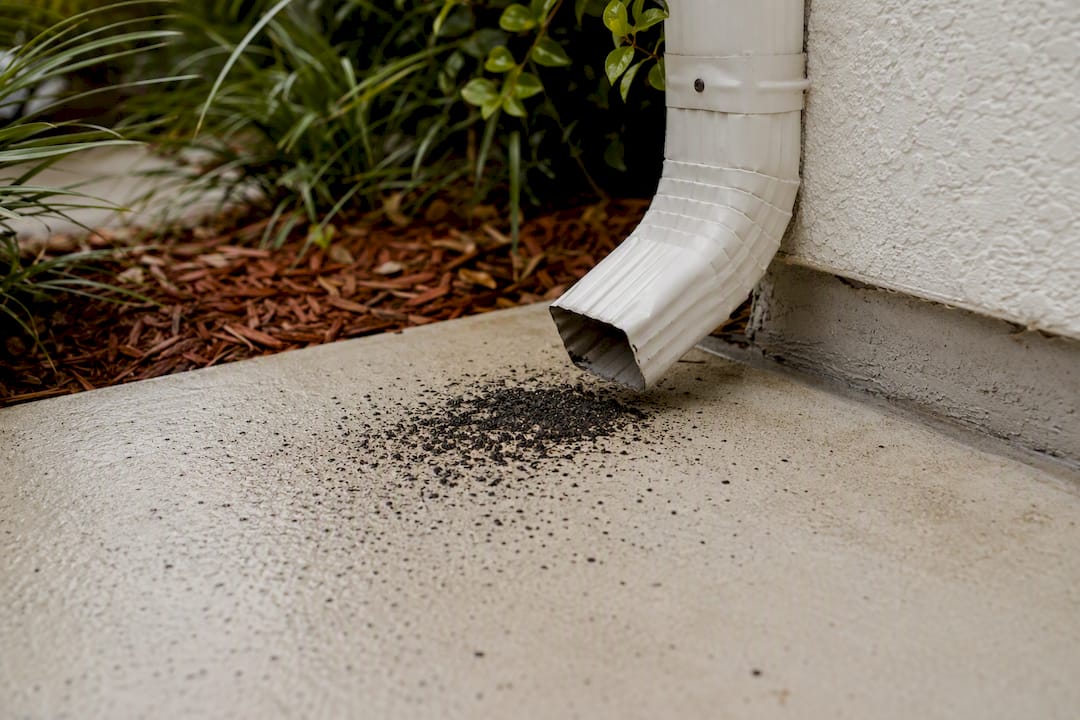
You can spot problems with these components without climbing a ladder. Check your gutters and downspouts for a buildup of loose granules that look like coarse sand. Walk your yard after a storm and look for the same grit near downspout outlets. Bald patches on south or west-facing slopes, where sun exposure is heaviest, usually show up before the rest of the roof does.
How Shingle Types Differ in What They're Made Of
Not every shingle uses the same ratio of these materials, and that difference explains why some roofs cost more and last longer than others.
- 3-tab shingles use a single, flat layer with lighter asphalt and filler content. They're the most affordable option, but thinner material means shorter manufacturer warranties, typically in the 20 to 25 year range, and less resistance to wind and impact.
- Architectural (laminated) shingles stack two or more layers, which means more asphalt and filler by weight and a thicker overall profile. That extra mass is why they usually carry 30 to 50 year warranties and hold up better in wind events.
- Impact-resistant and polymer-modified shingles add higher polymer content to the asphalt or use specialized granule coatings designed to absorb hail impact without cracking. They cost more upfront, but some insurers offer premium discounts for installing them in hail-prone regions.
Warranty length isn't marketing fluff. It's a direct reflection of how much asphalt, filler, and reinforcement went into the shingle. A 25-year 3-tab and a 50-year laminated shingle aren't just styled differently. They're built from meaningfully different quantities of the same core materials.
How Asphalt Shingles Are Actually Manufactured
Knowing the production process helps explain why two shingles that look identical on a shelf can perform very differently on a roof. The EPA's manufacturing summary for asphalt roofing outlines a fairly consistent sequence across manufacturers:
- The fiberglass mat feeds continuously into the production line.
- It passes through a saturator/coater, where filled, heated asphalt coats both sides.
- Granules are applied to the top face while the asphalt is still hot enough to bond them permanently.
- The shingle passes through pressing and cooling stations that set the layers together.
- It's cut into individual shingle shapes and, for laminated products, layers are bonded together.
- Sealant strips are applied to the underside.
- Finished shingles are packaged and banded for shipping.
This is also where modifiers get blended into the asphalt itself, before the mat ever gets coated. That timing matters. Polymer modification has to happen early so the asphalt stays workable enough to bond evenly with the mat and hold granules through the pressing stage.
Production defects show up on roofs in predictable ways. Uneven granule adhesion during that hot-asphalt stage leads to premature granule loss in isolated patches rather than uniform wear. Inconsistent sealant strip application can cause early blow-off in wind, even on a shingle that's otherwise in good shape. If one section of your roof is degrading noticeably faster than the rest and the age is the same, a manufacturing inconsistency, not just weather, could be part of the story.
Why Composition Determines How Fast Your Roof Fails
Shingle aging is fundamentally a chemical process, not just a cosmetic one. Ultraviolet light strips oils out of the asphalt over years of exposure, and that's what causes the loss of flexibility that eventually shows up as curling and cracking, according to research summarized by IIBEC. Granules exist specifically to slow that process by absorbing UV before it reaches the asphalt underneath.
Granule loss is the single most reliable early indicator of roof degradation. Once enough granules wear away, UV exposure to the asphalt increases directly, and the chemical breakdown that follows accelerates loss of flexibility, according to Roof Online. That's the mechanism behind why a roof can look "fine" for years and then suddenly start curling at the edges within a single hot season.
Mat type and polymer content also determine how a roof handles physical stress rather than chemical stress. Fiberglass mats resist the expansion and contraction that comes from daily temperature swings better than older organic mats did. Polymer-modified asphalt adds flexibility that helps shingles absorb hail impact and wind flexing without cracking outright.
Real-world lifespan depends on which combination of these materials you have, and on how much sun, heat, and moisture your roof takes on. A standard 3-tab shingle in a hot, sun-heavy climate can show significant granule loss well before its rated warranty period ends. A laminated, polymer-modified shingle in the same conditions typically holds up longer, simply because it started with more asphalt, more filler, and better UV protection built in.
How to Check Your Roof's Condition Before You Call a Roofer
You don't need special equipment to get a decent read on your roof's health. Start from the ground and work methodically.
- Check gutters and downspouts for loose granules, especially after heavy rain or wind.
- Use binoculars to scan south and west-facing slopes for bald patches or color inconsistency.
- Photograph any curling, cracking, or lifted edges you can see from the ground or a second-story window.
- Feel along accessible roof edges for a gritty texture, which usually means granules are still intact there.
- Note the roof's age and compare visible wear to what's typical for that shingle type and warranty length.
Use those observations to make a decision, not just a note. If granule loss is limited and the shingles still have some flexibility when you press gently on an accessible edge, your roof is likely a candidate for preservation rather than replacement. If you're seeing widespread brittleness, cracking across multiple slopes, or actual leaks inside the attic, replacement is probably the right conversation to have.
One thing to avoid: never pressure-wash a shingle roof. It strips granules faster than sun exposure ever would, and you can't put them back once they're gone.
Pro Tip: Take your gutter photos and roof-edge photos before scheduling any inspection. A visual record of granule buildup over a few weeks tells a technician far more than a single snapshot ever could.
This is exactly where preservation treatments fit in. Companies certified to apply Green Soy Technology work to restore flexibility to shingles that have lost oils but haven't lost their structural integrity, locking in remaining granules and slowing further UV damage. It's not a fix for every roof. A qualification inspection has to confirm the shingle mat and asphalt are still sound enough to respond to treatment before anyone recommends it. That's the whole reason a free assessment comes before any recommendation, not after.
What to Do Next With What You Now Know
Composition tells you what's failing; condition tells you what to do about it. If your granule loss is limited and the shingles still flex, you're likely looking at a preservation opportunity instead of a full tear-off. If cracking and brittleness have spread across the roof, replacement conversations make more sense.
Either way, the next step is the same: inspect from the ground, photograph what you find, compare it against the checklist above, and get an assessment before assuming replacement is your only option.
The Overlooked Truth About Shingle Aging
Most homeowners treat roof aging as a wear-and-tear problem, like tires or brake pads. It's not. It's a chemical one. UV light strips oils from asphalt over years, and once that process crosses a certain threshold, no amount of cleaning or patching brings that flexibility back. That distinction gets lost in most roofing advice, which focuses almost entirely on visible damage and skips the chemistry happening underneath the granules.
The conventional wisdom says wait until you see a leak or missing shingles before acting. By that point, you've usually missed the window where preservation was even possible. The smarter move is treating granule loss in the gutter as your actual warning system, not curling shingles you can see from the driveway. That's the gap between what most homeowners know and what the material science actually says.
If you take one thing from this, prioritize the ground-level inspection over the ladder climb. You'll catch the early signs faster, safer, and often years before a roofer would tell you it's too late to save anything.
— Daniellison
Sources
- Roof Online — Asphalt shingles introduction
- EPA manufacturing summary for asphalt roofing products
- CertainTeed — Anatomy of a shingle