
TL;DR:
- Certified roof specialists in South Florida undergo manufacturer-backed training and meet strict standards beyond licensing. Their expertise unlocks longer warranties, ensures higher installation quality, and offers legal protections, which uncertified contractors cannot provide. Investing in certification reduces the risk of premature roof failure and enhances resale value, making it a crucial choice for homeowners.
Certified roof specialists are roofing professionals who have completed manufacturer-backed training programs and met strict insurance, workmanship, and accountability standards that go well beyond a standard state license. For homeowners in Broward and Palm Beach County, hiring one is not a preference. It is a financial decision. South Florida's relentless sun, heat, and storm cycles accelerate shingle deterioration faster than nearly any other climate in the country, and the benefits of certified roof specialists show up most clearly when your roof faces that kind of punishment. Certified contractors unlock warranty tiers, workmanship standards, and legal protections that uncertified roofers simply cannot offer.
1. What warranty benefits do certified roof specialists provide?
Certified roof specialists unlock warranty coverage that uncertified contractors cannot access. Top-tier warranties from major manufacturers cover both materials and workmanship for 25–50 years, and some extend to lifetime coverage. An uncertified installer using the same shingles gets you a fraction of that protection.
The distinction matters because premium warranties become void when installation standards are not met, even if top-quality shingles are used. You could spend $20,000 on premium materials and lose your warranty coverage entirely because the installer lacked certification. That is not a technicality. That is a real financial exposure.
Certified warranties also cover more than leaks. Some manufacturer programs cover aesthetic defects, including granule loss and visible deterioration, not just water intrusion. That broader coverage matters in South Florida, where UV exposure degrades shingle appearance and structure simultaneously.
Transferable warranties add another layer of value. When you sell your home, the warranty transfers to the new owner, making your property more attractive to buyers and easier to appraise.
Pro Tip: Ask any contractor to show you the specific warranty certificate they can issue, not just a brochure. A certified contractor can name the exact tier and coverage years. An uncertified one cannot.
| Feature | Certified contractor | Uncertified contractor |
|---|---|---|
| Warranty length | 25–50 years or lifetime | Typically 5–10 years |
| Workmanship coverage | Included | Rarely included |
| Aesthetic defect coverage | Available with top tiers | Not available |
| Transferability | Yes | Rarely |
| Manufacturer backing | Full | None |
2. How certification affects installation quality and reliability
Shingle quality alone does not determine how long your roof lasts. Expert installation is the most critical factor, and certification programs exist specifically to enforce it. Manufacturers require certified contractors to complete hands-on technical training, pass assessments, and submit to periodic audits of their work.
Those audits are not optional. Contractors risk losing certification and premium warranty access if they fail to meet ongoing standards. That accountability structure creates a direct incentive to get every job right, not just the first few.
The practical result for you as a homeowner is fewer callbacks and fewer emergency repairs. Improper installation is a leading cause of premature roof failure, often triggering water damage claims that cost far more than the original roofing job. Certified installers are trained to avoid the specific errors that cause those failures.
Key quality advantages of certified roof specialists include:
- Manufacturer-trained installation techniques specific to each shingle system
- Documented audit history that holds contractors accountable over time
- Strict customer satisfaction standards required to maintain certification status
- Reduced risk of flashing failures, improper nailing patterns, and ventilation errors
- Faster problem identification during installation before issues become structural
South Florida's wind uplift requirements and hurricane codes add another layer of complexity. Certified contractors are trained to meet those local standards, not just general best practices.
3. What financial and legal protections certified specialists offer
Certified roofing specialists maintain insurance coverage that exceeds state minimums, including workers' compensation and general liability. That distinction protects you directly. If an uncertified contractor's worker is injured on your property and the contractor carries only minimum coverage, you can face liability exposure.
Certification programs also audit contractor financial stability. A contractor who cannot demonstrate financial health loses certification. That matters because a financially unstable contractor may disappear mid-project or be unable to honor warranty claims.
The protections certified specialists must maintain typically include:
- General liability insurance above state-required minimums
- Workers' compensation coverage for all crew members on site
- Verified financial stability reviewed during certification audits
- Documented complaint resolution processes required by manufacturer programs
These protections also affect your homeowner's insurance. A certified installation with a documented warranty can simplify claims processing after storm damage. Insurers respond better to documented workmanship records than to verbal assurances.
Pro Tip: Before signing any roofing contract, request a certificate of insurance directly from the contractor's insurer, not just a copy the contractor provides. Call the insurer to confirm coverage is active.
4. How certified installation increases your home's resale value
A certified roof installation adds measurable value when you sell. Transferable warranties from certified installations enhance your home's marketability and can improve appraisal outcomes, particularly within 5–10 years of installation. Buyers see a transferable warranty as a risk reduction, not just a feature.
Home inspectors and appraisers also respond to documented installation quality. A certified contractor provides paperwork that traces the installation back to a manufacturer-backed program. That paper trail gives buyers confidence and gives appraisers a concrete basis for valuation.
"A transferable warranty from a certified installer tells the next buyer that the roof was done right and that someone stands behind it. That is worth real money at closing." — Shingleroofrenewal
The resale advantages of certified installation include:
- Transferable warranty documentation ready for buyer review at closing
- Manufacturer-backed installation records that satisfy home inspection requirements
- Reduced buyer negotiation leverage on roof condition and repair credits
- Cleaner appraisal outcomes supported by verifiable workmanship standards
You can read more about how certified roofing affects home value specifically in South Florida's market conditions.
5. Understanding the difference between a license and a certification
Most homeowners assume a licensed contractor and a certified contractor are the same. They are not. A state license verifies legal and insurance compliance. A manufacturer certification confirms specialized training for advanced roofing systems. Both matter, but they serve different purposes.
A licensed contractor can legally install your roof. A certified contractor can install it correctly according to the manufacturer's exact specifications and unlock the warranty coverage that protects your investment. You need both, not one or the other.
This distinction becomes especially important in South Florida, where building codes are stricter than most of the country due to hurricane risk. A contractor who is licensed but not certified may meet the legal minimum without meeting the technical standard required for your specific shingle system.
Multi-certified contractors hold credentials from more than one manufacturer. That broader training lets them recommend products based on your roof's actual needs rather than pushing a single brand. For South Florida homeowners dealing with UV exposure, wind, and humidity simultaneously, that objectivity is worth asking about.
6. Practical tips for South Florida homeowners choosing a certified specialist
Certified roof specialists typically command a 10–20% cost premium over uncertified contractors. That premium unlocks enhanced warranties lasting up to 50 years and reduces the risk of costly callbacks. Over a 20-year horizon, the math consistently favors the certified option.
Use the roofing certification checklist developed for South Florida homes to verify credentials before signing anything. Ask every contractor these specific questions:
- Which manufacturer certifications do you currently hold, and can you show documentation?
- What warranty tier can you issue for this specific shingle system?
- How long have you maintained your certification, and have you ever had it suspended?
- Do you carry workers' compensation and general liability above state minimums?
Pro Tip: Verify certifications directly on the manufacturer's website. Most major manufacturers maintain a contractor locator tool that shows current certification status. Do not rely solely on what the contractor tells you.
| Evaluation factor | Why it matters |
|---|---|
| Manufacturer certification level | Determines warranty tier available to you |
| Number of manufacturer certifications | Indicates breadth of training and product objectivity |
| Insurance above state minimums | Protects you from liability on your property |
| Audit and complaint history | Reveals accountability track record |
| Transferable warranty availability | Directly affects resale value |
The 10–20% premium is real, but so is the cost of a roof that fails five years early. In Broward and Palm Beach County, a full replacement runs $15,000–$30,000. The certified specialist's premium is a small fraction of that exposure.
Key takeaways
Certified roof specialists deliver superior warranty coverage, workmanship accountability, and legal protections that uncertified contractors cannot match, making them the clear choice for South Florida homeowners protecting a $15,000–$30,000 investment.
| Point | Details |
|---|---|
| Warranty access | Only certified contractors unlock 25–50 year or lifetime manufacturer warranties. |
| Installation accountability | Certification audits reduce improper installation and costly callbacks. |
| Legal and financial protection | Certified contractors carry insurance above state minimums, reducing your liability. |
| Resale value | Transferable warranties improve appraisal outcomes and buyer confidence at closing. |
| License vs. certification | A license meets legal minimums; certification meets manufacturer technical standards. |
Why I think most homeowners underestimate certification
I have seen the same pattern repeat itself across South Florida neighborhoods. A homeowner hires the lowest bidder, gets a licensed contractor who is not certified, and ends up with a roof that fails within eight years. The shingles were fine. The installation was not.
The frustrating part is that the homeowner had no way to know the difference at the time of hire. Both contractors showed up with a license. Only one could have issued a 30-year workmanship warranty. That gap is invisible until something goes wrong.
What I have come to believe is that certification is not a luxury for expensive homes. It is the baseline standard for any asphalt shingle roof in South Florida's climate. The combination of UV intensity, wind cycles, and humidity here is genuinely punishing. A roof installed to manufacturer specifications by a trained, audited professional simply holds up longer. The data on callback rates and premature failures supports that conclusion clearly.
The other thing I would tell any homeowner is this: get involved early. Do not wait until your roof is visibly failing to ask about certifications and warranties. The best time to understand what protection you have is before you need it. Certified specialists are also more likely to catch early deterioration during routine inspections, which means you have more options before replacement becomes the only answer.
— Daniellison
Shingleroofrenewal's certified approach to roof preservation
Shingleroofrenewal serves homeowners in Broward and Palm Beach County as a certified applicator of Fresh Roof Green Soy Technology, a preservation treatment that restores shingle flexibility at the molecular level and extends roof life by 10–15 years. We are not roofers. We are the company you call before the roofer becomes necessary.
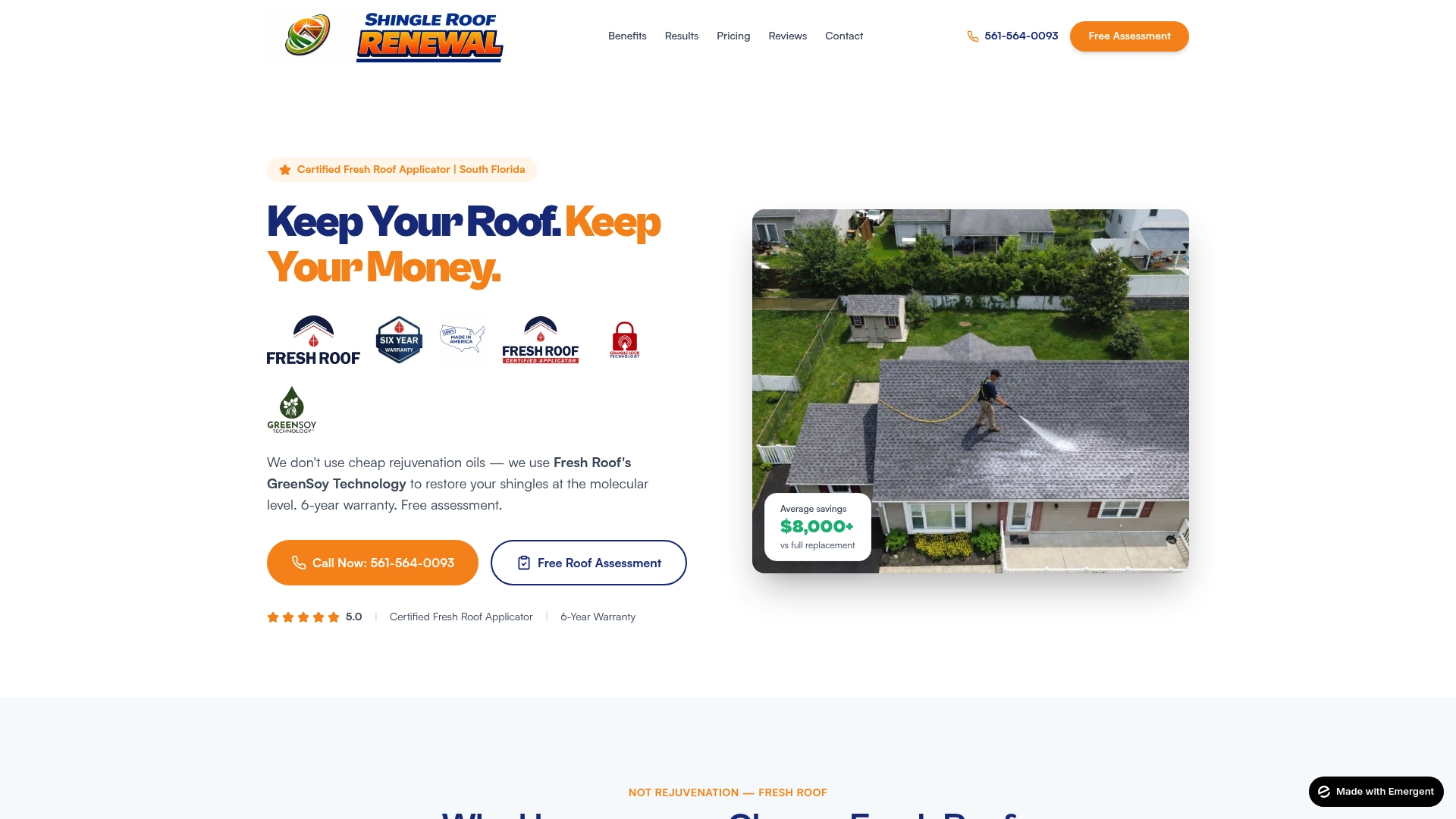
Our three-step process starts with a free inspection to determine whether your roof qualifies for renewal. If it does, you could save up to 80% compared to full replacement, backed by a 6-year transferable warranty. Most homeowners in South Florida do not realize their roof can still be preserved. Schedule your free inspection today and find out if yours qualifies before a maintainable roof becomes a replacement project.
FAQ
What makes a roofing contractor "certified"?
A certified roofing contractor has completed manufacturer-specific training programs and met ongoing audit requirements for workmanship, insurance, and customer satisfaction. Certification goes beyond a state license, which only verifies legal and insurance minimums.
Can I get a long-term warranty without a certified installer?
No. Top warranty tiers covering both materials and workmanship for 25–50 years are only available through certified contractors. Uncertified installers cannot issue these warranties regardless of shingle quality.
How do I verify a contractor's certification status?
Check the manufacturer's official website directly. Most major shingle manufacturers maintain a contractor locator tool that shows current certification status by name and location.
Does a certified roof installation help when selling my home?
Yes. Transferable warranties from certified installations improve appraisal outcomes and give buyers documented proof of quality workmanship, which reduces negotiation leverage on roof condition at closing.
Is a certified specialist worth the higher cost in South Florida?
Certified specialists typically cost 10–20% more than uncertified contractors. Given that a full roof replacement in South Florida runs $15,000–$30,000, that premium is a small cost compared to the risk of premature failure and lost warranty coverage.