
Most asphalt shingle roofs in Broward and Palm Beach counties can be made to last longer — without a full replacement. If your shingles still lie flat, granule loss is limited, and your roof falls in the right age window, a certified preservation treatment like Fresh Roof Green Soy Technology may add meaningful years to your roof's life. That's the short answer on what a long-lasting roof materials list really means for existing homeowners: it's not about picking new materials. It's about preserving what you already have.
The quickest next step is a professional inspection before any treatment is applied. NRCIA inspection data from a sample of 6,460 roofs show that a majority either qualified or could be repaired to qualify for LeakFREE® Roof Certification. That means most homeowners calling about replacement may not need one yet.
- Get a certified inspection first. Never apply coatings or treatments to an uninspected roof.
- Check ARMA guidance and your shingle manufacturer before any field treatment.
- Shingleroofrenewal is an authorized Fresh Roof applicator serving Broward and Palm Beach counties.
Pro Tip: Schedule your inspection before hurricane season. South Florida's UV load and storm cycles accelerate shingle oil loss faster than in most U.S. markets, so early detection matters more here.
Key Takeaways
Certified preservation with Fresh Roof Green Soy Technology can extend a qualifying asphalt shingle roof's life by a few years per application, at a fraction of the $15,000–$30,000 replacement cost typical in Broward and Palm Beach counties.
| Point | Details |
|---|---|
| Inspect before treating | Never apply any coating or rejuvenator without a certified inspection and written qualification first. |
| Candidate window | Best results for roofs aged roughly 8–18 years, lying flat, with limited granule loss and a single shingle layer. |
| Realistic life extension | Independent testing shows 3–5 years of added service per application; repeat treatments extend total gains. |
| Replacement triggers | Two or more shingle layers, deck rot, widespread failure, or 18–25+ years of heavy wear require tear-off, not treatment. |
| Shingleroofrenewal | Authorized Fresh Roof applicator offering free inspections and a 6-year transferable warranty for qualifying Broward and Palm Beach roofs. |
Table of Contents
- Does your asphalt shingle roof qualify for preservation?
- How do preservation treatments actually work?
- What are the real risks of roof preservation treatments?
- What should a certified inspection actually cover?
- How does preservation cost compare to full replacement?
- What happens on treatment day and after?
- When is replacement the right call instead?
- Why inspection-first preservation matters most in South Florida
- Shingleroofrenewal: certified preservation for Broward and Palm Beach homeowners
- Sources
Does your asphalt shingle roof qualify for preservation?
Not every roof is a candidate. The good news: most mid-life roofs are, if you catch them at the right time.
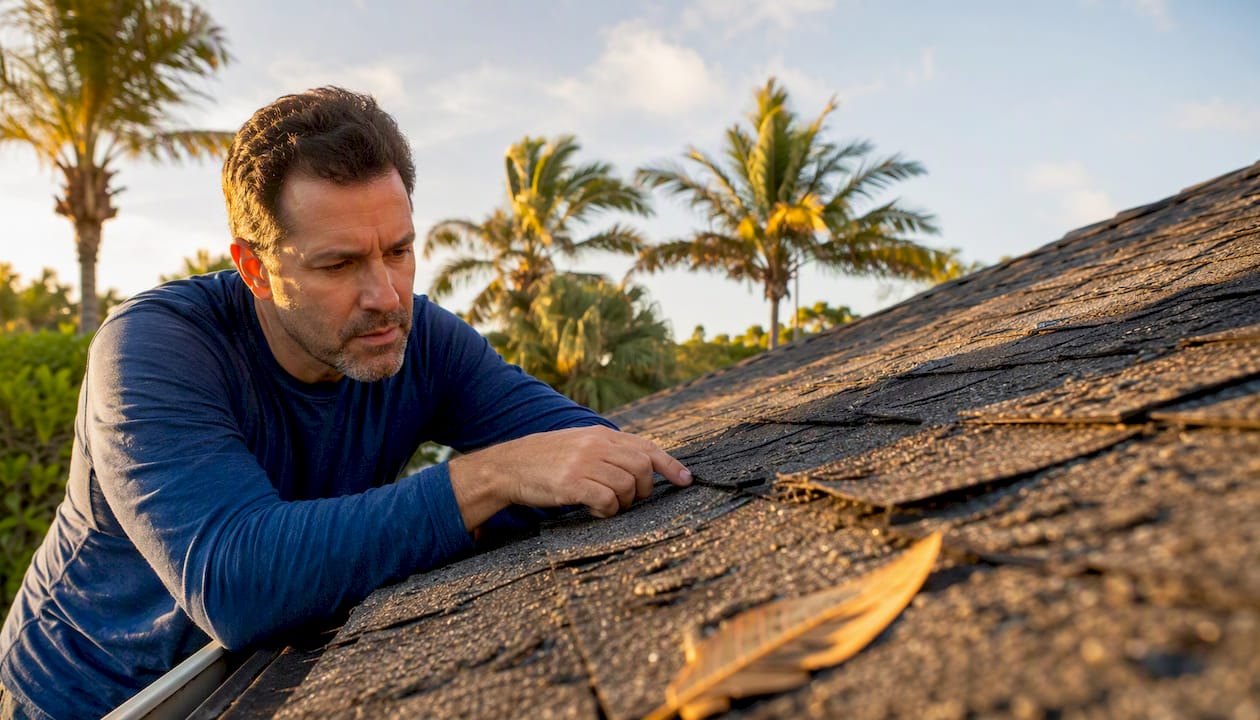
Age and shingle type matter. Standard 3-tab shingles typically qualify between 8 and 15 years. Dimensional (architectural) shingles have a wider window, roughly 10–18 years. Luxury shingles can extend that further. Beyond those ranges, the shingle mat may be too degraded to benefit from oil replenishment.
Condition checklist — your roof likely qualifies if:
- Shingles lie flat with no widespread curling or cupping
- Granule loss is moderate, not severe (bare mat patches are a disqualifier)
- No more than one layer of shingles is installed
- Decking shows no sag, rot, or soft spots
- Flashings are intact or repairable
- No active leaks that haven't been traced and fixed
South Florida adds extra pressure. Broward and Palm Beach homeowners deal with intense UV radiation, thermal cycling, and salt air that strip plasticizers from shingles faster than in northern climates. A roof that looks "fine" at 12 years in Ohio may already be past the preservation window here. That's why local thresholds run slightly earlier than national averages. You can compare asphalt shingle options to understand how shingle grades perform differently under Florida conditions.
ARMA's reroofing technical bulletin lists deck sag, rot, more than two existing layers, and severely uneven shingles as conditions that require removal rather than any overlay or preservation treatment.
Pro Tip: Walk your attic after a rain. Daylight coming through the decking or staining on the rafters tells you more about deck condition than any surface inspection.
How do preservation treatments actually work?
There are three categories of treatment, and they are not interchangeable.
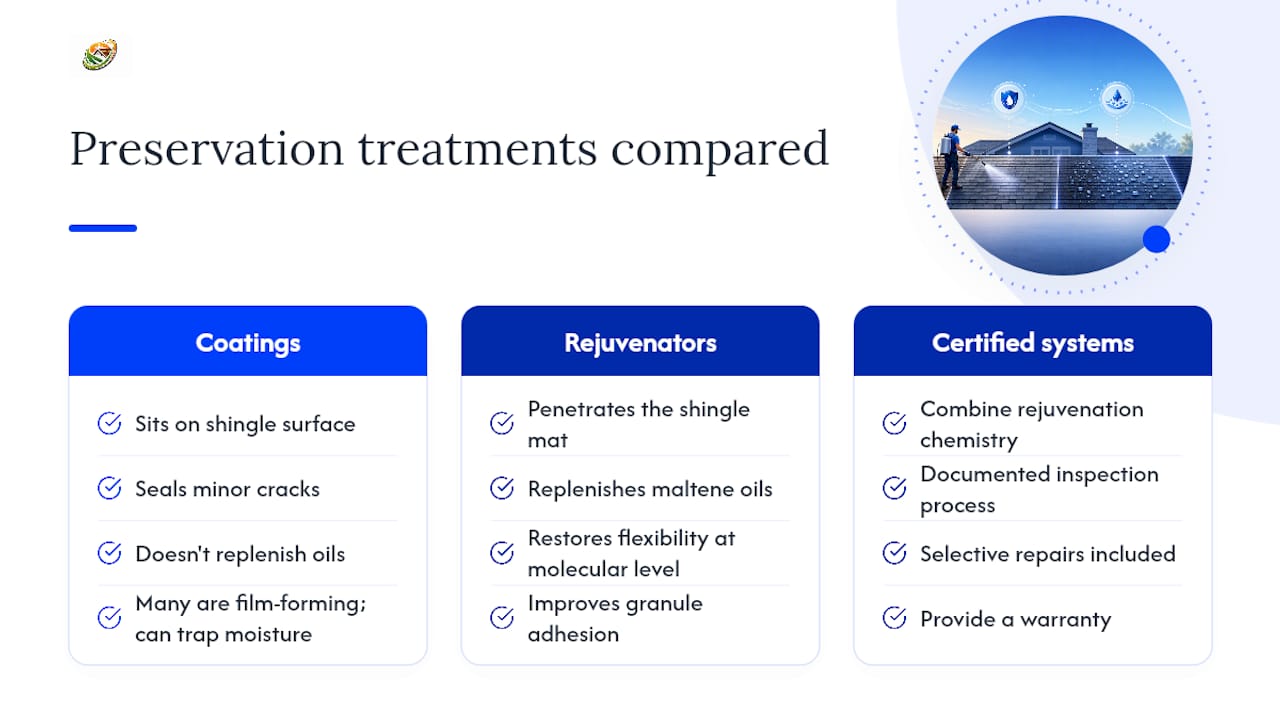
Coatings sit on top of the shingle surface. They can seal minor cracks but don't replenish the oils that make shingles flexible. Many are film-forming, which can trap moisture and cause more harm than good on an aging roof.
Field-applied rejuvenators penetrate the shingle mat and replenish the maltene oils that evaporate over time due to UV and heat exposure. Soy-based bio-oils, like those used in Fresh Roof Green Soy Technology, work at the molecular level to restore flexibility and improve granule adhesion rather than just coating the surface.
Certified preservation systems combine rejuvenation chemistry with a documented inspection process, selective repairs, and a warranty. That combination is what separates a preservation treatment from a spray-and-hope field application.
A lab study on soybean oil-based polymeric coatings reported restored shingle flexibility and improved granule retention in treated samples under controlled testing conditions. Independent testing also shows that flexibility improvements tend to peak within 30–90 days of application.
Realistic life-extension range: Independent ASTM flexibility testing indicates rejuvenation typically provides about 3–5 years of extended service per application, with diminishing returns on repeat treatments.
That 3–5 year range is the honest benchmark. Claims of 10–15 years of total added life are possible when treatments are applied early, repeated on schedule, and paired with proper maintenance — but a single application on a borderline roof won't deliver that outcome.
What are the real risks of roof preservation treatments?
Preservation treatments carry genuine risks when applied incorrectly or without manufacturer approval. Knowing them upfront protects your wallet and your warranty.
ARMA advises against field application of coatings or rejuvenators over installed shingles without manufacturer approval. Non-approved treatments can alter fire classification, change algae or impact resistance ratings, cause shrinkage, loosen granules, or trap moisture beneath the surface.
Common failure modes to watch for:
- Film-forming coatings that seal moisture into the shingle mat
- Granule loosening from incompatible chemistry
- Tab shrinkage causing new curling after treatment
- Vapor retardation leading to deck moisture damage over time
- Treatments applied over active leaks or damaged flashings
Warranty and insurance interactions are the most overlooked risk. A non-approved field treatment can void your shingle manufacturer's warranty and complicate an insurance claim after a storm. Always get written confirmation from your shingle manufacturer before any treatment proceeds.
Pro Tip: Ask your applicator for the manufacturer's written approval or a product data sheet showing compatibility with your specific shingle brand. A certified applicator using an approved process will have this documentation ready.
What should a certified inspection actually cover?
A proper inspection comes before any treatment decision. This is non-negotiable. The inspection confirms whether your roof qualifies, documents its baseline condition, and protects you if a warranty claim arises later.
What a certified inspector should evaluate:
- Visual shingle condition: flatness, granule loss percentage, cracking, curling
- Flexibility test on representative shingles
- Deck access check for rot, sag, or moisture damage
- Ventilation adequacy (poor ventilation accelerates shingle aging)
- Flashing condition at penetrations, valleys, and edges
- Layer count and structural soundness
- Salt-air corrosion on metal flashings (critical in coastal Broward and Palm Beach)
Step-by-step inspection process you should expect:
- Inspector reviews roof age, permit history, and shingle type before climbing
- Full surface walk to document granule loss and shingle flatness
- Flexibility test on a sample of shingles from multiple roof planes
- Attic inspection for deck condition and ventilation
- Flashing and detail inspection at all penetrations
- Written report with photos, measurements, and a clear qualify/don't-qualify recommendation
Questions to ask before hiring an inspector:
- Are you a certified applicator for Fresh Roof Green Soy Technology?
- What is your written qualification criteria for preservation?
- What warranty do you offer, and is it transferable?
- Will I receive before-and-after photos and a dated inspection report?
You can review roof inspection preparation guidance to know exactly what to have ready before the inspector arrives.
How does preservation cost compare to full replacement?
Full roof replacement in Broward and Palm Beach counties typically runs $15,000–$30,000 depending on roof size, pitch, and material. Certified rejuvenation and preservation treatments are often 15–20% of that replacement cost, making the savings substantial for a qualifying roof.
| Scenario | Preservation Cost | Replacement Cost | Estimated Life Extension |
|---|---|---|---|
| — | a few thousand dollars | a mid to high range replacement cost | a few years per application |
| 2,500 sq ft qualifying roof | a few thousand dollars | a high range replacement cost | a few years per application |
What drives the cost of preservation:
- Roof size and pitch complexity
- Extent of localized repairs needed before treatment
- Number of reapplications anticipated over the roof's remaining life
- Local labor rates in South Florida
Warranty differences matter. Short-term rejuvenation warranties from uncertified applicators may cover only 1–2 years. A certified preservation system backed by a transferable warranty, like the 6-year transferable warranty Shingleroofrenewal offers, adds real value when you sell the home.
Quick decision rule: Preservation makes financial sense when your roof qualifies structurally, the cost is a manageable fraction of replacement, and you have several years of potential service life remaining. When repairs alone would become expensive relative to replacement, plan for replacement instead. You can explore cost-effective roofing strategies to model different scenarios for your specific roof.
What happens on treatment day and after?
The process is straightforward when done by a certified applicator.
Day-of activities:
- Pre-treatment inspection confirms the roof still qualifies
- Localized repairs completed (cracked tabs sealed, loose flashings re-secured)
- Roof surface cleaned of debris and organic growth
- Green Soy Technology solution applied by spray across all roof planes
- Absorption window begins: 24–72 hours for the bio-oils to penetrate the shingle mat
After treatment:
- Keep foot traffic off the roof for at least 24 hours
- Avoid pressure washing for 90 days post-treatment
- Schedule a 12-month follow-up inspection to verify flexibility retention and granule adhesion
- Plan reapplications on the schedule your applicator recommends, typically every 3–5 years
You should receive a dated inspection report, before-and-after photos, and written documentation of the flexibility test results. If an applicator can't provide those, that's a red flag.
When is replacement the right call instead?
Preservation has real limits. Some roofs need to come off, and delaying that decision costs more in the long run.
Replace rather than preserve when:
- Two or more shingle layers have already been installed (most codes prohibit a third)
- More than roughly 50% of shingles show cracking, curling, or missing tabs
- Decking is rotted, sagging, or structurally compromised
- Recurring leaks persist despite multiple repairs
- Severe granule loss has exposed the fiberglass or organic mat on large areas
- The roof is 18–25+ years old with heavy wear patterns
Preservation won't fix structural issues, restore missing granules, or repair failed flashings. If the underlying deck is compromised, no surface treatment changes that. ARMA's reroofing guidance is clear: when deck rot, significant sag, or more than two layers are present, removal is the correct path.
Why inspection-first preservation matters most in South Florida
South Florida is genuinely harder on asphalt shingles than most of the country. The combination of intense UV, high humidity, salt air, and repeated tropical storm cycles strips plasticizers from shingles years ahead of schedule. A roof that might last 25 years in a temperate climate can show preservation-window characteristics at 10–12 years here.
That's why the "call us before you call the roofer" approach isn't just a tagline. Catching a roof at the right moment, before it crosses from preservation candidate to replacement candidate, is the entire game. Early intervention with a certified process is what separates a $2,500 preservation job from a $25,000 replacement. The inspection is what tells you which side of that line you're on.
Shingleroofrenewal: certified preservation for Broward and Palm Beach homeowners
Spending $15,000–$30,000 on a roof replacement when your shingles still qualify for preservation is a costly mistake many South Florida homeowners make simply because they didn't get an inspection first.
Shingleroofrenewal is an authorized Fresh Roof Green Soy Technology applicator serving Broward and Palm Beach counties. We are not roofers. We are the inspection-first preservation specialists homeowners call before the roofer shows up.
What you get:
- Free roof inspection and written qualification assessment
- Certified Green Soy Technology application if your roof qualifies
- Before-and-after documentation and a dated inspection report
- 6-year transferable warranty on qualifying roofs
- A clear recommendation: preserve or replace, with no pressure either way
Schedule your free roof inspection today and find out whether your roof qualifies for preservation before committing to a full replacement.
Sources
These are the primary sources used to build this guide. Each covers a distinct aspect of shingle preservation, inspection, and replacement decisions.
- Are roof rejuvenation products a good investment for asphalt roofs? — NRCIA
- Soybean Oil-based polymeric coatings for the rejuvenation of old asphalt shingles — Reports and Data (DOI)
- Roof rejuvenation vs. replacement — VP Roofing