
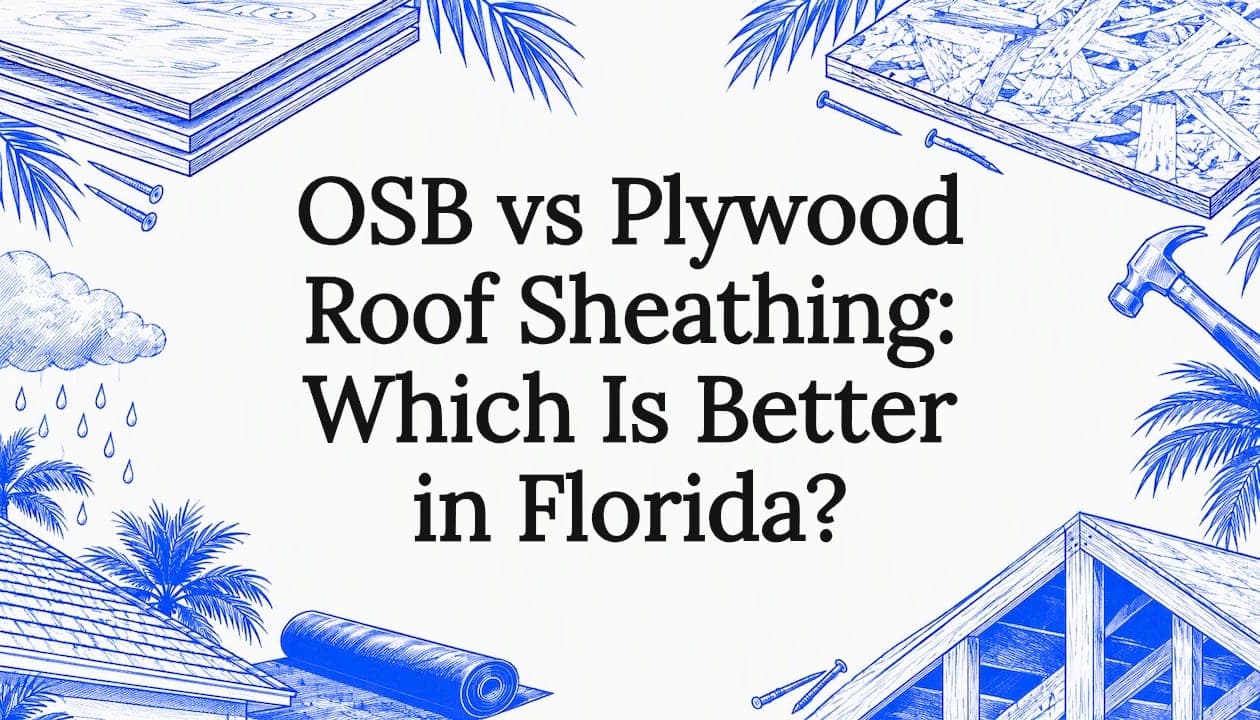
Both work. Plywood is the more forgiving panel when a roof gets wet or takes impacts, and OSB is the cheaper, more uniform panel that most builders use. Both are made to the same U.S. product standard and carry the same span ratings. In South Florida, how the deck is nailed, sealed and kept dry matters more than which panel you pick. Here is how to compare them, what the Florida guidance says, and what to check before anyone tears off your shingles.
TL;DR
- OSB and plywood share performance standards and span ratings, so a correctly installed deck of either can carry an asphalt shingle roof.
- Plywood wets faster but dries faster and swells less. OSB resists soaking longer but swells more at the edges, and that swelling can be permanent.
- IBHS recommends at least 7/16-inch panels, so 7/16 OSB meets the minimum when it is fastened correctly.
- Florida's own guidance warns that many existing decks are under-nailed for hurricane uplift, and staples perform poorly.
- A sound deck under aging shingles is a reason to preserve the roof, not replace it. Have it inspected first.
Table of Contents
- How OSB and plywood are different
- Strength and stiffness
- Moisture: where the two panels really differ
- Is 7/16 OSB strong enough for a roof?
- Why builders choose OSB
- OSB vs plywood at a glance
- South Florida: fastening matters more than the panel
- Ventilation and installation details
- How to choose for your roof
- Our perspective
- Find out if your roof still has life left
- FAQ
- Sources
How OSB and plywood are different
Plywood is built from thin wood veneers glued in alternating layers. OSB is made from compressed wood strands bonded with resin. Plywood has a smoother surface, and OSB has the distinct strand pattern you can see on the panel.

They are more alike than the arguments online suggest. APA, the engineered wood association, states that both panels are produced under U.S. Voluntary Product Standard PS 2-18, assessed at the same span-rated grading levels, and made with water-resistant resins meant to hold up after severe moisture exposure. A panel stamped for a given span rating is rated for that span, whichever material it is.
There are real differences in how each behaves over time, and they show up mostly when water gets involved.
Strength and stiffness
For ordinary roof sheathing, strength is rarely the deciding factor. Research summarized by UMass found OSB nail withdrawal and pull-through as good as or better than plywood, while plywood may have an edge in impact resistance.
On stiffness, Green Building Advisor's technical comparison reports that plywood averaged about 7% stiffer than OSB of the same thickness and span rating. The same source notes OSB is more uniform, with fewer soft spots, because plywood's veneers can have voids.
So plywood is a bit stiffer, OSB is a bit more consistent, and neither gap is large enough to decide a roof on its own.
Moisture: where the two panels really differ
This is the part that matters most for a roof, and it is where the common claim "OSB rots faster" comes from.
UMass reports that OSB takes longer to become saturated than plywood but also dries more slowly. It swells more at the edges, and that swelling can be irreversible. Plywood wets faster, dries faster, and swells less and more reversibly. With prolonged leaks, OSB panels can degrade faster than plywood.
Testing reported in Professional Roofing puts numbers on it. One-half-inch plywood averaged 9.4% thickness swell, versus 32.9% for 7/16-inch OSB, about 3.5 times more for OSB. The same article reports cross-direction linear expansion of 0.30% for plywood and 0.38% for OSB, with both at about 0.23% along the panel.

The National Roofing Contractors Association takes a clear position here. As reported by Professional Roofing, NRCA says long-term moisture cycling can cause OSB dimensional change, ridging and fastener back-out, so it prefers PS 1 plywood when it has the choice for roof-deck substrates.
There is a counterpoint. IIBEC, the building envelope consultants' institute, notes that OSB should be kept dry and that ongoing leakage causes problems. It also points out that deck buckling commonly comes from inadequate ventilation, improper edge attachment, insufficient panel gaps, or a mix of those. Many apparent OSB failures are installation and ventilation problems, not defects in the panel.
What this means in plain terms
- If your roof has a slow leak that went unnoticed for months, OSB decking is likelier to be permanently damaged than plywood.
- If your roof stays dry and your attic breathes, either panel can last.
- Panels left exposed during construction or a re-roof, before underlayment goes on, are the most vulnerable.
Is 7/16 OSB strong enough for a roof?
Yes, for the minimum. The Building America Solution Center, summarizing IBHS guidance, recommends at least 7/16-inch plywood or OSB for roof sheathing. The panel must also suit your framing. TECO's design guide says panels need a span rating suitable for the framing, an Exposure 1 or Exterior bond classification, supported ends, and about 1/8-inch gaps between ends and edges.
That gap is easy to skip and costly to miss. IIBEC advises that panels should not be tightly abutted and recommends a 1/8-inch gap along the sides. Clips can help, but they are not meant to be the only spacing device.
Thin panels do not fail on day one. They show up years later as sagging between rafters or trusses, visible ripples under the shingles, or soft spots underfoot.
Why builders choose OSB
The reasons are practical. Green Building Advisor says OSB is typically less expensive than CDX plywood, uses wood efficiently, and is manufactured more uniformly, with fewer veneer voids. It remains a sound roof-deck option when it is kept dry, correctly spaced, properly fastened and covered promptly.
That is why most production homes you see in Broward and Palm Beach counties built in recent decades have OSB, plywood, or a mix of both. The panel choice was usually a cost decision, and the quality of the nailing was left to the crew.
Cost is the one area where we will not quote exact numbers. Prices for panels and labor move with the lumber market, roof pitch, access, removal and disposal, and permits. Ask a licensed roofer for a written line item for decking repairs rather than relying on a national average.
OSB vs plywood at a glance
| Factor | Plywood | OSB |
|---|---|---|
| Standard and span ratings | Same performance standard and span-rating system | Same performance standard and span-rating system |
| Stiffness | About 7% stiffer in one comparison | Slightly less stiff, more uniform |
| Surface | Smoother, veneer voids possible | Strand pattern, fewer soft spots |
| Wetting and drying | Wets faster, dries faster | Soaks slower, dries slower |
| Edge swelling | Less, more reversible | More, can be permanent |
| Prolonged leaks | More forgiving | Can degrade faster |
| Typical cost | Higher | Typically lower |
South Florida: fastening matters more than the panel
The Florida Division of Emergency Management's Hurricane Retrofit Guide says that existing plywood or OSB deck attachment has often been inadequate for hurricane uplift, and that staples have performed poorly compared with properly nailed systems. Its advice before new shingles go on: inspect every sheet, replace rotted, delaminated, warped or unsound sections, and fasten the deck to current standards.
The Building America Solution Center describes three steps to improve roof resilience: attach the deck with IBHS-recommended fasteners, seal the deck, and install drip edge at the eaves and gable rakes. The recommended nailing is 8d ring-shank nails at 4 inches on center near the roof edges and on each side of the ridge, and 6 inches on center elsewhere. Its practical point is that hurricane performance depends on the whole deck assembly, not simply whether the panel is OSB or plywood.
Local permit rules reflect this. Martin County's re-roof windstorm certification form, for example, says re-roofing applications require existing sheathing to be re-nailed under the 2023 Florida Building Code, generally with 8d ring-shank nails at 6 inches on center along framing, subject to exceptions. It also lists secondary water barrier options, and which one is allowed depends on roof slope and product requirements. Your own city or county sets the details, so ask your building department what applies to your address.
Code is also moving. Miami-Dade says the Ninth Edition Florida Building Code takes effect December 31, 2026, and that high-velocity hurricane zone roofing and test-protocol changes will affect some current underlayment approvals. If you plan a replacement soon, ask your contractor which code edition your permit falls under.
On impact, UMass describes the large-missile test used in Miami-Dade and Broward: a 9-pound 2-by-4 at 34 mph, with 19/32-inch plywood as the benchmark discussed in the article. That is a reason Florida roofers often lean toward plywood for demanding conditions.
Ventilation and installation details
TECO's guide says the deck surface should be dry before roof covering goes on, ventilation should meet applicable codes, and underlayment should go down before shingles to limit weather exposure. Heat and humidity trapped in an attic stress both the deck and the shingles above it. For a look at how airflow design affects a roof's performance, the principles in warm and cold roof design explain why moisture control sits at the center of every roof build-up. We cover the shingle side of this in our guide on how poor ventilation shortens shingle life.
When a deck does need work, a full re-roof is the moment to fix it. Homeowners weighing the process can read about re-roofing and roof deck replacement to see what a survey-led scope looks like. In Florida, make sure the nailing pattern, the secondary water barrier and the drip edge are written into your contract.
How to choose for your roof
- Find out what you have. Check your permit records or ask an inspector. Many homes have OSB, and that is not a defect.
- Check for moisture signs. Look for water stains on attic sheathing, dark or soft patches, swollen edges, and nail heads backing out.
- Check the fastening. Staples or widely spaced nails on an older deck are the bigger hurricane risk.
- Match the panel to the situation. For new work in a wet or storm-exposed setting, plywood is the more forgiving choice. For a dry, well-ventilated deck, OSB is a sound and economical one.
- Do not replace a sound deck. If the panels are firm, dry and well attached, the deck is not the reason to tear off the roof.
Our perspective
Most homeowners who ask us about OSB and plywood are really asking a different question: do I need a new roof? The answer starts with the shingles, not the sheathing.
The deck is hidden, protected and, when the roof is kept dry, usually in decent shape. The shingles take the sun, heat, rain and storms. In Broward and Palm Beach counties they dry out, turn brittle, crack, curl and shed granules long before the wood beneath them has a problem. A tear-off to "upgrade the decking" often starts from the wrong assumption.
That is why we inspect first. We look at the shingles, check for signs of moisture and wear, and assess whether the roof qualifies for renewal. Our certified Fresh Roof Green Soy Technology is designed to restore shingle flexibility, slow deterioration and lock in granules on qualifying asphalt shingle roofs. If your roof is a good candidate, you could save up to 80% compared with a full replacement, with a 6-year transferable warranty.
If we find a soft, wet or under-nailed deck, we will tell you plainly, because that is a job for a roofer. Our rule is simple: call us before you call the roofer.
Daniellison
Find out if your roof still has life left
Replacement can run $15,000 to $30,000, and the sheathing question often gets used to justify it. Our free roof assessment checks the condition of your shingles and tells you honestly whether the roof qualifies for preservation and renewal. We serve Broward and Palm Beach county homeowners, including Boca Raton, Delray Beach and Plantation.
Schedule your free roof assessment and find out before you spend on a tear-off. You can also see how our approach differs in Fresh Roof vs roof rejuvenation, or read our guide on when to repair or replace a roof in South Florida.
FAQ
Does OSB rot faster than plywood?
Only when it stays wet. OSB soaks slowly but dries slowly, and its edges can swell permanently, so prolonged leaks can degrade it faster than plywood. On a roof that stays dry and ventilated, either panel can last for decades.
Why do people use OSB instead of plywood?
Cost and consistency. OSB is typically cheaper and more uniform, with fewer voids. It works well when it is kept dry, spaced correctly, nailed properly and covered promptly.
What type of sheathing is best for a roof?
For shingle roofs, any properly rated panel of at least 7/16-inch thickness that suits your framing meets the IBHS recommendation. Plywood is the more forgiving option for moisture and impacts. The nailing pattern, deck sealing and drip edge matter at least as much as the panel.
Should I replace my roof deck when I replace my shingles?
Not automatically. Florida guidance says to inspect every sheet and replace only rotted, delaminated, warped or unsound sections. Then re-nail the deck to current standards before new shingles go on.
Sources
- Roof Deck Sheathing and Sealing for Sloped Roofs, Building America Solution Center
- Evaluating OSB for Coastal Roofs, UMass Building and Construction Technology
- Wood Structural Panel (WSP), APA
- Plywood vs. OSB, Green Building Advisor
- Plywood or OSB? Professional Roofing, April 2021
- Roof Decks A to Z: Part IX: Oriented Strand Board (OSB), IIBEC
- TECO Plywood Design and Application Guide
- Hurricane Retrofit Guide: What To Do When Re-Roofing, Florida Division of Emergency Management
- Residential Re-Roof Windstorm Loss Certification, Martin County
- Product Approval Notices, Miami-Dade County
- Warm vs cold roof
- Re-roofing and roof replacement