
Professional roof coating on shingles, using a certified rejuvenator rather than a paint-like sealer, can extend the life of a qualifying asphalt shingle roof and delay a costly replacement. A certified applicator applies Fresh Roof Green Soy Technology, a soy-based rejuvenator, after a professional inspection confirms your roof is a candidate. It will not save a roof with active leaks, exposed substrate, or rotted decking.
TL;DR:
- Rejuvenation treatment is effective only on roofs that are mid-life with dry but not cracked or heavily curled shingles, and no active leaks or structural damage.
- The process can add roughly 5 to 7 years of life with proper scheduling, but does not repair or reverse already failed or rotted decking, or stop active leaks.
- Cost savings are significant, with treatment typically costing 15% to 20% of replacement and providing a transferable warranty that may increase resale value.
- Early inspection by a professional is crucial to determine eligibility and avoid unnecessary replacement costs, especially before structural or active leak issues develop.
- Rejuvenation reduces landfill waste and manufacturing emissions by preserving existing shingles using soy-based chemistry, especially if homeowners delay full replacement.
Table of Contents
- What Causes Shingles to Fail, and How Does Rejuvenation Fix It?
- Is Your Shingle Roof a Good Candidate for Rejuvenation?
- What Can Roof Coating on Shingles Actually Achieve?
- How Does the Inspection and Application Process Work?
- What Does Roof Coating on Shingles Cost Compared to Replacement?
- Does Preserving Shingles Instead of Replacing Them Help the Environment?
- Why an Inspection Before Replacement Actually Matters
- Ready to Find Out If Your Roof Qualifies?
- Sources
- FAQ
What Causes Shingles to Fail, and How Does Rejuvenation Fix It?
Asphalt shingles age the same way an old rubber gasket does. They start out pliable and slowly dry out until they crack under pressure.
That happens because of maltene loss. Maltenes are the lightweight oils inside asphalt that keep shingles bendable. Florida sun and heat cook those oils out year after year, a process called oxidation. Once enough maltene content is gone, shingles turn brittle, curl at the edges, and start shedding granules, the small stone particles that shield the asphalt from UV rays and give shingles their fire resistance. Granule loss is not cosmetic. It is an early warning that the protective layer underneath is exposed and aging faster.
A shingle roof sealant built on rejuvenation chemistry works differently than a surface film. Engineered soy-based formulas, using transesterified methyl esters rather than raw vegetable oil, penetrate the asphalt matrix and chemically interact with the binder itself instead of just sitting on top of it. That distinction matters when comparing coating for asphalt shingles to old-style spray paints, which only mask problems rather than treat them.
The results are measurable, not anecdotal:
- Industry data cited by AURI shows treated shingles can regain a significant increase in flexibility after treatment.
- Independent laboratory testing has recorded improved tear resistance and reduced moisture absorption in treated versus untreated shingles.
- Peer-reviewed research on soybean oil-based emulsions confirms restored flexibility and granule retention under lab conditions.
Pro Tip: Results depend heavily on how much maltene content is left. The earlier you catch the drying-out process, the better the chemistry has to work with.
Is Your Shingle Roof a Good Candidate for Rejuvenation?
Not every aging roof qualifies, and that is the first thing an honest inspection should tell you.
Roofs that respond best to treatment usually share a few traits:
- Age in the range where shingles have started drying out but have not failed outright, typically mid-life rather than brand new or decades old
- Moderate, even granule loss across the roof plane rather than bare patches
- Shingles that feel stiff or brittle to the touch but are not widely cracked or curling at every edge
- No history of active leaks or water staining on interior ceilings
Certain signs disqualify a roof from professional rejuvenation altogether. Active leaks, exposed asphalt substrate, widespread curling, and soft or rotted decking underneath all point to a system past the point rejuvenation can reach. Industry practitioners are consistent on this point: treatment works before structural damage sets in, not after.
Pro Tip: Take photos of any curling, staining, or granule buildup in your gutters before your inspection. It gives your technician a clearer timeline of how fast your roof is aging.
A documented, professional inspection is the only reliable way to know where your roof falls. Guessing from the ground costs homeowners more than it saves.
What Can Roof Coating on Shingles Actually Achieve?
Set realistic expectations before you book anything, because rejuvenation is a preservation tool, not a miracle cure.
- Life extension per treatment. Manufacturers and industry sources report roughly 5 to 7 years of added life per application, with some homeowners reaching 10 to 15 years total through repeat treatments on a maintenance schedule.
- Flexibility and granule retention. Lab testing shows measurable gains in flexibility and reduced moisture absorption after treatment, which slows the cracking and shedding that lead to leaks.
- Tear resistance. Treated shingles hold up better against wind uplift and storm debris than untreated, brittle ones, an important factor across Broward and Palm Beach counties during hurricane season.
What it will not do is rebuild a roof that has already failed structurally. Rejuvenation restores the oils and bonding in shingles that still have life left, but it cannot repair rotted decking, stop an active leak, or reverse the damage in shingles that are already cracked through. Results also vary by starting condition, climate exposure, and how consistently a roof has been maintained.
How Does the Inspection and Application Process Work?
The path from first phone call to a treated roof follows three steps, and each one matters for the results you get.
- Inspect. A technician walks the roof, photographs shingle condition, checks granule loss patterns, and looks for disqualifying damage like exposed substrate or soft decking.
- Assess. The findings get compared against eligibility criteria to determine whether your roof qualifies for renewal or needs a different recommendation entirely.
- Apply. If your roof qualifies, technicians use calibrated low-pressure spray equipment at a specified application rate, a method distinct from how any DIY shingle roof sealant would be applied.
Application itself typically takes a few hours depending on roof size, but the chemistry needs 24 to 48 hours of dry conditions to fully penetrate the shingle matrix. That means scheduling around Florida's rain patterns is part of the job, not an afterthought. A credible applicator should document before-and-after roof condition and provide a written record of what was applied and when the next treatment should happen.
What Does Roof Coating on Shingles Cost Compared to Replacement?
Cost is usually the number that gets a homeowner to actually book the inspection.
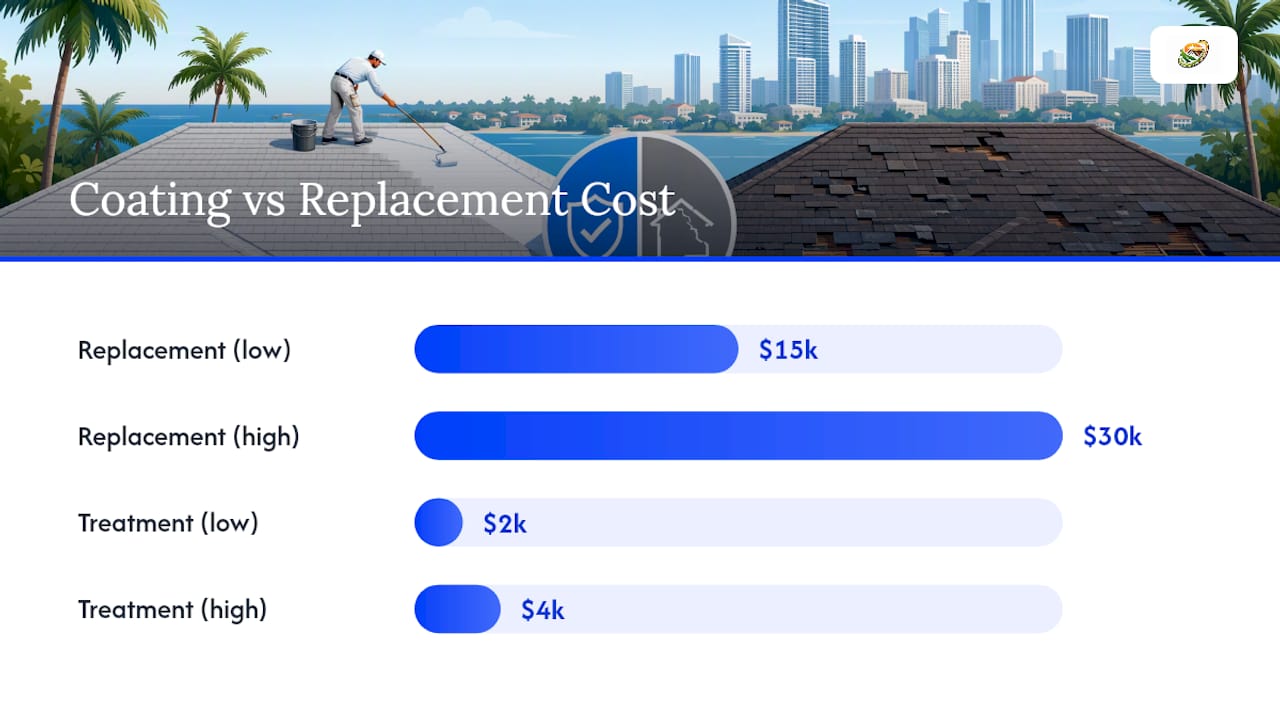
Industry estimates put rejuvenation treatment at roughly $1.00 to $1.45 per square foot, which works out to about 15% to 20% of what a full replacement runs. Against a typical replacement cost of $15,000 to $30,000, a qualifying roof treated instead can mean savings in the thousands rather than tens of thousands.
- A $20,000 replacement estimate versus a treatment cost in the $2,000 to $4,000 range on the same square footage
- A transferable warranty backing the treatment, which may add resale value if you sell before the warranty runs out
- No new debt or financing needed for a job that costs a fraction of a tear-off and rebuild, in many cases
A written warranty provides assurance regarding the treatment's performance.
Does Preserving Shingles Instead of Replacing Them Help the Environment?
Every roof that gets rejuvenated instead of torn off is one less pile of shingles in a landfill.
If just 1% of single-family homes nationwide chose preservation over replacement in a given year, Ohio State University estimates cited by AURI put the potential impact at 5.6 billion pounds of shingle waste diverted from landfills and 1.1 million metric tons of CO2 emissions avoided.
- Fewer tear-offs means less asphalt shingle waste trucked to landfills
- Skipping manufacturing and shipping for new shingle materials lowers the production emissions tied to replacement
- Soy-based formulations draw on renewable agricultural inputs rather than petroleum-heavy alternatives
Why an Inspection Before Replacement Actually Matters
Most homeowners call a roofer first because that is who they have always called. It is the wrong order of operations for a roof that still has usable life in it.
The gap between what replacement promises and what a roof actually needs is bigger than most people realize. A roofer's job is to sell and install a new roof. Ours is to tell you honestly whether you need one yet. Those are different incentives, and homeowners rarely hear the preservation option because the people they call first do not offer it.
Shingle Roof Renewal is is certified to apply Fresh Roof Green Soy Technology, backed by a 6-year transferable warranty on qualifying jobs. The chemistry behind rejuvenation is not new science dressed up in marketing language. It is documented, lab-tested, and it works within specific limits that any honest applicator should explain upfront rather than after you have already signed a contract.
— Daniellison
Ready to Find Out If Your Roof Qualifies?
Shingle Roof Renewal is serves the call before the roofer for homeowners across Broward and Palm Beach counties who suspect their shingles have more life left than a contractor's estimate suggests. A free inspection tells you exactly where your roof stands, no guessing, no pressure toward a $15,000 to $30,000 replacement you might not need yet.
If your home is in Delray Beach or Plantation, start with your city's inspection page to see local service details. For homeowners elsewhere in South Florida, the main site covers the same free assessment process. Every inspection includes a full walkover, photo documentation, and a straight answer on whether your roof qualifies for renewal. Qualifying roofs can save thousands compared to full replacement, backed by a 6-year transferable warranty. For a broader look at keeping shingles in good shape between treatments, the seasonal home maintenance calendar is a useful companion resource, and this piece on why professional inspections matter explains the broader case for catching problems early. Schedule your free inspection and find out where your roof actually stands before you spend a dollar on replacement.
Sources
- Soy offers new life for aging roofs | AURI
- The chemistry behind shingle rejuvenation | Can This Roof Be Saved
- Soybean oil-based polymeric coatings for the rejuvenation of old asphalt shingles (Reports and Data / DOI)
- How roof rejuvenation technology works for asphalt shingles | Reactiv8
FAQ
Can You Coat a Shingle Roof That's Already Leaking?
No. Active leaks, exposed substrate, and decking damage disqualify a roof from rejuvenation treatment and require repair or replacement instead.
How Long Does Roof Coating on Shingles Last?
Manufacturers and industry sources report roughly 5 to 7 years of added life per treatment, with some homeowners reaching 10 to 15 years total through repeat applications.
Does Rejuvenation Void My Shingle Manufacturer's Warranty?
Warranty terms vary by manufacturer, so ask your inspector to check your specific shingle warranty before treatment; Shingle Roof Renewal backs qualifying jobs with its own 6-year transferable warranty.
How Do I Find a Certified Applicator Near Me?
Look for a certified applicator of a documented rejuvenator system, like Fresh Roof Green Soy Technology, that offers a written inspection report and a transferable warranty rather than a same-day sales pitch.