
Roof rejuvenation typically costs between $0.75 and $2.75 per square foot, or roughly $1,500 to $5,000 for an average home, compared to $15,000 to $30,000 or more for full replacement. That single treatment can buy you 10 to 15 years of extra roof life if your shingles qualify. The catch: not every roof does, so the right first move is always a professional inspection, not a purchase decision based on price alone.
TL;DR:
- Smaller roofs often have a higher cost per square foot because fixed setup and cleanup expenses are spread over fewer materials.
- Penetrating bio-oil treatments cost between $0.75 and $1.65 per square foot and typically need reapplication every five years to maintain effectiveness.
- Rejuvenation is suitable for shingles that are moderately weathered but not cracked or actively leaking, while replacement is needed for rotted decking or active leaks.
- Over 20 years, treating a 2,000 square foot roof every five years costs significantly less than full replacement, which often exceeds $15,000.
- Proper inspections should include tests for shingle flexibility, flashing condition, attic leaks, decking integrity, and ventilation to determine roof eligibility.
Table of Contents
- What Determines Roof Rejuvenation Cost?
- Penetrating Bio-Oils vs. Coatings: Which Costs More?
- Is Your Roof a Good Candidate for Rejuvenation?
- How Does Rejuvenation Cost Compare to Replacement Over Time?
- What Are the Real Limits and Red Flags to Watch For?
- What Happens During a Professional Roof Inspection?
- What Warranty and Insurance Terms Should You Expect?
- A Real-World Example: From Inspection to Preservation
- What Should You Budget for Maintenance After Rejuvenation?
- Does Rejuvenation Improve Energy Efficiency and Reduce Waste?
- Publisher Perspective: When We Recommend Rejuvenation vs. Replacement
- Get a Free Inspection and Find Out If Your Roof Qualifies
- Sources
What Determines Roof Rejuvenation Cost?
Roof rejuvenation cost breaks down into a fairly predictable range once you know the variables that move it. Penetrating treatments generally land between $0.75 and $1.65 per square foot, while a typical single-family home ends up paying $1,500 to $3,500 total. That is the baseline most homeowners in Palm Beach and Broward counties should expect to see on a written quote, assuming the roof needs no significant repair work first.
Several factors push that number up or down:
- Roof area. More square footage means more material, though the per-square-foot rate often drops slightly on larger jobs.
- Pitch and steepness. Steep roofs require harnesses, extra safety setup, and slower application, all of which add labor time.
- Complexity. Dormers, valleys, chimneys, and multiple roof planes multiply the number of edges and transitions a crew has to work around.
- Access. A roof crowded by trees, fencing, or a tight lot line takes longer to stage and treat than an open, single-story ranch.
- Prep and cleaning. Moss, algae, and years of accumulated debris often need to be cleared before any treatment can penetrate the shingle surface.
- Local labor rates. South Florida crews price differently than a Midwest market simply based on regional cost of living and demand.
Here is something most cost guides skip: smaller roofs frequently cost more per square foot, not less. A crew still has to load equipment, drive to the site, and spend a similar amount of time on setup and cleanup regardless of whether they are covering 1,200 square feet or 3,500. That fixed mobilization cost gets spread across less material on a small roof, which raises the effective rate.
Add-on repairs are the other quiet cost driver. A quote that looks attractive at $0.90 per square foot can jump considerably once a contractor tacks on flashing repair, a few replacement shingles, or extra prep for algae staining. Ask for those line items broken out separately so you know what you are actually paying for the treatment itself versus the repairs around it.
Penetrating Bio-Oils vs. Coatings: Which Costs More?
Roof rejuvenation is not one product. It is a category that covers two fundamentally different treatments, and mixing them up when comparing quotes is how homeowners end up confused about why one bid is double another.
Penetrating bio-oil treatments work by soaking into the asphalt shingle itself, restoring the oils that heat and UV exposure have baked out over the years. This is the approach behind Fresh Roof Green Soy Technology, which works at the molecular level to rebuild flexibility rather than simply coating the surface. Trade press has tracked the rise of these soy- and corn-based formulas precisely because they extend roof life, which cost a fraction of replacement price, while reducing landfill waste from unnecessary tear-offs.
Elastomeric and acrylic coatings, by contrast, sit on top of the shingle as a surface film. They can improve water resistance and reflectivity, but they do not restore the shingle's underlying flexibility the way a penetrating oil does.
| Treatment type | Typical cost per sq ft | How it works | Re-treatment cycle |
|---|---|---|---|
| Penetrating bio-oil | $0.75–$1.65 | Absorbs into the shingle, restoring flexibility | Often every 5 years |
| Elastomeric/acrylic coating | $0.75–$2.75 | Forms a protective film on the surface | Varies by product, generally longer |
Two quotes that both say "roof rejuvenation" can describe entirely different products at entirely different price points. Before you sign anything, confirm the exact product name, whether it penetrates or coats, and what re-treatment schedule the contractor recommends.
Is Your Roof a Good Candidate for Rejuvenation?
Not every asphalt shingle roof qualifies, and figuring that out before you spend a dime is the whole point of an inspection. Here is what typically makes a roof a strong candidate:
- Shingles are moderately weathered, not brand new and not fully brittle or cracked through.
- Surface granule loss and sun fading are present, but the roof has no history of recurring leaks.
- Flashing around chimneys, vents, and valleys is still intact.
- No widespread missing or torn-off shingles across large sections.
These conditions usually rule a roof out:
- Active leaks or a pattern of repeated leak repairs.
- Shingles that are cracked all the way through, not just curled at the edges.
- Compromised or rotted decking underneath the shingles.
- Recent major storm damage from hail or high wind.
Small repairs before treatment are common and usually reasonable. Replacing a handful of damaged shingles or resealing a flashing joint typically adds a modest amount to the total rather than derailing the project.
Pro Tip: Ask the inspector to show you the specific spots that need repair before you approve any additional cost. A trustworthy contractor documents this with photos, not just a verbal estimate.
How Does Rejuvenation Cost Compare to Replacement Over Time?
Numbers make this decision a lot easier than gut instinct does. Take a 2,000 square foot roof and run it through two paths.
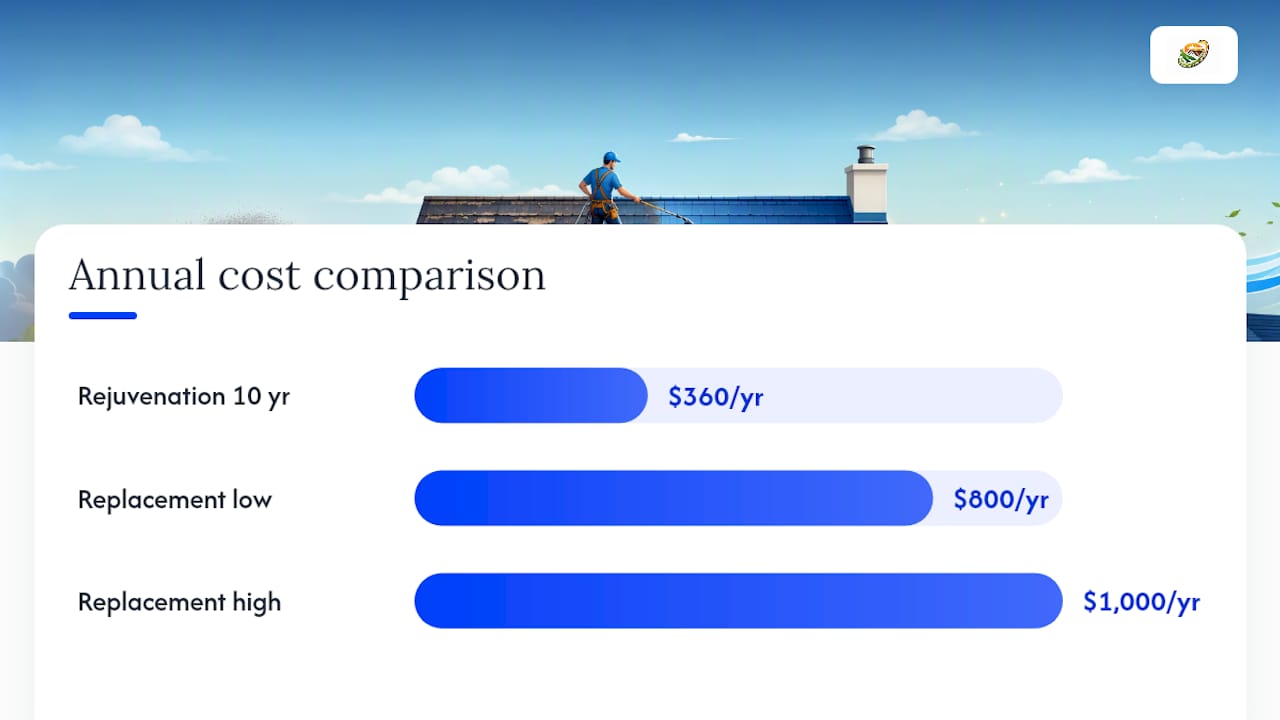
- Rejuvenation path: A single penetrating treatment costs roughly $1,800 (at $0.90 per square foot) and typically adds 10 to 15 years of usable roof life. If you re-treat once around year five for another $1,800, you have spent $3,600 over 10 years, or $360 per year.
- Replacement path: Full replacement on a comparable roof commonly runs $18,000 to $22,000 in coastal markets, based on regional cost comparisons. Spread over the 20 to 25 years a new roof might last, that comes out to roughly $800 to $1,000 per year, before financing costs.
Stretch the rejuvenation path to 20 years with a treatment every five years, and you are still likely paying well under half of what replacement costs on an annualized basis, assuming the roof continues to qualify at each check-in.
The math favors rejuvenation heavily when a roof qualifies, but the comparison isn't purely financial. Replacement means a noisy, multi-day tear-off, a dumpster in your driveway, and shingles headed to a landfill. Rejuvenation means a crew treats the existing roof in a fraction of the time, with no debris and no waste stream. For homeowners weighing resale timing, a documented, warrantied rejuvenation can also read better to a buyer than a roof nearing the end of its life with no recent work done.
What Are the Real Limits and Red Flags to Watch For?
Rejuvenation restores flexibility and slows granule loss. It does not fix rotted decking, and it will not stop an active leak that already has water reaching your attic. Anyone who tells you otherwise is overselling the product.
Watch for these warning signs before you sign a contract:
- A guarantee offered before anyone has actually inspected your roof in person.
- Pressure to prepay for multiple future treatments up front.
- Warranty language that is vague about what is and is not covered.
- A price that seems dramatically lower than every other quote you have gathered, with no explanation for the gap.
NRCIA field data on more than 6,400 roof inspections found that over 66% of roofs either qualified outright or could be brought into qualifying condition with modest repairs, which reinforces that inspection and repair, not blanket treatment, should drive the decision.
Pro Tip: Before hiring anyone, ask for the exact product name, any independent testing behind it, and a copy of the written warranty. If a contractor hesitates to hand over those three things, walk away.
What Happens During a Professional Roof Inspection?
A real inspection follows a checklist, not a guess. Here is what a thorough one covers:
- Shingle flexibility test. The inspector bends a sample shingle to see whether it still flexes or snaps.
- Granule loss assessment. Heavy granule shedding in gutters or downspouts signals accelerated aging.
- Flashing condition. Rusted, lifted, or gapped flashing around chimneys and vents is a common repair item.
- Attic inspection. Checking the underside of the decking for water stains catches leaks that never showed up inside the house.
- Decking condition. Soft spots or visible sagging usually disqualify a roof from rejuvenation until repaired or replaced.
- Ventilation review. Poor attic airflow accelerates shingle aging from the underside, which affects how long any treatment will last.
Flashing repairs, decking work, and any sign of an active leak are the items most likely to raise your final price or take rejuvenation off the table entirely. A useful inspection report documents each of these with photos and a clear qualification recommendation, not just a one-line pass or fail. For homeowners weighing cost-effective ways to extend shingle life, this step is where the real savings decision gets made.
What Warranty and Insurance Terms Should You Expect?
Most reputable rejuvenation treatments carry a warranty in the 5 to 6 year range, and a transferable warranty adds real value if you plan to sell before it expires. Standard exclusions typically include leaks that predate treatment and any underlying decking damage discovered later, so read that fine print carefully.
- Ask your insurance carrier directly whether they recognize rejuvenation treatments when you file a future claim; policies vary by insurer and state.
- Bio-oil treatments are commonly re-treated roughly every five years, so budget for at least one more application over a 10 to 15 year window.
- Keep every receipt and warranty document together; a future buyer or claims adjuster will want to see the treatment history, not just take your word for it.
A Real-World Example: From Inspection to Preservation
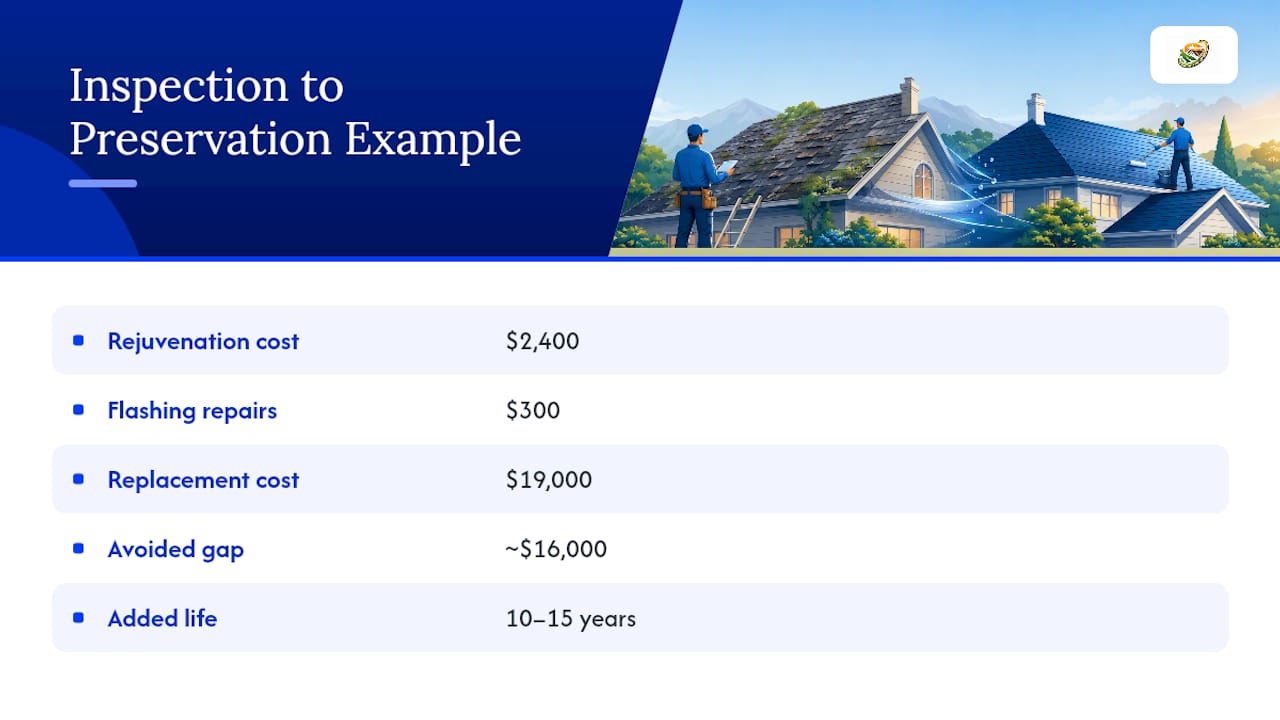
A typical qualifying scenario looks like this: an inspection finds moderate granule loss and curling on a 12-year-old roof, but no active leaks and sound decking. Small flashing repairs run about $300. The rejuvenation quote comes in around $2,400 for a 2,400 square foot home, with the treatment projected to add 10 to 15 years of life. Full replacement on the same home would have run an estimated $19,000. That gap, roughly $16,000, is the entire argument for inspecting before you assume replacement is your only option.
What Should You Budget for Maintenance After Rejuvenation?
Rejuvenation is not a one-time fix you forget about for two decades. Budget for periodic re-treatment, typically every five years for penetrating bio-oil products, at a similar or slightly lower cost than your initial application since prep work is usually less intensive the second time around. Between treatments, expect only minor upkeep: clearing debris from valleys, checking gutters after storm season, and a quick visual check of flashing points once or twice a year.
Set aside a modest annual reserve rather than treating the cost as a single expense. If your initial treatment ran $2,000 and you plan to re-treat every five years, that works out to roughly $400 a year in maintenance reserve, well below what most homeowners set aside for a full roof replacement fund. Skipping a scheduled re-treatment does not cause immediate failure, but it does shorten the extended life you paid for, since the oils that restored flexibility gradually dry out again under sun and heat exposure. Homeowners in hot, sunny climates should treat that five-year window as a real deadline, not a loose suggestion, given how much faster UV exposure accelerates shingle embrittlement in those regions.
Does Rejuvenation Improve Energy Efficiency and Reduce Waste?
Rejuvenation's clearest environmental benefit is what it keeps out of the landfill. A full tear-off sends the old shingles, underlayment, and often the decking straight to a disposal site, while a rejuvenation treatment leaves the existing roof in place and simply extends its working life. On a typical 2,000 to 2,500 square foot roof, that avoids a significant volume of asphalt shingle waste that would otherwise need hauling and dumping.
Some coatings also carry a reflectivity benefit, which can modestly reduce attic heat gain during peak summer months and ease the load on your air conditioning system, though this effect varies by product and roof color and should not be treated as a guaranteed utility bill reduction. The more consistent savings come from delaying the embodied environmental cost of manufacturing and installing an entirely new roof: the raw materials, transportation, and installation labor a full replacement requires. For homeowners who care about both their wallet and their footprint, rejuvenation offers a rare case where the cheaper option and the lower waste option point the same direction.
Publisher Perspective: When We Recommend Rejuvenation vs. Replacement
We recommend rejuvenation when a roof shows normal wear but no active leaks, no rotted decking, and intact flashing. We recommend replacement when decking has failed or leaks have already caused interior damage. That is why our process stays simple: inspect, assess, recommend. No roof gets a sales pitch before it gets a real look. If you are unsure which category yours falls into, schedule a free inspection and let the roof answer the question.
— Daniellison
Get a Free Inspection and Find Out If Your Roof Qualifies
Shingleroofrenewal is the alternative to jumping straight to a $15,000 to $30,000 replacement quote: we inspect first, and only recommend treatment when your roof actually qualifies for it. Our free inspection includes a full roof walk, a written condition report, and a clear recommendation on whether preservation makes sense for your specific roof.
If your roof qualifies, we apply certified Fresh Roof Green Soy Technology, which restores flexibility at the molecular level, locks in loose granules, and improves wind and fire resistance, backed by a 6-year transferable warranty. Curious readers can also see how the process works for architectural shingle roofs specifically.
Call us before you call the for your roofer. Schedule your free roof inspection today and find out where your roof stands.
Sources
- Are Roof Rejuvenation Products a Good Investment for Asphalt Roofs? — NRCIA
- Roof Rejuvenation Cost in 2026: Per Sq Ft & Total — The Roofing Brief
- Roof rejuvenation cost vs replacing an asphalt shingle roof — Hardshore Roofing and Exteriors
- Eco roof sprays promise longer life, less waste — Roofing Contractor