
Roof rejuvenation is typically classified as maintenance, not an insured repair. It will not reset your roof's insurance age, but a properly documented treatment can sometimes help you at renewal time or during a pre-inspection. That distinction, maintenance versus replacement, is exactly what insurers look at when they set your settlement terms under replacement cost value or actual cash value, and it's why Florida Statute 627.7011(5) matters if your roof is under 15 years old.
Before you schedule any treatment, take three steps:
- Pull your declarations page and confirm whether your policy pays RCV or ACV.
- Ask your agent what roof age and roof type they have on file.
- Get a dated professional inspection and photos before any work begins.
A qualifying inspection from Shingleroofrenewal can tell you whether preservation makes sense before you make any insurance-related decision.
Key Takeaways
Roof rejuvenation typically counts as maintenance rather than a covered repair, so it won't reset your roof's insurance age, but documented treatment can still support your position at renewal.
| Point | Details |
|---|---|
| Rejuvenation is maintenance | Insurers usually classify it like gutter cleaning, not a covered repair, and it rarely resets roof age. |
| RCV vs. ACV drives your payout | ACV coverage on an older roof can leave a five-figure gap between replacement cost and actual payout. |
| Never treat before an adjuster visit | Treating a roof ahead of a pending storm damage inspection can complicate or void a legitimate claim. |
| Documentation protects you | Dated inspections, photos, and precise invoice wording give your agent real evidence of maintenance. |
| Shingleroofrenewal offers a qualifying path | A free three-step inspect-assess-recommend process with a 6-year transferable warranty for qualifying South Florida roofs. |
This article is general information, not a substitute for advice from a qualified financial advisor. Consult a qualified financial professional about your own circumstances before acting on anything here.
Table of Contents
- What Roof Rejuvenation Treatments Are and What They Realistically Do
- How Insurers Typically Treat Rejuvenation: The Underwriting and Claim Perspective
- When Roof Rejuvenation Can Help Your Insurance Situation
- Risks and Warranty Interactions to Check Before You Treat
- A Homeowner Decision Checklist Before You Schedule Rejuvenation
- Cost Comparison: Rejuvenation vs. Full Replacement and Potential Savings
- If Your Roof Qualifies: What to Expect From Shingleroofrenewal
- How Local Insurance Rules Shape Coverage for Rejuvenated Roofs
- Common Insurer Red Flags for Rejuvenated Roofs
- Best Practices for Maintaining Coverage After Rejuvenation
- Why We Say Call Us Before You Call the Roofer
- Schedule Your Free Roof Inspection Today
- Sources
What Roof Rejuvenation Treatments Are and What They Realistically Do
Penetrating rejuvenation treatments work by soaking into the asphalt shingle itself, not sitting on top of it like a coating. The oils re-plasticize brittle asphalt, restoring flexibility and helping lock granules back onto the shingle surface instead of letting them wash into your gutters.
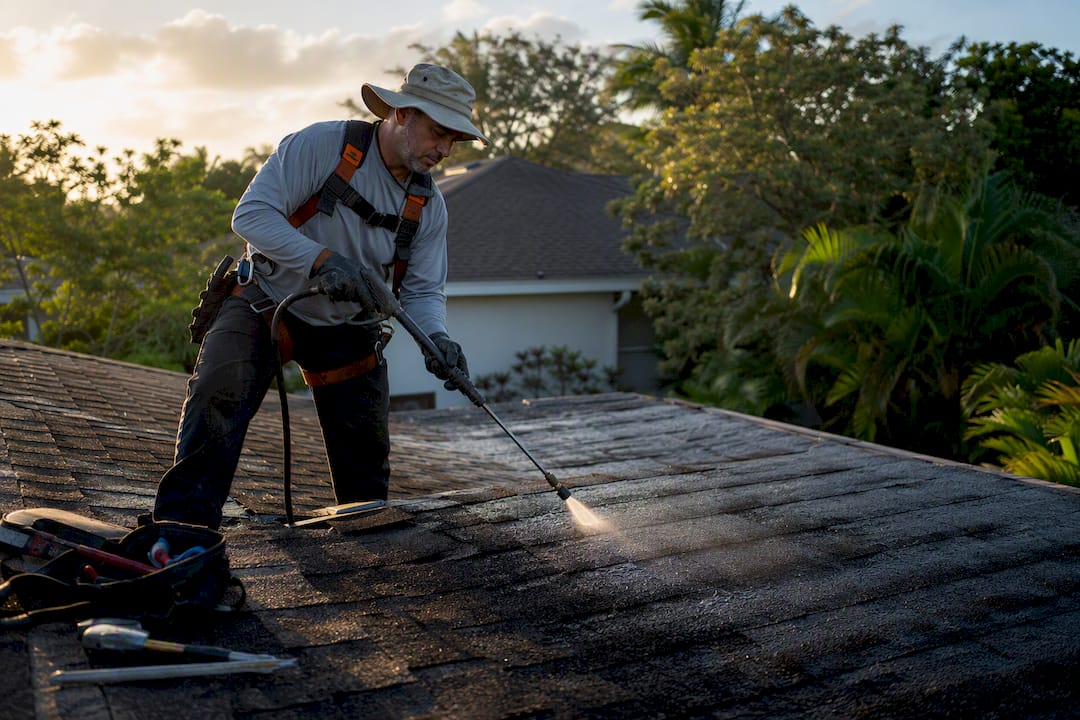
On a qualifying roof, this can realistically extend service life by 10 to 15 years. Not every roof qualifies. Shingles that are already cracked through, curling at the edges, or missing significant granule coverage usually need replacement instead.
Shingleroofrenewal follows a three-step process: inspect the roof, assess its condition against qualification criteria, and recommend either preservation or a referral for replacement. Roofs that qualify are backed by a 6-year transferable warranty.
Pro Tip: Ask any rejuvenation provider whether their treatment penetrates the shingle mat or just sits on the surface. That single question tells you whether you're getting real restoration or a temporary cosmetic fix.
How Insurers Typically Treat Rejuvenation: The Underwriting and Claim Perspective
Here's the mechanic that catches most homeowners off guard: your insurer doesn't care how good your roof looks after treatment. It cares about the year on file and the settlement form attached to your policy.
RCV vs. ACV, explained simply. Replacement cost value pays what it actually costs to put a new roof on today. Actual cash value pays that same figure minus depreciation for the roof's age and condition. On an older roof, that gap can be enormous.
Age thresholds insurers watch:
- Around 10 to 12 years, some carriers begin requiring inspections or asking questions at renewal.
- Near 15 years, many insurers push roofs onto ACV coverage or add exclusions.
- Past 20 years, non-renewal becomes common practice across much of the industry.
Insurers no longer rely only on what you tell them. Aerial imagery, drone footage, and AI-based condition scoring let carriers estimate roof age and wear from the outside, often before you even schedule an inspection yourself.
That's the core reason rejuvenation gets classified the way it does: insurers view it the same way they view gutter cleaning or attic ventilation upgrades, useful upkeep, but not a covered repair and not a reason to change the roof's recorded install date. Treatment can make shingles more flexible and durable. It does not make your roof younger on paper.
When Roof Rejuvenation Can Help Your Insurance Situation
Rejuvenation earns its place in a handful of specific scenarios, and it's worth being honest about where those limits sit.
- Pre-renewal inspections. If your carrier is asking questions about a roof approaching the 10 to 15 year mark, a documented treatment paired with a fresh inspection report can sometimes support your case for continued coverage.
- Proactive maintenance windows. Treating a roof well before any red flags appear, and keeping the paperwork, builds a maintenance record an agent can reference later.
- Not a fix for active damage. If your roof already has storm damage or your insurer has flagged you for possible non-renewal, rejuvenation is the wrong move at the wrong time.
- Timing rule that matters most. Never treat a roof while a storm damage claim is pending or an adjuster inspection is scheduled. Treatment can obscure evidence the adjuster needs to see.
Risks and Warranty Interactions to Check Before You Treat
A few pitfalls can turn a smart preservation decision into a costly mistake, so check these before signing anything.
- Masking storm damage. Treating a roof that has hail bruising or wind-lifted shingles can hide evidence your insurer needs to approve a legitimate claim later.
- Manufacturer warranty language. Some shingle manufacturers draw a hard line between "coatings," which can void warranty coverage, and penetrating treatments, which typically do not alter the shingle's original chemistry.
- Policy exclusions. Read your policy for language excluding "chemical treatments" or "coatings," and confirm with your provider exactly how your invoice should describe the treatment applied.
- Precise invoice wording. Insist your contractor write "penetrating rejuvenation treatment," not "roof coating," on every invoice and inspection report.
A Homeowner Decision Checklist Before You Schedule Rejuvenation
Work through these steps in order, and you'll walk into any insurance conversation with the documentation to back your position.
- Pull your declarations page and confirm whether you're on RCV or ACV.
- Ask your agent what roof year and roof type they currently have on file for your home.
- Find out what specifically triggers an inspection request or a non-renewal notice from your carrier.
- Schedule a dated professional inspection and take before-and-after photos of the roof.
- Confirm your contractor's invoice uses precise, accurate treatment language.
- Send the full documentation packet to your agent and keep copies for your own records.
Pro Tip: Keep every inspection report, photo set, and invoice in one folder, digital or physical. If you ever face a coverage dispute, having your documentation organized and dated is often the difference between a quick resolution and a drawn-out fight.
Cost Comparison: Rejuvenation vs. Full Replacement and Potential Savings
The math here is straightforward once you separate two questions: what does the work cost, and what does your insurance actually pay if something goes wrong afterward?
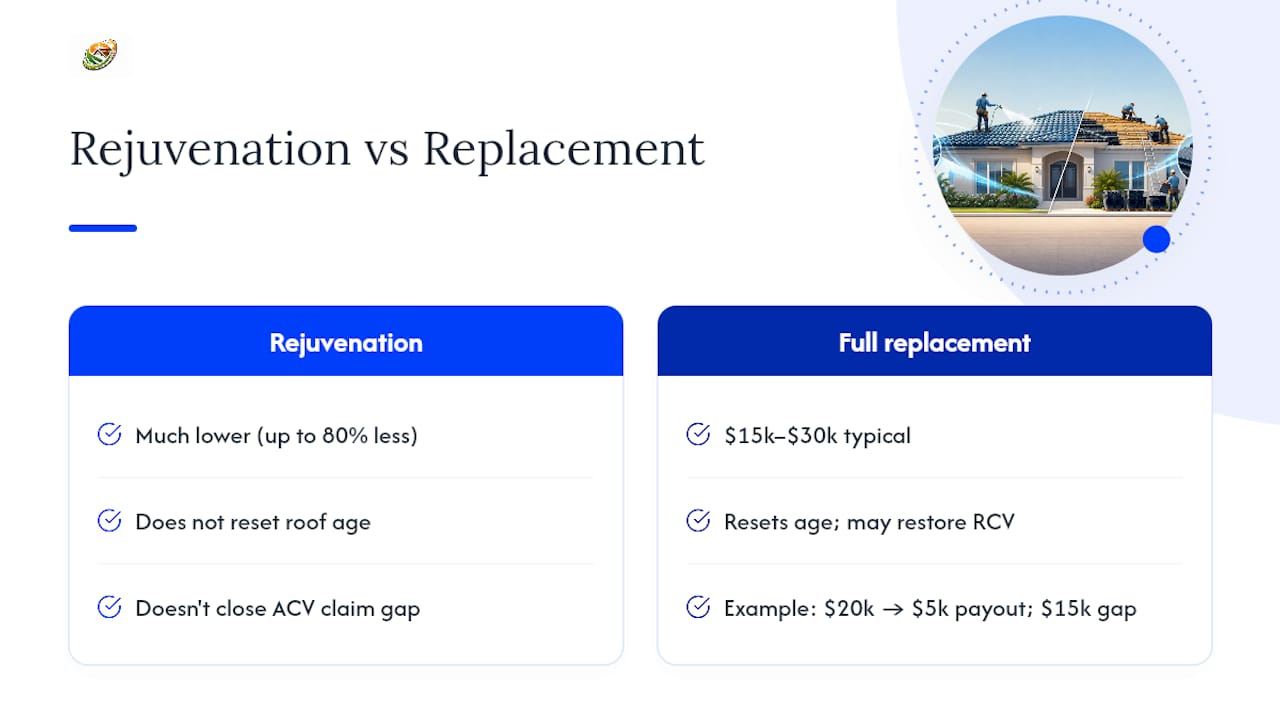
Full replacement on a typical South Florida home runs $15,000 to $30,000. Rejuvenation on a qualifying roof can save homeowners up to 80% compared to full replacement.
Here's where insurance enters the picture: replacement resets your roof's age with the carrier and can move your policy back onto RCV, which sometimes makes replacement the financially sensible move despite the higher upfront cost.
Consider a $20,000 roof on ACV coverage at 15 years old. Using straight-line depreciation, a claim might pay out roughly $5,000, leaving a $15,000 gap the homeowner covers out of pocket. Rejuvenation doesn't close that gap. It just extends the time before you have to face it.
If Your Roof Qualifies: What to Expect From Shingleroofrenewal
Most homeowners never realize their roof can still be saved. We inspect first, assess honestly, and only recommend preservation when the roof genuinely qualifies for it.
The process runs in three steps, and each one produces something you can hand to your insurance agent if needed.
- Inspect: A certified applicator examines shingle flexibility, granule retention, and overall wear.
- Assess: We compare findings against qualification criteria for Fresh Roof Green Soy Technology treatment.
- Recommend: You get a clear answer: preserve, or a referral toward replacement if the roof is past saving.
| Step | What You Receive |
|---|---|
| Inspection | Dated report with photos of current shingle condition |
| Assessment | Written qualification determination |
| Treatment (if qualified) | Invoice with precise "penetrating treatment" wording and 6-year transferable warranty |
Pro Tip: Have your policy declarations page handy when you schedule your inspection. Knowing your current settlement form ahead of time helps us tailor our recommendation to your actual insurance situation, not just your roof.
How Local Insurance Rules Shape Coverage for Rejuvenated Roofs
Florida homeowners have a legal backstop that most states don't offer. Florida Statute 627.7011(5) prevents insurers from refusing to issue or renew a policy solely because a roof is under 15 years old. That protection matters if you're getting pressure to replace a roof that's still well within its useful life.
The statute has real limits, though. It does not prevent an insurer from requesting an inspection on an older roof, and there is no requirement anywhere in Florida law that carriers accept rejuvenation as a substitute for replacement. Some homeowners assume a state protection for roof age translates into a state mandate accepting preservation work. It doesn't work that way.
Broward and Palm Beach County homeowners face an added wrinkle: intense sun, heat, and hurricane exposure accelerate shingle aging faster than in milder climates, which pushes many local roofs toward those 10 to 15 year underwriting thresholds sooner than national averages suggest. That's precisely why South Florida homeowners benefit more than most from proactive documentation and early inspections. Carriers writing policies in this region already factor storm risk heavily into their underwriting models, so a roof with a clean, documented maintenance history tends to draw less scrutiny than one with no paper trail at all.
If your insurer requests information about your roof's age or condition, know that state law gives you some footing to push back on outright refusal for younger roofs, but it won't override a carrier's right to ask questions or request proof of condition.
Common Insurer Red Flags for Rejuvenated Roofs
Insurers don't reject claims or non-renew policies at random. Certain patterns tend to trigger closer scrutiny, and it's worth knowing what they are before you're caught off guard.
Mismatched invoice language. An invoice that says "roof coating" instead of "penetrating rejuvenation treatment" can read to an underwriter like a cosmetic fix on a roof that's actually failing. Word choice on paperwork carries real weight.
No dated inspection history. A homeowner who treats a roof but can't produce a dated, professional inspection report has essentially no evidence to counter an insurer's own aerial or drone assessment.
Treatment applied after storm damage occurs. If a carrier's imagery shows granule loss or shingle lifting from a recent storm, and then sees a rejuvenation invoice dated shortly after, that sequence can raise questions about whether damage was concealed rather than repaired.
Roof age far exceeds material life expectancy. Even flawless documentation won't help if the underlying shingle is decades past its expected service life. Insurers weigh actual condition, not just paperwork.
No response to inspection requests. Ignoring a carrier's request for a roof inspection or condition update is one of the fastest paths to a non-renewal notice, treatment or no treatment.
Avoiding these red flags mostly comes down to sequencing: inspect and document before you treat, never after damage, and always with accurate paperwork.
Best Practices for Maintaining Coverage After Rejuvenation
Treatment day isn't the finish line. Insurance coverage is an ongoing relationship, and a few habits keep that relationship healthy for years after your roof is treated.
Schedule a follow-up inspection every two to three years, even after a successful treatment, and keep each report on file. Shingles continue aging after rejuvenation, just more slowly, and a fresh inspection record shows continued care rather than a one-time fix you're hoping will last forever.
Notify your agent proactively when you complete any maintenance work, rather than waiting for a renewal question to come up. A short email with your inspection report and invoice attached takes five minutes and can prevent a surprise non-renewal letter down the road.
Review your policy annually for any changes to roof-age language or settlement form. Insurers adjust these terms more often than most homeowners realize, and catching a shift from RCV to ACV early gives you time to plan rather than react.
Keep every piece of paperwork, inspection reports, photos, invoices, and warranty documents, in one place. If you ever need to demonstrate a maintenance history to a new insurer or during a policy dispute, an organized file does more work than any conversation you could have with an adjuster. A longevity checklist built around these habits makes the process far less overwhelming over time.
Why We Say Call Us Before You Call the Roofer
Our mission at Shingleroofrenewal is simple: stop premature roof replacements before they happen, and cut down on the landfill waste that comes from tearing off roofs that didn't need to come off. We're a certified authorized applicator of Fresh Roof Green Soy Technology, and every qualifying roof we treat carries a 6-year transferable warranty.
We're not roofers, and we're not trying to be. We're the call you make first, so you know exactly what condition your roof is really in before anyone hands you a replacement estimate.
— Daniellison
Schedule Your Free Roof Inspection Today
Shingleroofrenewal is the option South Florida homeowners have before calling a roofer, a free, no-obligation inspection that tells you whether your roof genuinely qualifies for preservation instead of a $15,000 to $30,000 replacement bill.

Before your inspection, pull your insurance declarations page and gather any recent photos of your roof. Be upfront with your agent about your roof's actual install year. That honesty protects you far more than it exposes you. Then head to the Shingleroofrenewal landing page to schedule your free inspection and find out where your roof actually stands.
Sources
- Does insurance cover roof rejuvenation, premiums and risks? - LegalClarity
- How Aging Roofs Drive Up Homeowners Insurance Costs in 2026 - Urban Splatter
- Homeowners insurance premiums by roof type and age - The Roofing Brief