
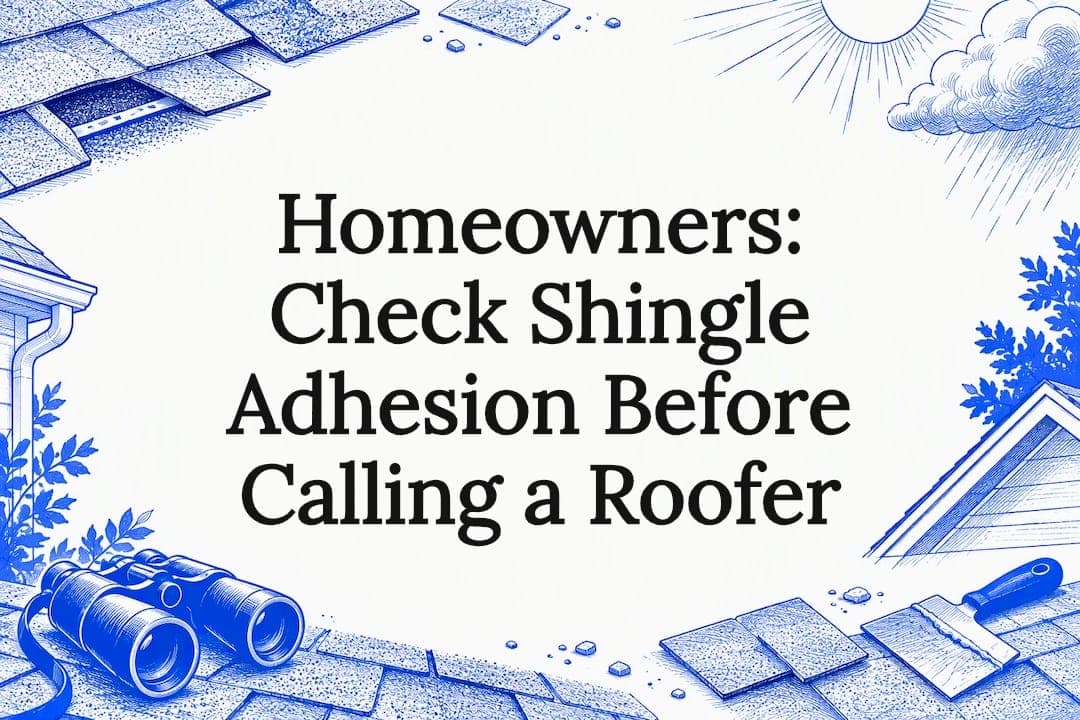
Shingle adhesion loss happens when the factory sealant strip that bonds one shingle to the next fails, leaving tabs loose and the roof vulnerable to wind uplift. Once that bond breaks, wind can get under the shingle edge and peel back entire sections during a storm. If you notice lifted tabs, start with a visual inspection and resist the urge to glue them down with whatever caulk is in the garage.
TL;DR:
- IBHS testing found wind performance begins declining between years five and ten; north facing, low slope planes may receive too little sun to seal.
- Inspect tabs, curled edges, missing shingles, and high nails from the ground, and photograph affected areas; avoid climbing steep roofs or handling brittle shingles.
- For intact, unsealed tabs, apply small dabs of roofing cement approved by the manufacturer under each tab; replace cracked shingles rather than resealing them.
- Preservation suits roofs with sound shingle mats and decking, limited granule loss, and localized lift; widespread failure, rot, or bare areas may require replacement.
Table of Contents
- What causes shingle sealant to fail?
- How sealant strips bond and why aging changes the chemistry
- What to check for: an inspection checklist
- Fixing and preventing adhesion loss the right way
- When preservation beats replacement
- How Green Soy Technology restores shingle flexibility
- Preservation versus replacement: the cost and lifespan math
- Why Florida's climate accelerates adhesion loss
- What makes a roof a good candidate for preservation
- Early inspection beats waiting for the next storm
- Shingle Roof Renewal: a free assessment before you call a roofer
- FAQ
- Sources
What causes shingle sealant to fail?
Adhesion loss rarely has one cause. Most of the time, it is a combination of how the roof was installed, how old it is, and what kind of weather it has absorbed over the years.
- Factory sealant never activated: shingles installed in cold weather, or on north-facing slopes with limited direct sun, may not get enough heat to trigger the bond.
- Aging and oxidation: IBHS long-term testing shows wind performance typically starts declining somewhere between year five and year ten as the asphalt hardens and loses flexibility.
- Installation errors: high-nailing, crooked courses, missing starter strips, or thin underlayment all weaken the overall adhesion system, independent of the sealant itself.
- Temperature shocks: sudden storms can drop roof surface temperatures fast, stressing shingles that are already brittle.
- Dust and debris: grit sitting on an unsealed strip can create a permanent barrier between the shingle layers, blocking the bond even after the weather warms up.
Products from different manufacturers age at very different rates, so two roofs on the same block can show completely different symptoms after the same number of years in the sun.
How sealant strips bond and why aging changes the chemistry
Factory-applied sealant is an asphalt-based adhesive that needs heat to activate, according to ARMA's guidance on sealants. Sunlight warms the shingle surface, softens the sealant strip, and presses it against the shingle below to form the bond that keeps tabs flat during wind events.

As asphalt ages, it oxidizes and hardens. That process raises the temperature needed to reactivate the sealant, so a strip that bonded easily in its first summer may barely soften at all a decade later. Two testing standards matter here: ASTM D7158 classifies shingles by wind resistance, including how well the sealant resists uplift during the classification tests, while ASTM D6381 governs in-place field testing with tools like the Quad-Pod to measure actual seal strength on an existing roof, as described in Roofing Contractor's coverage of in-place testing.
IBHS testing has identified sealant unsealing as the single greatest driver of wind vulnerability in asphalt shingle roofs. North-facing and low-slope planes often underperform because they receive less direct sun, which means less heat to drive the initial bond.
What to check for: an inspection checklist
A careful look from the ground, and a closer one from a ladder when it is safe, can tell you a lot about adhesion loss before a storm tests the roof for you.
- Scan each slope for creased or curled tabs, shingles missing from a course, and patches of bare, granule-stripped surface.
- Check north-facing and steep slopes first, since these areas commonly receive less solar activation.
- Gently lift the edge of a tab near the rake, eave, or hip to feel whether it releases easily or resists.
- Look for installation clues: nails sitting high above the sealant line, no visible starter strip at the eaves, or courses that drift out of alignment.
- Photograph every affected area, note the roof plane and approximate square footage, and keep the images organized for an insurance adjuster or repair estimate.
Pro Tip: Do the finger-lift test in the cool part of the morning, when shingles are less pliable and less likely to be damaged by handling.
Skip this entirely if the roof pitch is steep or the shingles feel brittle underfoot. A visual check from the ground or a pair of binoculars is safer and still catches most of the obvious signs.
Fixing and preventing adhesion loss the right way
Prevention starts at installation. Shingles should go down in moderate temperatures, with correct nail placement, a proper starter strip at the eaves, and underlayment that matches the manufacturer's specifications. Skipping any of these steps weakens the whole adhesion system, no matter how good the shingle itself is.
When sealant never activated in the first place, hand-sealing is the accepted fix. ARMA and IBHS both point to hand-sealing as appropriate on steep slopes or after cold-weather installs, using manufacturer-approved roofing cement applied in small dabs under the tab, never as a surface coating.
- Use only roofing cement rated for shingle application, applied sparingly under each tab.
- Avoid general-purpose caulks or construction adhesives, which can react with the asphalt and accelerate delamination.
- Re-nail any high-nailed shingles instead of just sealing over the problem.
- Replace individual tabs or courses when the shingle itself has cracked or lost its granule coating, rather than trying to reseal damaged material.
Pro Tip: If more than a few courses show adhesion loss, treat it as a signal to get a full roof inspection rather than patching tab by tab.
Incompatible adhesives are a common and avoidable mistake. Industry guidance on in-place testing warns that the wrong cement can chemically interact with the shingle mat and cause faster deterioration than leaving the shingle alone. When adhesion loss is widespread rather than isolated to a few tabs, a professional repair, or a preservation assessment, makes more sense than a tube of cement and a ladder.
When preservation beats replacement
Not every roof with adhesion loss needs to be torn off. Roofs with early-to-moderate adhesion loss, where the shingle mat is still structurally sound but has lost flexibility, are often good candidates for preservation rather than full replacement.
We follow a process with inspection, condition assessment, and qualification for roof renewal. That sequence matters because not every roof is a fit, and an honest qualification step protects you from paying for a treatment that will not hold.
For qualifying roofs, preservation aims to:
- Restore flexibility to shingles that have hardened with age.
- Reduce ongoing granule shedding.
- Extend the usable life of the existing roof rather than replacing it outright.
Qualification depends on the roof's current condition, which is why an on-site assessment comes before any recommendation.
How Green Soy Technology restores shingle flexibility
Fresh Roof's Green Soy Technology is a soy-based treatment designed to penetrate the shingle at a molecular level rather than sit on top of it as a coating. Once absorbed, it works to resoften the asphalt that has hardened through years of oxidation, restoring some of the flexibility the shingle had when it was new.
That restored flexibility matters directly for adhesion. A brittle shingle cracks and curls instead of lying flat, which keeps wind from finding an edge to grab. Softer, more pliable shingles also hold their granule coating better, which slows the sun damage that caused the hardening in the first place. The treatment is also formulated with fire safety in mind, and because it is soy-based, it fits a preservation approach that keeps usable shingles out of the landfill instead of sending them to a tear-off.
This is not the same as a generic rejuvenation oil sprayed on the surface. The distinction matters because surface treatments can leave the shingle looking refreshed while doing little for the hardened asphalt underneath, which means the adhesion problem returns on the same timeline. A treatment that reaches deeper into the shingle has a better chance of addressing the actual cause of brittleness rather than masking it.
Preservation versus replacement: the cost and lifespan math
Full roof replacement for a typical South Florida home can be a significant expense, which often causes homeowners to delay action even when their roof still has useful life left. Preservation exists as a middle option for roofs that qualify, aiming to restore performance without that bill.
Say a roof is seven years into what should be a 20-year shingle life, and inspection shows adhesion loss limited to a few slopes rather than throughout the whole structure. Replacing that roof means paying full price for a tear-off years before the shingles were actually worn out. Treating it, when it qualifies, aims to add years back to a roof that still has sound decking and a structurally intact shingle mat, at a fraction of the replacement cost.
The environmental math follows the same logic. Every roof that gets preserved instead of torn off is one less load of asphalt shingles going into a landfill, which lines up with a preventative approach to roofing rather than a replace-first one. For homeowners weighing a near-term expense against a long-term one, the qualification step is what determines whether preservation is the lower-cost, lower-waste path or whether replacement is genuinely the right call.
Why Florida's climate accelerates adhesion loss
Few climates are harder on asphalt shingles than South Florida's. Intense UV exposure bakes the asphalt day after day, driving the oxidation that hardens shingles and raises the temperature needed to reactivate any sealant that never bonded properly. Add near-daily summer heat cycling and the aging process runs faster here than it does in milder climates.
Storm frequency compounds the problem. Rapid temperature swings during convective storms can shock a shingle surface that was baking in full sun minutes earlier, and IBHS has documented roof-face temperature drops of roughly 50 degrees Fahrenheit during these events. That kind of swing stresses shingles that have already lost some flexibility, and it arrives at the exact moment wind loads are highest.

The result is a roof that ages on an accelerated schedule compared to the same product installed somewhere with milder sun and fewer storms. For more on how these mechanisms play out specifically for local roofs, see our breakdown of why Florida asphalt roofs fail and how to extend their life. The practical takeaway is that a roof's age in years tells you less in this climate than a direct inspection of its current flexibility and sealant condition.
What makes a roof a good candidate for preservation
Qualification is not a formality. It is the step that separates a roof that will genuinely benefit from preservation from one that actually needs replacement, and it starts with a hands-on inspection rather than a guess based on the roof's age.
Key criteria we look at include:
- Shingle mat condition: the underlying fiberglass or organic mat needs to be intact, without widespread cracking through to the backing.
- Extent of granule loss: light to moderate granule loss is often workable, but bare patches exposing the asphalt mat across large areas point toward replacement.
- Decking condition: soft spots, rot, or structural sag underneath the shingles are a replacement signal regardless of how the shingles themselves look.
- Pattern of adhesion loss: isolated tab lift on a few slopes behaves differently than adhesion failure across the entire roof.
- Prior repair history: roofs patched repeatedly with incompatible cements may have localized damage that limits how much a restorative treatment can help.
A roof that passes this kind of review is one where restoring flexibility can meaningfully extend its service life. A roof that does not pass is better served by an honest recommendation to replace, which is why the assessment comes before any treatment, never after.
Early inspection beats waiting for the next storm
The biggest mistake homeowners make with shingle adhesion loss is waiting until a storm forces the issue. A roof that gets inspected at the first sign of lifted tabs has options that a roof inspected after wind damage does not.
Catching adhesion loss early protects your wallet and keeps usable material out of a landfill. Use manufacturer-approved materials and qualified professionals for any repair, since the wrong adhesive can do more harm than the original problem.
— Daniellison
Shingle Roof Renewal: a free assessment before you call a roofer
If your shingles are showing adhesion loss, you do not have to jump straight to a full tear-off. Our free roof assessment gives you a clear, honest read on where your roof stands before you spend a dollar on replacement.
- We inspect the roof in person, checking sealant condition, granule loss, and decking.
- We assess whether the shingles have the flexibility and structure needed for preservation.
- We tell you plainly whether your roof qualifies for renewal or whether replacement is the better call, including a cost comparison against full replacement.
We serve homeowners in areas where sun and storm exposure put extra strain on asphalt shingles. If a professional look at your roof sounds like the right next step, schedule a free roof assessment and find out where your roof actually stands.
FAQ
Is granular loss on shingles normal?
A small amount of granule loss is normal as asphalt shingles age, since granules shed gradually over the roof's service life. Heavy or patchy granule loss that exposes the asphalt mat underneath signals accelerated aging or adhesion problems and is worth a professional look.
How do you restick lifted shingles?
Hand-sealing with a small dab of manufacturer-approved roofing cement under the tab is the standard fix recommended by ARMA, particularly for steep slopes or shingles installed in cold weather. General-purpose caulks and construction adhesives should be avoided, since incompatible products can accelerate deterioration rather than fix the bond.
Is granular loss on a roof covered by insurance?
Coverage depends on the cause and your specific policy, since most insurers distinguish between gradual wear, which is typically excluded, and sudden storm damage, which may be covered. Check your policy language and document the affected areas with photos before filing a claim.
What assessment framework determines if a roof qualifies for preservation?
Qualification is based on the physical condition of the roof rather than its age alone, looking at shingle mat integrity, extent of granule loss, decking condition, and the pattern of adhesion loss across the roof. A professional on-site assessment is the only reliable way to determine whether a specific roof is a good candidate for preservation or needs replacement.
Sources
- IBHS research reveals critical links in asphalt shingle wind performance after 10 years of aging
- Sealants: The magic touch (Asphalt Roofing Manufacturers Association)
- In place shingle testing | Roofing Contractor