

TL;DR:
- Deep roof penetration involves ensuring nails and structural openings reach proper depths to secure shingles and prevent leaks, especially in hurricane-prone South Florida. Proper nail depth, sealing, and flashing detail are critical to avoid costly water damage, shingle blow-off, and insurance issues. Regular professional inspections and high-quality sealants help maintain roof integrity and extend its lifespan in challenging climates.
Deep roof penetration is defined as the required depth that roofing nails or structural openings must reach through roof layers to secure asphalt shingles and maintain a watertight seal. For South Florida homeowners, this concept is not abstract. It directly determines whether your roof survives the next hurricane season or fails quietly during a summer rainstorm. Understanding penetration depth, industry standards, and the risks of poor detailing gives you the knowledge to assess your roof before a small problem becomes a $15,000 replacement.
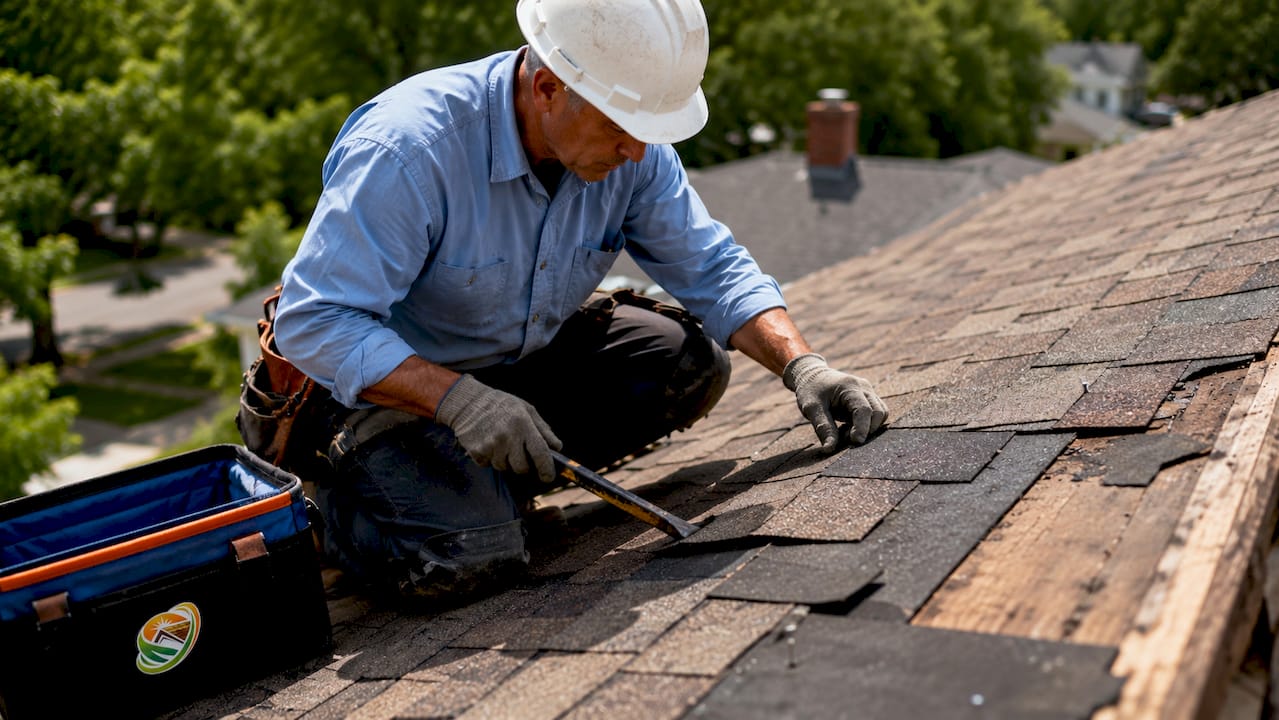
What is deep roof penetration for asphalt shingles?
Deep roof penetration refers to two related but distinct concepts in roofing. The first is nail penetration depth, meaning how far a roofing nail must drive through shingles and into the roof deck. The second is structural penetration, meaning any opening cut through the roof for vents, pipes, or HVAC units. Both types must meet specific standards to protect your home.
The industry term you will hear from roofing professionals is "penetration depth" for nails and "roof penetration detailing" for openings. Both fall under what homeowners commonly search for as deep roof penetration or deep shingle penetration.
Nail penetration: the depth standard that matters most
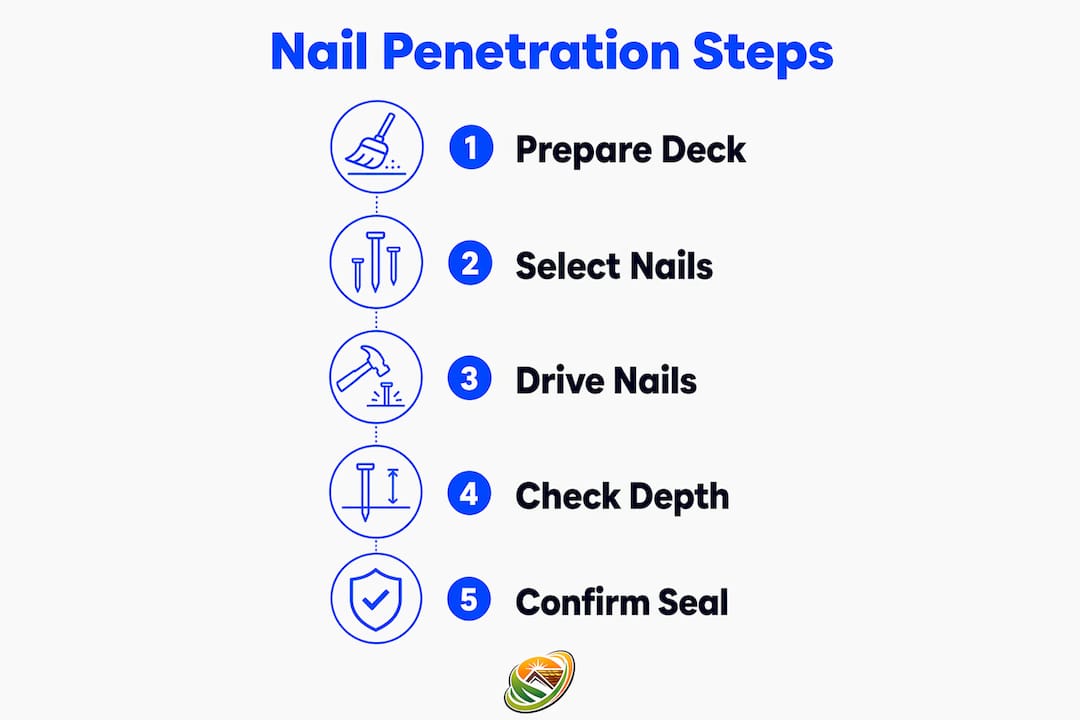
Roofing nails must penetrate at least 3/4 inch into the roof deck to provide structural holding power. If the decking is thinner than 3/4 inch, the nail must pass at least 1/8 inch beyond the underside of the sheathing. That minimum depth is not a suggestion. It is the threshold between a shingle that holds and one that lifts in a 90 mph wind.
In South Florida's High Velocity Hurricane Zones, the standard goes further. HVHZ building codes require six nails per shingle using ring-shank nails that fully penetrate the deck. This is a legal requirement tied directly to your roof warranty and insurance compliance. A roof nailed with four smooth-shank nails at shallow depth may look fine from the street but will not pass a post-storm inspection.
Pro Tip: Ask your roofer or inspector to confirm the nailing pattern and nail type used on your roof. Ring-shank nails with full deck penetration are required in Broward and Palm Beach counties under HVHZ code.
Correct vs. incorrect penetration depth: a quick comparison
| Condition | Nail Depth | Impact |
|---|---|---|
| Correct penetration | 3/4 inch or more into deck | Strong hold, wind resistance, warranty valid |
| Under-driven nail | Less than 3/4 inch | Reduced holding power, shingle lift risk |
| Over-driven nail | Nail head breaks shingle surface | Seal failure, water entry point, granule loss |
| Flush-driven nail | Nail head sits flat on shingle | Optimal seal integrity and holding power |
Roofing nails must be driven flush, meaning neither under-driven nor over-driven, to maintain seal integrity. Over-driven nails are just as damaging as shallow ones. They break the shingle surface, create a direct water entry point, and reduce the holding power that keeps your roof attached during a storm.
How do non-nail roof penetrations affect waterproofing?
Structural roof penetrations include plumbing vents, exhaust stacks, HVAC units, attic fans, and skylights. Every one of these openings is a potential failure point if not properly detailed and sealed. The penetration itself is not the problem. The problem is always the detailing around it.
Poor penetration detailing causes over 75% of flat roof failures. That statistic applies to commercial flat roofs, but the principle holds for residential asphalt shingle roofs in South Florida. Every unsealed gap around a vent pipe or HVAC curb is an open invitation for water.
Common roof penetrations and how they should be sealed
- Plumbing vent pipes: Require a rubber boot flashing that fits tightly around the pipe. The boot must be UV-resistant and replaced every 10–15 years in Florida's climate.
- HVAC units and curbs: Need metal flashing with a minimum 4-inch overlap between base and counter flashing to prevent wind-driven rain from getting underneath.
- Exhaust vents and attic fans: Require step flashing integrated into the shingle courses, not just caulk applied over the top.
- Skylights: Need full flashing kits with both step and counter flashing, plus a continuous bead of ASTM C920-rated sealant at all joints.
Florida's heat creates a specific challenge that homeowners rarely think about. Flashing materials and asphalt shingles expand at different rates under intense sun. A rigid sealant that works fine in a northern climate will crack within one or two summers in South Florida. Only flexible, UV-stable sealants maintain a watertight bond through repeated thermal cycling.
Pro Tip: Never let a contractor seal a roof penetration with standard hardware store caulk. Require ASTM C920-rated sealant specifically formulated for roofing applications. The difference in lifespan is measured in years, not months.
What problems does inadequate penetration depth cause?
Improper nail penetration and poor penetration sealing share the same outcome: water gets in. The damage that follows is expensive and often hidden until it is severe.
-
Water intrusion and mold growth. Unsealed penetrations can cause water damage costing up to $12,000 per incident. Mold growth follows within 24–48 hours of sustained moisture exposure, affecting indoor air quality and requiring remediation on top of roof repairs.
-
Shingle lift and blow-off. Under-driven nails with less than 3/4 inch penetration lose holding power in high winds. During a tropical storm, shingles with shallow nail penetration are the first to lift, exposing the deck to direct rain.
-
Insurance claim denial. Improper penetration detailing that fails to meet fire-stop codes can result in denied insurance claims. Insurers in Florida increasingly require proof of code-compliant installation before paying out storm damage claims.
-
Granule loss acceleration. Over-driven nails that break the shingle surface accelerate granule loss around the nail head. Granules protect the asphalt layer from UV degradation. Once they are gone in a concentrated area, that section of shingle deteriorates faster than the rest.
-
Deck rot. Slow leaks around penetrations rarely announce themselves. Water seeps under flashing, saturates the decking, and causes rot that may not be visible until a roofer pulls up shingles during an inspection.
"Homeowners often confuse a roof penetration with a leak. The penetration is not the problem. The failure of the seal around it is." This distinction matters because it changes where you look and what you fix.
Symptoms you can watch for include water stains on ceiling drywall below vents or skylights, soft spots on the roof surface near penetrations, and granule buildup in gutters concentrated in one area. Any of these signs warrants a professional assessment, not a DIY patch.
How to assess and maintain roof penetrations in South Florida
Knowing what to look for is the first step toward protecting your roof. A proper assessment covers both nail penetration quality and the condition of every structural opening on the roof.
- Look at nail heads during any roof access. Nail heads should sit flush with the shingle surface. Raised nail heads indicate under-driven nails. Dimpled or cracked shingle surfaces around nails indicate over-driving.
- Inspect flashing at every penetration. Flashing should lie flat, show no rust or separation, and have no visible gaps at joints. Lifted edges are a red flag.
- Check sealant condition. Sealant around pipe boots, HVAC curbs, and exhaust vents should be continuous, flexible, and free of cracks. Chalky or brittle sealant has failed.
- Use thermal imaging for hidden moisture. Thermal imaging and moisture meters detect compromised seals before visible damage appears. This is the most reliable way to find slow leaks early.
- Get a professional evaluation before any retrofit. Adding or modifying penetrations in an existing roof disrupts the thermal and moisture envelope. Professional assessment prevents water pooling caused by altered drainage patterns.
The role of certified roof applicators is critical here. A certified professional understands local code requirements, knows which sealants perform in Florida's climate, and can identify penetration issues that an untrained eye will miss. DIY repairs with non-certified materials consistently fail faster in South Florida's heat and humidity.
A recommended maintenance schedule for South Florida homes includes a professional roof inspection every 12 months, a visual self-check after every named storm, and sealant replacement around all penetrations every 5–7 years. Ask your roofing professional specifically about HVHZ nailing compliance and whether your current flashing meets the 4-inch overlap standard.
Key Takeaways
Deep roof penetration is the single most overlooked factor in asphalt shingle roof longevity, and getting it right from installation through maintenance determines whether your roof lasts 15 years or 30.
| Point | Details |
|---|---|
| Nail depth standard | Roofing nails must reach at least 3/4 inch into the deck to hold shingles in high winds. |
| HVHZ code compliance | South Florida requires six ring-shank nails per shingle with full deck penetration for warranty and insurance validity. |
| Penetration detailing | Poor sealing around vents and pipes causes over 75% of roof failures at penetration points. |
| Water damage cost | Unsealed penetrations can cause up to $12,000 in water damage per incident, plus mold remediation costs. |
| Maintenance priority | Annual professional inspections and ASTM C920-rated sealants are the most cost-effective way to protect penetrations long-term. |
What I have learned after years of watching South Florida roofs fail
By Daniellison
Most homeowners I talk to assume their roof is either fine or needs replacing. Very few think about the middle ground, and that is exactly where penetration problems live. A roof can look solid from the ground and still have three failed pipe boot seals, a dozen over-driven nails, and flashing that has been separating for two rainy seasons.
The biggest misconception I see is that a penetration equals a leak. It does not. A properly detailed penetration is watertight for decades. The failure is always in the execution: wrong sealant, wrong nail depth, wrong flashing overlap. These are installation and maintenance failures, not design flaws.
South Florida makes this harder than most places. The sun degrades sealants faster. The heat cycles stress flashing joints daily. Hurricane season tests every weak point simultaneously. A roof that would last 25 years in Georgia might show penetration failures in 10 years here without proper maintenance.
My honest recommendation: do not wait for a ceiling stain to call someone. By the time water shows up inside your home, the damage behind the drywall is already significant. A professional roof assessment costs a fraction of what water remediation costs. Get one before the next storm season, not after.
— Daniellison
Is your roof ready for what South Florida throws at it?

Shingleroofrenewal specializes in exactly this kind of early detection. We inspect asphalt shingle roofs across Broward and Palm Beach counties, assess penetration conditions, nail patterns, flashing integrity, and overall shingle health, then tell you honestly whether your roof qualifies for preservation or needs professional repair. Our certified Fresh Roof Green Soy Technology restores shingle flexibility at the molecular level, extending roof life by 10–15 years for qualifying roofs. Most homeowners we work with save thousands compared to full replacement. Schedule your free inspection at Shingleroofrenewal and find out where your roof actually stands before you call a roofer.
FAQ
What is the minimum nail penetration depth for asphalt shingles?
Roofing nails must penetrate at least 3/4 inch into the roof deck, or pass at least 1/8 inch beyond the underside of decking thinner than 3/4 inch. In South Florida's HVHZ zones, ring-shank nails with full deck penetration are legally required.
What causes most roof leaks at penetration points?
Leaks at penetrations are caused by failed sealants, improper flashing installation, or missing overlap coverage, not by the penetration itself. Proper detailing with ASTM C920-rated sealants and a minimum 4-inch flashing overlap prevents the vast majority of these failures.
Can I seal a roof penetration myself?
DIY repairs with standard store-bought caulk fail quickly in Florida's climate. Professional repairs require ASTM C920-rated sealants and must restore any fire-stop ratings that were disrupted. Improper DIY repairs can also void your roof warranty and create grounds for insurance claim denial.
How often should roof penetrations be inspected in South Florida?
South Florida homeowners should have penetrations professionally inspected every 12 months and after every named storm. Sealant around pipe boots, HVAC curbs, and exhaust vents typically needs replacement every 5–7 years due to UV degradation and thermal cycling.
How does nail penetration depth affect my roof warranty?
Shallow or over-driven nails that do not meet HVHZ code requirements can void your manufacturer's shingle warranty and disqualify storm damage claims with your insurer. Code-compliant nail depth and pattern are documented requirements in Broward and Palm Beach county building codes.