
Actual cash value pays you what your roof is worth today, after depreciation. Replacement cost value pays what it costs to install a new roof, no depreciation deducted. For a homeowner filing a claim, that difference between ACV vs RCV roof coverage can mean thousands of dollars, sometimes forcing you to cover the rest yourself if you're on an ACV policy with an aging roof. If that gap worries you, the fix is either an RCV endorsement, a close read of your declarations page, or a preservation inspection to extend your roof's life before you ever need to file.
TL;DR:
- Many policies specify that roofs are valued as ACV, meaning depreciation is deducted upfront, which can significantly reduce your initial payout compared to RCV.
- Roof depreciation is calculated based on expected lifespan, actual age, condition, and maintenance, with recoverable depreciation available if the policy is RCV.
- The difference between ACV and RCV can reach up to $10,000 for a $15,000 roof, depending on depreciation and claim process timing.
- Checking your policy's declarations page and securing a contractor estimate beforehand are critical steps to understand and maximize your claim recovery.
- Roof preservation inspections can extend roof lifespan, qualify for renewal, and potentially save up to 80 percent compared to full replacement costs.
Table of Contents
- ACV vs RCV Roof Coverage: What the Terms Actually Mean
- How Do Insurers Calculate Roof Depreciation?
- How Insurers Pay Out Roof Claims, Step by Step
- What Does an ACV vs RCV Roof Payout Look Like in Dollars?
- How to Check Whether Your Roof Is ACV or RCV
- Why Roof Preservation Changes Your Financial Exposure
- Why Do ACV vs RCV Roof Disputes Happen So Often?
- Do ACV and RCV Roof Rules Vary by State?
- Does a Code Upgrade Affect Your RCV Roof Payout?
- A Homeowner's Rule of Thumb on ACV vs RCV
- Consider a Preservation Inspection Before You File a Claim
- Sources
ACV vs RCV Roof Coverage: What the Terms Actually Mean
Actual cash value is replacement cost minus depreciation. If your 18-year-old roof would cost $16,000 to replace new, ACV subtracts an amount tied to how much useful life the roof has already used up, then pays you the remainder. Replacement cost value skips that subtraction. It pays what a new roof actually costs, materials and labor, at today's prices.
Here's where it gets tricky. Many homeowners insurance policies use RCV for the dwelling structure but default to ACV specifically for the roof, treating it as a separate, faster-aging component. This isn't universal, but it's common enough that you can't assume your whole-house RCV coverage automatically applies to your shingles.
A few things determine which one applies to your roof:
- Whether your policy has a roof-specific endorsement or exclusion
- Your roof's age relative to insurer thresholds, commonly 15 to 20 years
- The roofing material (asphalt shingles depreciate differently than metal or tile)
- State rules that limit or require certain roof valuation practices
The National Association of Insurance Commissioners explains this distinction plainly: replacement cost coverage pays to rebuild without deducting depreciation, while actual cash value pays only the depreciated worth at the time of the loss.
How Do Insurers Calculate Roof Depreciation?
Depreciation isn't a guess. Adjusters typically calculate it using the roof's expected useful life (asphalt shingles are often rated for 20 to 25 years), its actual age, and its condition at the time of the claim. A 12 year old roof rated for 25 years has used up roughly half its expected life, so an adjuster may depreciate the payout by close to that proportion.
- Expected useful life of the material
- Current age of the roof
- Wear, granule loss, and prior storm damage
- Maintenance history, when documented
Under RCV policies, insurers often withhold part of the payment as recoverable depreciation. That withheld amount isn't lost. You can collect it after completing the repair and submitting proof, like a contractor invoice. Under ACV, there's no second check. The depreciation deduction is final.
Pro Tip: Ask your adjuster directly whether your depreciation is recoverable or non-recoverable. Those two words on your claim paperwork determine whether you'll ever see that withheld money again.
The older the roof, the bigger this gap gets.
How Insurers Pay Out Roof Claims, Step by Step
Whether you're on ACV or RCV, the first check rarely covers everything. Understanding the sequence keeps you from being caught off guard.
- Initial payment. Under ACV, you receive the depreciated value minus your deductible, and that's the full settlement. Under RCV, you receive that same depreciated amount first, with the remainder held back as recoverable depreciation.
- Repair and documentation. You hire a contractor, complete the work, and submit invoices or receipts proving the job was done and what it cost.
- Second payment. The insurer releases the recoverable depreciation, closing the gap between your initial check and full replacement cost.
The trap: many RCV policies set a deadline to complete repairs and file for that second payment. Miss it, and the recoverable depreciation can become permanently unrecoverable. Homeowners who accept the first check and delay repairs, thinking they'll get to it eventually, are the ones who lose that money.
What Does an ACV vs RCV Roof Payout Look Like in Dollars?
Numbers make this concrete faster than definitions do. Picture a $15,000 roof replacement with a $1,000 deductible, which is close to the example the NAIC uses to illustrate the difference. Say depreciation on this roof is calculated at $10,000.
| Payout stage | RCV policy | ACV policy |
|---|---|---|
| Full replacement cost | $15,000 | $15,000 |
| Depreciation deducted | $0 (recoverable, withheld temporarily) | $10,000 (permanent) |
| Deductible | $1,000 | $1,000 |
| Initial check | $10,000 | $10,000 |
| Second check after repairs | $10,000 | $0 |
| Total received | $15,000 | $10,000 |
That's a $10,000 difference for the identical roof, the identical damage, and the identical deductible. The only variable is the valuation method written into the policy. Under RCV, that final $10,000 only arrives after you've completed the repair and sent proof to the insurer, which is why the paperwork step matters as much as the coverage type itself.
How to Check Whether Your Roof Is ACV or RCV
Your policy's declarations page is the single source of truth here, not the summary your agent emailed you three years ago. Look specifically for a section labeled "roof surfacing" or "roof coverage" separate from the main dwelling coverage line. If it lists a different valuation method than the rest of your policy, that's your answer.
- Search the declarations page for any roof-specific endorsement or exclusion
- Check for a separate roof deductible, sometimes a percentage rather than a flat dollar figure
- Confirm whether depreciation is marked recoverable or non-recoverable
- Note your roof's installation date against any age threshold the insurer applies
Call your agent and ask two direct questions: does my roof carry ACV or RCV, and if it's ACV, is an RCV endorsement available for a premium adjustment? Many carriers offer RCV roof endorsements for younger roofs but revert to ACV once the roof crosses a certain age, so timing your request matters.
Pro Tip: Get a written contractor estimate before you file any claim, even before damage happens if you suspect your roof is aging. That number becomes your leverage with the adjuster and your proof when collecting recoverable depreciation later.
If switching to RCV isn't available or costs more than you want to pay, a preservation inspection is worth scheduling anyway. It tells you exactly how much life your current shingles have left.
Why Roof Preservation Changes Your Financial Exposure
Every year you extend a roof's serviceable life is a year further from that steep ACV depreciation curve. Restoring shingle flexibility can slow the cracking and granule loss that pushes insurers toward ACV reclassification in the first place, which delays the point where a claim becomes financially painful.
Shingleroofrenewal's inspection process checks granule retention, shingle flexibility, and existing cracking to determine whether a roof still qualifies for renewal instead of full replacement. Homeowners who qualify have saved up to 80% versus a full tear off, backed by a 6 year transferable warranty. That's not an insurance product. It's a way to push your replacement date further out, on your own terms, rather than an adjuster's depreciation schedule.
Why Do ACV vs RCV Roof Disputes Happen So Often?
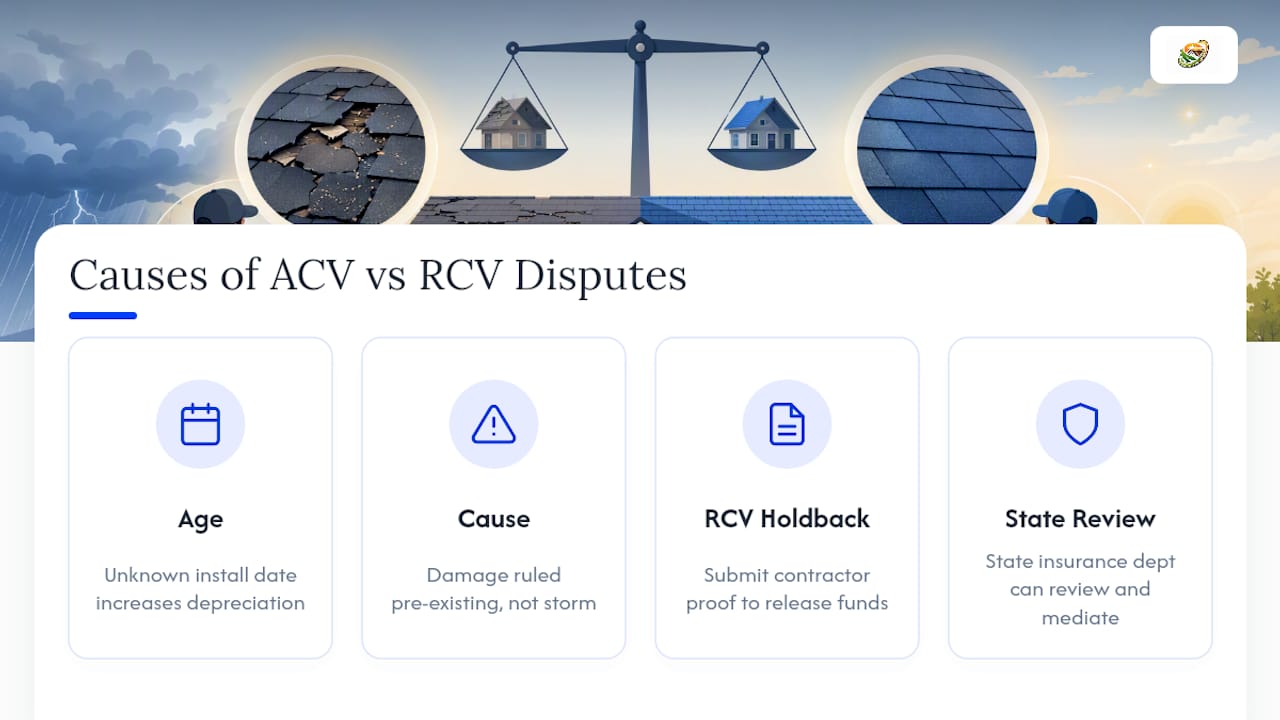
Roof claims generate more insurer pushback than almost any other homeowners insurance category, and most disputes trace back to one of three disagreements.
The first is age. Insurers and homeowners frequently disagree about how old a roof actually is, especially after a home changes hands without complete records. If your closing documents don't specify installation date, expect the insurer to estimate conservatively, which usually means a higher depreciation deduction than you'd get with paperwork in hand.
The second is condition versus cause of loss. Adjusters sometimes attribute damage to "wear and tear" or pre-existing deterioration rather than a covered storm event, which can shrink or void a claim entirely. This is where photos and maintenance records from before the loss become valuable. A homeowner who can show a roof was well maintained right up until a hailstorm has a stronger position than one who can't.
The third is the recoverable depreciation holdback itself. Homeowners on RCV policies sometimes assume the first check is the final one, cash it, and never submit contractor proof to release the rest. When they realize months later that more money was available, the repair deadline has often already passed. This isn't usually bad faith on the insurer's part. It's a paperwork step that gets buried in a stressful, unfamiliar process.
When a genuine dispute arises over valuation method or depreciation math, your state insurance department's consumer division can review the claim file and, in some cases, mediate. That's a stronger path than arguing with a call center.
Do ACV and RCV Roof Rules Vary by State?
They do, and the variation is bigger than most homeowners expect. Some states restrict how aggressively insurers can apply ACV to roofs, or require insurers to offer an RCV option even on older roofs. Other states, especially those exposed to frequent hail or hurricane losses, allow insurers wide latitude to write roof-specific ACV endorsements regardless of the rest of the policy.
A handful of states also regulate how roof depreciation must be calculated, requiring insurers to use documented useful-life tables rather than an adjuster's discretion. Others leave that calculation largely up to the carrier's internal guidelines, which is part of why two homeowners with similar roofs in different states can get very different settlement offers for comparable damage.
Coastal and storm-prone states tend to have the most detailed roof-specific rules, simply because roof claims are more frequent there and insurers have pushed for more predictable underwriting language. The Texas Department of Insurance publishes consumer guidance with sample payout tables showing exactly how depreciation scales with roof age, and most state insurance departments offer something similar.
Your best move is checking your own state insurance department's consumer page rather than relying on generic national advice, because the rules genuinely differ enough to change your outcome.
Does a Code Upgrade Affect Your RCV Roof Payout?
Building codes change, and older roofs often don't meet current requirements for underlayment, ventilation, or wind resistance. When a covered loss requires you to rebuild, local code may force upgrades your original roof never had, and that creates a payout wrinkle worth understanding before you file.
Standard RCV coverage typically pays to replace what you had, matching the prior roof's materials and specifications. It does not automatically cover the cost difference created by mandatory code upgrades. That gap is covered separately by an endorsement often called "ordinance or law" coverage, which pays for the additional cost of bringing a rebuilt structure up to current code.
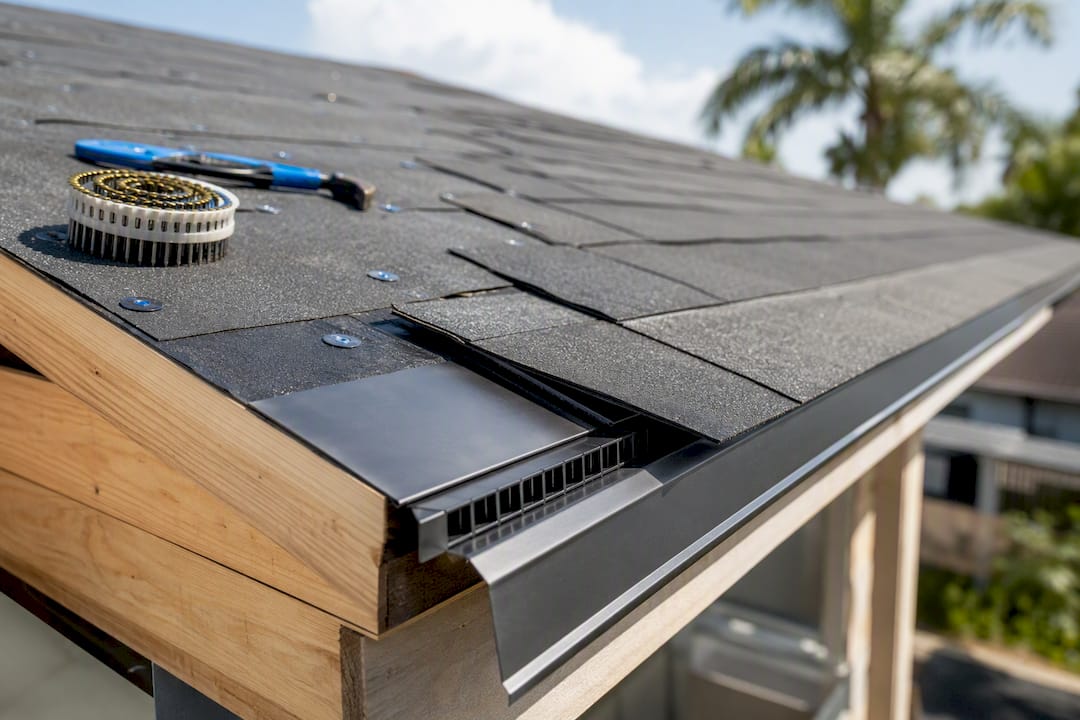
Without that endorsement, a homeowner on RCV can still end up paying out of pocket for upgraded decking, better fasteners, or updated flashing that code now requires, even though the base roof replacement itself is fully covered. This is a common surprise. Homeowners hear "replacement cost" and assume it means everything necessary to legally rebuild, when it often means only replacing what was already there.
If your home is in an older neighborhood or your roof predates recent code revisions in your area, ask your agent specifically about ordinance or law coverage limits. It's usually a small percentage add-on to your dwelling coverage, and it's the piece that closes the gap between what RCV pays and what code compliance actually costs.
A Homeowner's Rule of Thumb on ACV vs RCV
If your roof is under ten years old, ACV's lower premium is a reasonable bet since depreciation hasn't eaten much value yet. Past that age, the math flips, and RCV's higher premium usually costs less than the depreciation gap you'd absorb in a claim.
Whichever you carry, pull your declarations page today, get a written contractor estimate on file, and calendar your insurer's repair deadline the moment any claim is approved. Documentation is what turns recoverable depreciation into money you actually collect.
— Daniellison
Consider a Preservation Inspection Before You File a Claim
Shingleroofrenewal is the alternative to a full roof replacement for homeowners in Palm Beach and Broward counties worried about facing an ACV shortfall on an aging roof. Instead of guessing whether your shingles will survive the next depreciation calculation, a free inspection tells you directly whether your roof qualifies for renewal or genuinely needs replacement.

The inspection checks granule loss, shingle flexibility, and existing cracking, the same factors insurers use to justify ACV depreciation in the first place. If your roof qualifies, our Green Soy Technology process restores flexibility and can extend roof life, qualifying homeowners have saved up to 80% compared to full replacement, backed by a 6 year transferable warranty. It also means fewer roofs headed to the landfill before they truly need to be.
Call us before you call the roofer. Schedule your free roof inspection and find out whether preservation can keep you off the ACV depreciation clock entirely. For more on when replacement genuinely is the right call, see our guide on replacing a 20 year old roof.
Sources
For a deeper look at valuation math, see the NAIC's replacement cost versus actual cash value guide, MoneyGeek's ACV vs RCV breakdown, and Roof Policy's recoverable depreciation guide. For a contractor-facing view, The Original Roof Repair Company's insurance policy guide is worth a read. Always confirm current rules with your own state insurance department before filing.
- Rebuilding After a Storm: Know the Difference Between Replacement Cost and Actual Cash Value When It Comes to Your Roof
- How to Collect Recoverable Depreciation | Roof Policy
- Understanding ACV vs. RCV in Homeowners Insurance — MoneyGeek