
Many roofs with brittle shingles can still be saved if the damage is localized, but widespread cracking across multiple slopes usually means replacement is coming. The field "brittle test" you may have heard about is a type of useful evidence but not a definitive pass/fail standard. Its results depend on temperature and can be misinterpreted. Before you do anything else: photograph the damage, note the outdoor temperature, and get a qualified inspection rather than trying a DIY fix that could void a warranty.
TL;DR:
- Widespread cracking, tearing, or delamination across multiple slopes indicates replacing the roof, while localized damage may be repairable or preservable.
- Flexibility tests should be conducted in moderate temperatures and on multiple slopes, with thorough documentation to avoid misinterpretation of surface aging.
- Granule loss, curling tabs, craze cracking, and creases that do not relax all signal aging, but progress varies with exposure, shading, and shingle type.
- Preservation treatments can extend roof life if the asphalt remains structurally sound, but heavily cracked or torn shingles require full replacement.
- Early assessment and intervention improve outcomes, with professional inspections prioritizing visual condition and site-specific signs over informal field tests.
Table of Contents
- Recognizing Brittle Shingles: Visual and Tactile Signs
- Why Shingles Become Brittle: The Material Science in Plain Terms
- How Pros Assess Brittleness: the Field Check, Its Limits, and Better Evidence
- Repairs vs. Replacement: Practical Options and Realistic Limits
- Cost and Timing: How Brittleness Changes Scope and Budget
- Decision Checklist: What to Do Next
- What a Professional Preservation Assessment Actually Involves
- A Quick Note on Timing and Prevention
- See if Your Roof Qualifies for Preservation
- Sources
- FAQ
Recognizing Brittle Shingles: Visual and Tactile Signs
Brittle shingles announce themselves before they fail outright, and knowing what to look for saves you from guessing. The most obvious clue is granule loss: bald patches where the protective ceramic coating has worn away, exposing dark, shiny asphalt underneath. That exposed asphalt degrades faster once it loses its granule shield.
Beyond granule loss, watch for:
- Curling tabs that lift at the edges or corners instead of lying flat
- Craze cracking, a web of fine surface cracks that spreads like dried mud
- Snapping or cracking sounds when a tab is gently lifted, rather than a soft bend
- Creases that won't relax after being pressed flat, a sign the mat has lost elasticity
- Tearing near nail lines, where wind stress concentrates on already-stiff material
Age matters here. South-facing slopes exposed to direct sun tend to show signs of aging sooner than shaded north slopes on the same roof. Architectural shingles with heavier asphalt mats also tend to resist brittleness longer than older three-tab styles, which is worth knowing if you're comparing roof age against symptom severity.
Why Shingles Become Brittle: The Material Science in Plain Terms
Brittleness isn't random wear. It's asphalt chemistry breaking down under sun and heat, and understanding the mechanism helps explain why some roofs age faster than others.
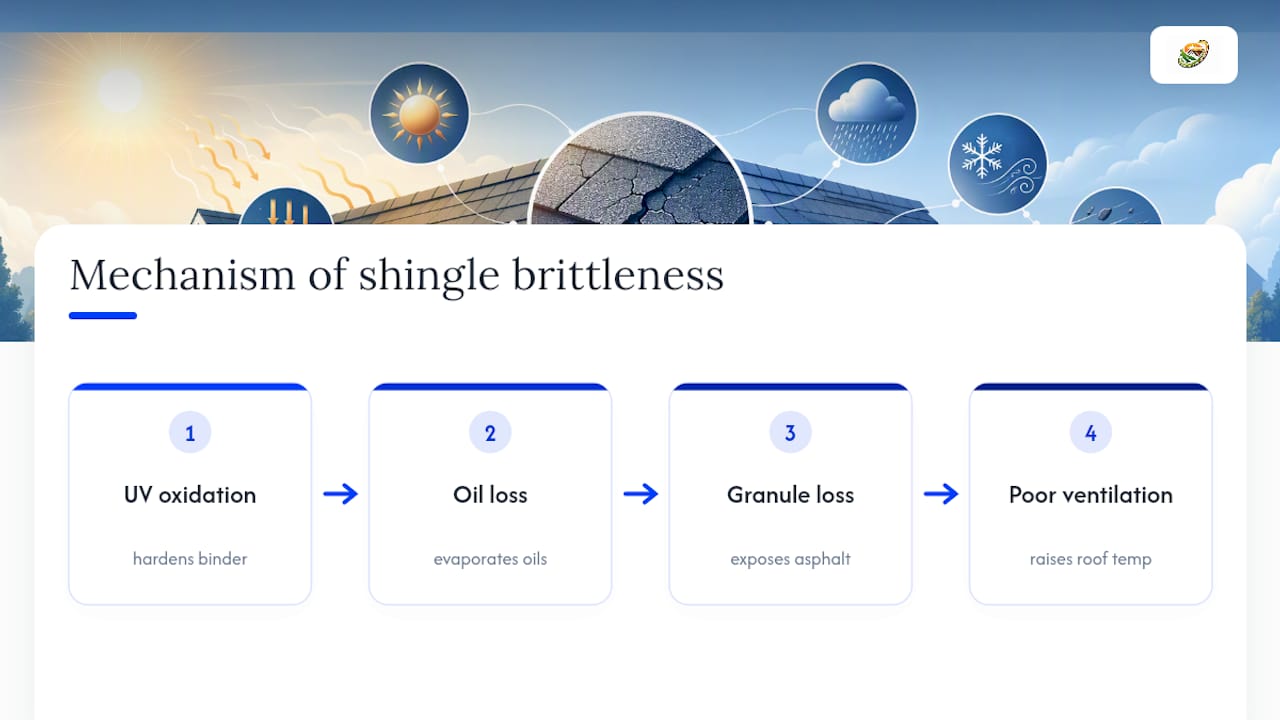
UV exposure oxidizes the asphalt. Sunlight drives a chemical reaction called photo-oxidation, which hardens the surface layer of the shingle. Laboratory work from the National Institute of Standards and Technology found that accelerated weathering creates carbonyl compounds in the asphalt binder that stiffen the material at a molecular level. That stiffening is the root of the cracking you see on the surface.
At the same time, asphalt shingles contain volatile oils that keep the binder flexible. Heat and sun cook those oils off gradually, and as they evaporate, the shingle shrinks slightly and unevenly, producing the fine surface cracks known as craze cracking, according to InterNACHI's inspection guidance on asphalt composition shingles.
Granules do double duty. They shield the asphalt from UV rays, so once a shingle sheds enough granules, the exposed asphalt oxidizes faster, and that acceleration compounds granule loss further. It's a feedback loop, not a one-time event. Poor attic ventilation adds another layer of stress, trapping heat under the roof deck and pushing shingle temperatures well above ambient air temperature on hot days, which speeds every one of these chemical changes.
How Pros Assess Brittleness: the Field Check, Its Limits, and Better Evidence
The brittle test is simple: gently lift a shingle tab and see whether it bends or snaps. It's popular because it's fast and requires no tools. It's also widely misunderstood.
- Pick a moderate temperature window. Cold shingles are stiffer for reasons that have nothing to do with long-term degradation, so testing on a 45-degree morning will make almost any roof look brittle.
- Test multiple, representative slopes. A single check on one sun-baked corner tells you little about the rest of the roof.
- Use a gentle, consistent lift technique. Aggressive prying can crack a perfectly serviceable shingle and create false evidence.
- Document everything. Photograph each test location, note the temperature, and record the result before moving to the next spot.
Here's the part most homeowners never hear: there is no ASTM standard for an outdoor brittle test. Industry critics at IIBEC have called out its widespread misuse, pointing out that results vary with temperature, technique, and even who's doing the testing. A single failed check on a cold morning is not proof a roof needs replacing, and insurance industry commentary has specifically warned adjusters and contractors against treating one informal test as conclusive in a claim.
Pro Tip: If a contractor recommends full replacement based on a single brittle check with no photos, no temperature log, and no second slope tested, ask for a second opinion before you sign anything.
When the stakes are high, whether that's a large insurance claim or a roof close to the edge of qualifying for preservation, a lab-style rheology or softening-point test can characterize the binder's actual condition. Asphalt Foundation research shows this kind of testing can distinguish genuinely failed binder from surface aging that still functions. For most homes, though, a documented multi-slope field check paired with a professional visual inspection is plenty.
Repairs vs. Replacement: Practical Options and Realistic Limits
Not every brittle shingle means a new roof. The right move depends on how widespread the damage is and how much usable material remains.
- Spot repairs work when damage is isolated to a few shingles: lift the surrounding tabs, pull the nails, slide the damaged shingle out, and replace it. This only makes sense when the rest of the field is still flexible.
- Adhesives and roof cement can seal a lifted tab or a small crack temporarily, but they don't restore flexibility to the asphalt itself. Treat these as stopgaps, not solutions.
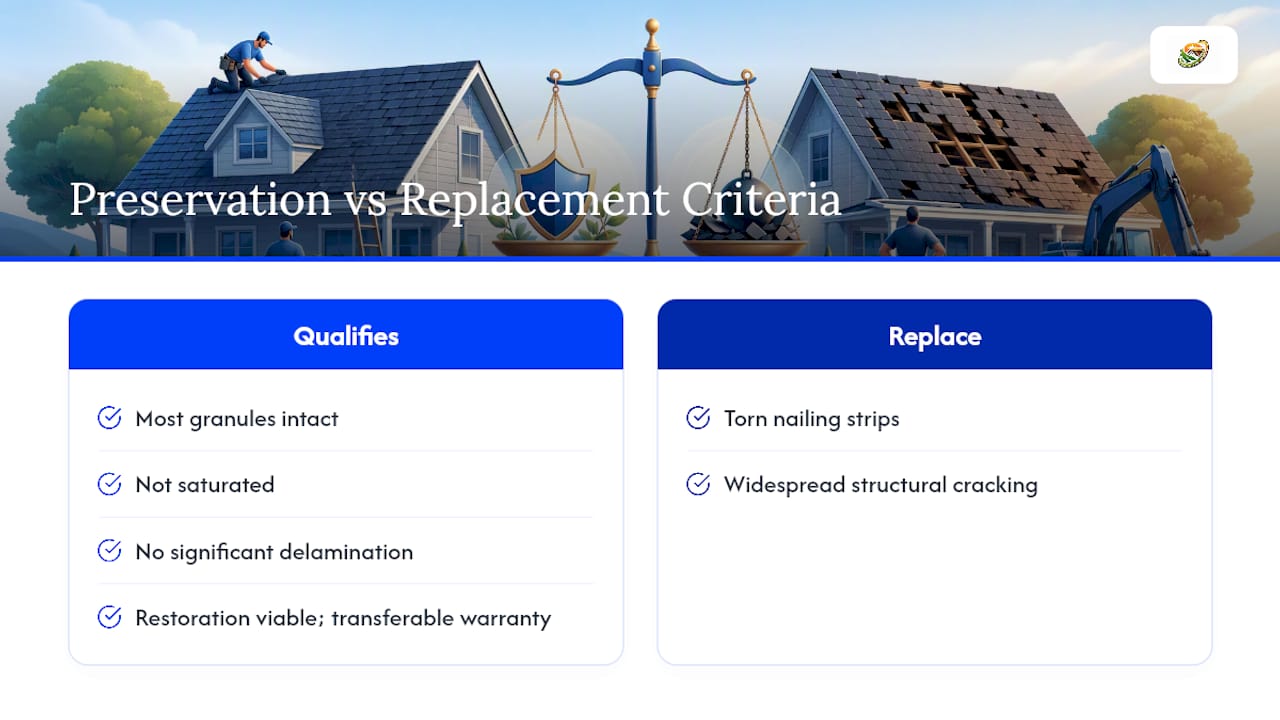
- Preservation treatments target roofs where the asphalt has dried out but hasn't failed structurally. A qualifying roof typically shows surface aging and some granule loss, but no widespread delamination or torn nailing strips. The process runs inspection, then condition assessment, then treatment.
- Full or slope replacement becomes the responsible choice once cracking is widespread, shingles tear at the nail line under light pressure, or layers are visibly separating (delamination). At that point, no treatment restores structural integrity.
Interestingly, InterNACHI's guidance notes that weathered-looking shingles can keep shedding water for years. Surface aging alone isn't a verdict. That's exactly the gap where preservation and honest inspection do the most good, and where a resource like Shingleroofrenewal's guide to restoring shingle flexibility walks through candidate conditions in more depth.
Pro Tip: Don't judge your whole roof by your worst slope. South and west exposures age faster than north-facing sections, so a full assessment should cover every slope before anyone recommends full replacement.
Cost and Timing: How Brittleness Changes Scope and Budget
Brittleness changes the math on every quote you get. A handful of spot repairs might run a few hundred dollars and take an afternoon. Slope replacement climbs from there, and a full tear-off and replacement is the most expensive path, often landing in the $15,000 to $30,000 range for a typical home, though costs vary by region, roof size, and material.
Brittle shingles slow contractors down. Crews work more carefully around fragile material to avoid creating new damage, which adds labor time to any job. For insurance claims, adjusters generally want dated photos, temperature records from any field checks, and a clear distinction between storm damage and age-related wear. Inspection to scope documentation often takes days, with repair or replacement scheduled separately based on contractor availability.
Decision Checklist: What to Do Next
- Check the basics first. Note your roof's age, look for visible bald spots or granule buildup in gutters, and check for interior stains or leaks.
- Run a documented brittle check on at least two slopes, in moderate temperature, and record the results in writing with photos.
- Photograph everything you find, including the outdoor temperature at the time and the exact location of each test.
- Ask any contractor these questions: How many slopes did you test? What was the temperature? Can I see photos? Will this void my current warranty?
- Watch for red flags: a replacement recommendation with no documentation, pressure to sign same-day, or refusal to explain why preservation isn't an option.
- Skip testing in unsafe conditions. Never climb onto a wet, icy, or steeply pitched roof to perform a brittle check yourself. Leave that to a professional with the right equipment.
For a deeper look at early failure signs before you get to this checklist, Shingleroofrenewal's guide to warning signs covers what to catch before it becomes a bigger problem.
What a Professional Preservation Assessment Actually Involves
A real qualification visit starts with a full-roof inspection, not a single test on one slope. The next step is an honest condition assessment: how much granule loss, how many slopes show craze cracking, and whether the asphalt mat still has enough integrity to respond to treatment. Only then comes a recommendation.
Candidate roofs generally aren't saturated, still have most of their granule coating intact, and show no significant delamination between layers. When a roof qualifies, restorative treatment aims to restore flexibility and lock in remaining granules, extending service life under a transferable warranty. Preservation isn't a fit for every roof. A roof with torn nailing strips or widespread structural cracking needs replacement, not restoration, and any honest assessment will tell you that directly.
A Quick Note on Timing and Prevention
Early intervention beats emergency replacement almost every time, and that's not marketing talk, it's just how asphalt aging works. Catching brittleness while granules are still mostly intact gives a roof options that a fully cracked, delaminating roof simply doesn't have anymore.
I've watched homeowners spend thousands more than necessary because nobody looked at their roof until a leak forced the issue. The fix isn't complicated: get eyes on the roof before it's an emergency.
— Daniellison
See if Your Roof Qualifies for Preservation
Most homeowners assume a brittle, aging roof means an automatic call to a roofing contractor and a five-figure bill. Shingleroofrenewal exists specifically for the step before that call. Our Free Roof Assessment inspects your roof, evaluates its actual condition, and tells you honestly whether it qualifies for preservation instead of replacement.

If your roof qualifies, a certified roof restoration treatment can restore flexibility to aging shingles, lock in remaining granules, and extend roof life, with warranty coverage. This is not a rejuvenation oil sprayed on for temporary shine. It's a documented process built to give you real years back on a roof you might have written off. If you're in Boca Raton, Delray Beach, Plantation, or elsewhere in Palm Beach or Broward County, schedule your free inspection and find out where your roof actually stands before anyone quotes you a full replacement.
Sources
NIST shingle degradation research, InterNACHI inspection guidance, Asphalt Foundation durability report, and IIBEC's brittle test critique each inform the guidance above. For local contractor comparisons, see this roofing company overview for Tampa Bay, and for claims documentation, this wind mitigation inspection guide.
- Long-Term Durability of Asphalt Shingle Roof Covers: Laboratory Degradation Characteristics — NIST
- Widespread misappropriation of the brittle test for asphalt shingles — IIBEC / Interface
- Mastering Roof Inspections: Asphalt Composition Shingles, Part 32 — InterNACHI
- Durability of Asphalt Shingles (AIF research report) — Asphalt Foundation
FAQ
How do you fix granule loss on shingles?
Isolated granule loss on an otherwise sound roof can sometimes be addressed with a restorative treatment that helps lock remaining granules in place, but heavy, widespread granule loss usually points to a shingle nearing the end of its service life rather than something a topical fix reverses.
Is there such a thing as a brittle test on shingles?
Yes, but it's an informal field check, not a certified standard. There is no ASTM pass/fail brittle test, and results shift with temperature and technique, which is why a single failed check shouldn't be the sole basis for a replacement decision.
How do you know when it's time to replace your shingles?
Replacement becomes the responsible choice when cracking spans multiple slopes, shingles tear at the nailing strip under light pressure, or you see delamination between shingle layers. Isolated damage on an otherwise flexible roof often qualifies for repair or preservation instead.
What does granular loss on shingles look like?
Granule loss shows up as bald, discolored patches where the protective coating has worn away, exposing shiny dark asphalt underneath, along with a buildup of loose granules collecting in gutters and down spouts.