
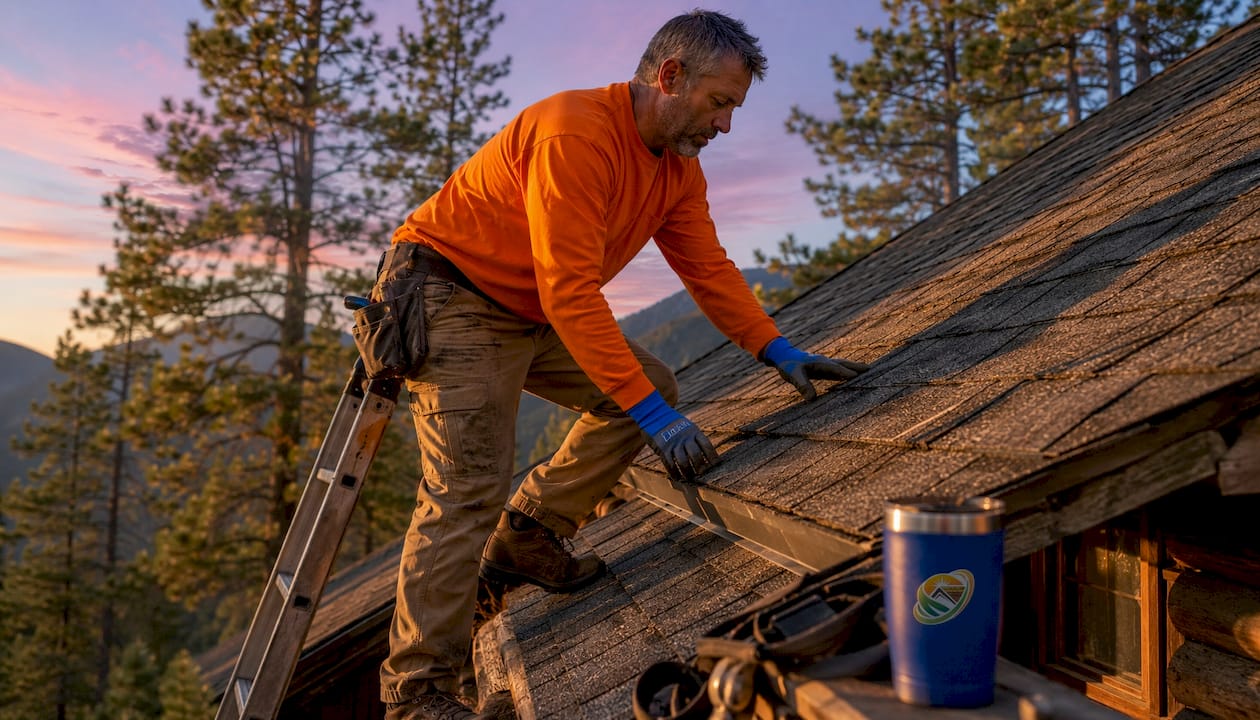
Most asphalt shingle repairs fall between $360 and $1,750, with many homeowners spending around $960 for a standard fix. Minor work — replacing a few shingles or sealing a small patch — typically runs $130–$500. Major repairs involving large leaks, slope sections, or decking damage can reach $2,000–$6,500 or more.
The quick verdict: repair is advisable when damage is localized, your roof has remaining service life, and the affected area covers a limited portion of the total surface. When the roof is older, deterioration spreads, or you're patching the same spots repeatedly, replacement becomes the better investment.
At a glance:
- Minor repairs like a few shingles or small patches typically cost less
- Standard repairs involving flashing, ridge cap, or valley are moderately priced
- Major repairs such as for large leaks, slopes, or decking are substantially more expensive
- The national average spend for roof shingle repairs is around $960 to $1,150.
Table of Contents
- How much does each type of shingle repair cost?
- What drives your repair estimate up or down?
- DIY vs. hiring a pro: which actually saves money?
- When does repair make sense, and when should you replace?
- How do you get accurate, comparable quotes?
- How long do repairs take, and what does waiting cost you?
- What maintenance and preservation options reduce your lifetime repair cost?
- Key Takeaways
- The case for catching it early
- Your roof may qualify for preservation, not replacement
- Useful sources for homeowners who want to dig deeper
How much does each type of shingle repair cost?
Not every repair costs the same, and the type of damage determines the price more than almost anything else. Here's what common repairs actually cost, based on national pricing data.
| Repair Type | What It Fixes |
|---|---|
| Replacing a few shingles | Fixes wind-lifted, cracked, or missing tabs |
| Small section patch | Addresses storm damage or localized wear |
| Flashing reseal or replacement | Repairs leaks at chimneys, skylights, or walls |
| Ridge cap repair | Fixes exposed ridge or wind damage at peak |
| Valley repair | Corrects water channeling failures and seam leaks |
| Vent boot replacement | Replaces cracked rubber boots causing attic leaks |
| Full slope repair | Repairs widespread section damage or underlayment failure |
Flashing repairs are often underestimated. A failed flashing seal at a chimney or skylight is one of the most common sources of interior water damage, yet the fix itself is relatively affordable when caught early. Valley repairs cost more because they handle significant water volume and require careful layering.
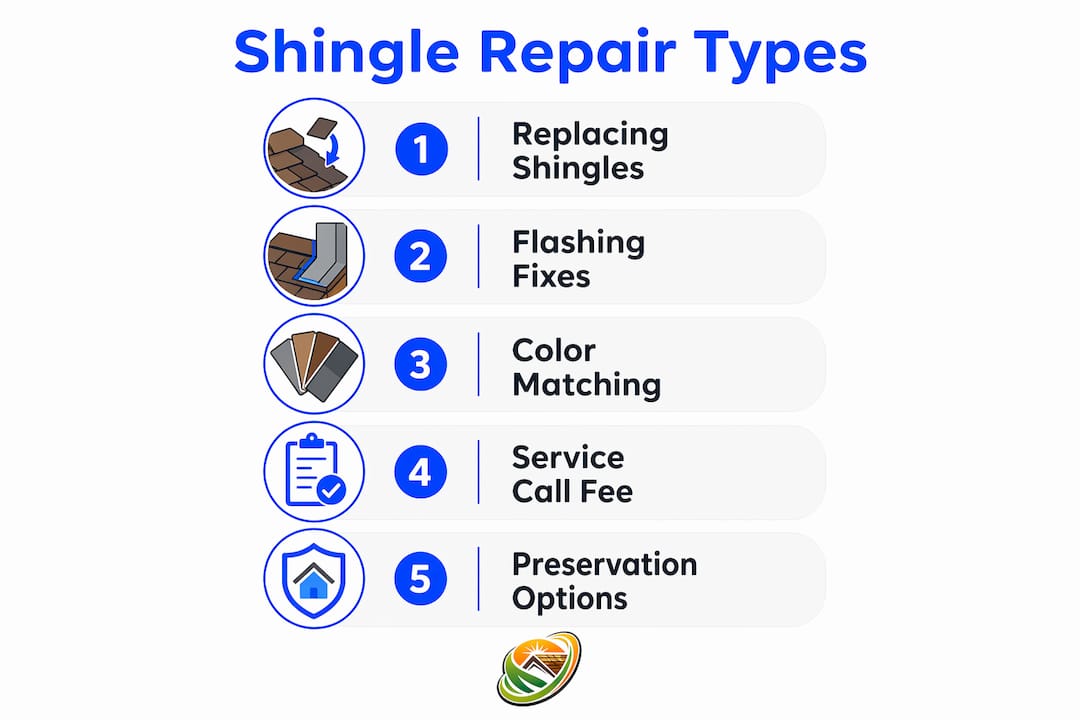
Pro Tip: Most roofers charge a minimum service call fee of $150–$300. If you have two or three small issues, schedule them together — bundling saves you from paying that base fee twice.
Color-matching can also increase the total cost. Contractors may need extra time to source close-match materials or blend sections if your shingles are discontinued or have weathered significantly.
What drives your repair estimate up or down?
Several factors shift a quote well beyond the base repair cost. Understanding them helps you evaluate bids more clearly.
- Roof pitch and height: Steep roofs (above 6:12) and two-story homes require additional safety equipment and slower work. Labor rates vary by 10–25% across states, and pitch adds another layer of cost on top of that.
- Material type: 3-tab shingles are the least expensive to repair. Architectural (dimensional) shingles cost more per square. Premium designer shingles can push material costs significantly higher.
- Extent of damage: Surface-only shingle swaps are straightforward. When underlayment or decking is compromised, costs rise fast. Decking replacement alone runs $700–$2,500 or more.
- Storm or emergency timing: Contractors are in high demand after major storms. Prices reflect that.
- Permits and disposal: Depending on your municipality, permit fees can range from $0 to $500. Debris disposal adds $20–$150 to most jobs.
- Warranty inclusions: A contractor offering a multi-year workmanship guarantee typically prices that into the quote. It's worth it — verbal promises don't hold up when a leak returns six months later.
DIY vs. hiring a pro: which actually saves money?
For a single cracked tab on a one-story, low-pitch roof, a confident homeowner with basic tools can handle the swap. Materials for a few shingles cost $10–$50, and the job takes an hour or two. That's a genuine saving compared to a $200–$300 service call for a minor fix.
The math changes fast on anything more complex.
- Missed damage: A DIY patch that covers the visible crack often misses the underlayment tear or nail pop underneath. That leak comes back — and the second repair costs more.
- Improper flashing: Flashing installation requires precise sealing and layering. Done wrong, it creates a slow leak that damages decking and insulation over months before you notice it.
- Voided warranties: Many shingle manufacturer warranties require professional installation for repairs. A DIY patch can void coverage on the surrounding field.
- Safety: Falls are the leading cause of construction-related fatalities. A steep or wet roof is not a safe DIY project.
Pro Tip: Never attempt repairs on roofs steeper than 6:12 or on any multi-story home without proper fall protection. For anything involving flashing or leak diagnosis, hire a licensed professional — the cost of getting it wrong far exceeds the service call.
When does repair make sense, and when should you replace?
This is the question that matters most. Repair is not always the right answer, and neither is replacement.
- Apply the 30% rule. If visible or storm-related damage affects less than roughly 30% of your roof and the rest of the surface is in good condition, repair is usually financially viable.
- Check roof age. Roofs under 15 years with localized damage are strong repair candidates. Once a roof passes 20 years, widespread brittleness and granule loss make spot repairs increasingly unreliable.
- Watch for these red flags that point toward replacement:
- Widespread curling or cupping across multiple slopes
- Shingles that crack or crumble when touched
- Granule accumulation in gutters across the whole roof
- Persistent leaks returning after multiple repairs
- Sagging or soft spots in the decking
- Consider cumulative repair cost. Three repairs averaging $1,150 each total $3,450 without adding a single year to your roof's lifespan.
- Get a professional deck assessment before any re-roofing decision. Layering new shingles over a compromised deck creates structural risk.
ARMA guidance: Local building codes typically limit shingle layers to two. The Asphalt Roofing Manufacturers Association recommends a professional assessment of deck condition before any overlay decision — not just a visual check from the ground.
One detail most guides skip: on roofs 15–20 years old, lifting shingles to perform a patch often cracks adjacent shingles because aged asphalt loses flexibility. A repair meant to fix one area can trigger failures nearby.
How do you get accurate, comparable quotes?
Getting three quotes is standard advice. Getting three comparable quotes takes a little more structure.
Step-by-step process:
- Schedule an in-person inspection — not a drive-by estimate. Ask for photos of the damage.
- Request a fully itemized written estimate covering materials, labor, disposal, and any permit costs.
- Compare material brands and shingle grades across bids, not just the bottom line.
- Confirm the project timeline, cleanup terms, and who pulls the permit.
Questions to ask every contractor:
- Are you licensed and insured in this state? Can you provide proof?
- Is your estimate itemized by material, labor, and fees?
- What workmanship warranty do you offer, and what does it cover?
- Will you handle the permit, or is that on me?
- Can you provide two or three recent references for similar repairs?
Red flags to walk away from:
- Verbal-only quotes with no written scope
- Pressure to sign before you've had time to compare
- Unusually low bids that skip a decking or underlayment check
- Vague warranty language like "we stand behind our work" with no defined term or coverage
How long do repairs take, and what does waiting cost you?
Most single-shingle swaps take a few hours, with small section repairs requiring more time and major repairs possibly taking a full day, depending on access and complexity.
Scheduling during normal business hours can significantly reduce costs compared to emergency or after-hours work, which tends to be more expensive.
Delaying repairs often substantially increases the final bill, especially if interior damage occurs, such as attic insulation replacement, decking rot, or mold remediation.
What maintenance and preservation options reduce your lifetime repair cost?
Repairs fix problems. Maintenance prevents them. The two work together, but most homeowners only call a contractor after something fails.
Annual maintenance checklist:
- Schedule a professional inspection every 1–2 years, or after any major storm
- Clean gutters twice a year to prevent water backup under shingles
- Check flashing at chimneys, skylights, and walls for lifting or cracking
- Assess attic ventilation — poor airflow accelerates shingle deterioration from below
- Monitor granule loss in gutters; early loss signals accelerating wear
- Address any lifted or cracked shingles before the next rain season
Maintenance plans that bundle annual inspections with small repairs typically run $150–$500 per year and reduce emergency repair frequency significantly.
Preservation options for mid-life roofs:
Beyond standard repairs, preservation technologies offer a different path for roofs that still have structural integrity but show early signs of wear. Chemical restoration treatments can restore shingle flexibility, slow granule loss, and extend service life without a full tear-off.
| Option | Best For | Potential Savings vs. Replacement |
|---|---|---|
| Targeted patching + reseal | Isolated damage, healthy deck | Moderate — extends repair window |
| Flashing and ridge cap reseal | Aging seals, no structural damage | High — prevents interior damage |
| Chemical preservation treatment | Mid-life roofs with flexibility loss | Up to 50% vs. premature replacement |
| Annual inspection plan | All roof ages | Reduces emergency repair frequency |
Pro Tip: Early preservation on a mid-life roof is almost always cheaper than waiting. A roof that qualifies for shingle lifespan extension treatment today may not qualify in two years if deterioration continues.
Key Takeaways
Early repair and preservation consistently cost less than deferred replacement — the 30% rule, roof age, and visible deterioration are the three factors that determine which path makes financial sense.
| Point | Details |
|---|---|
| Typical repair cost range | Most repairs fall between $360 and $1,750, with the national average spend around $960 to $1,150. Minor fixes are less expensive, while major repairs can be significantly higher in cost. |
| Use the 30% rule | Repair is generally viable when damage affects a limited portion of a roof that still has remaining service life. |
| Waiting adds about 20% | Delayed repairs often result in higher overall costs due to the addition of interior damage repairs. |
| Bundle small repairs | Roofers typically charge a minimum service call fee, so scheduling multiple small fixes together can save money. |
| Shingleroofrenewal's pathway | Shingleroofrenewal offers a 3-step inspection and preservation process for qualifying mid-life roofs in South Florida. |
The case for catching it early
Most homeowners treat their roof reactively. Something leaks, they call a roofer, they pay for a patch. That cycle works fine on a young roof with isolated damage. On a roof that's 12–18 years old and showing early signs of wear, it's a slow drain on your budget.
The part that gets overlooked: repair is a form of preservation when it's done early and done right. A $400 flashing fix at year 12 is not the same as a $400 flashing fix at year 19 on a roof where the shingles are already brittle. The first one buys you years. The second one buys you months — and the next repair is already forming.
What I'd tell any homeowner: don't just ask "how much will this repair cost?" Ask "what condition is the rest of my roof in, and what will I be spending over the next five years?" A professional inspection with photos and a written findings report gives you that answer. A verbal estimate from someone who glanced at your gutters does not.
The trust signals matter too. A licensed contractor who provides an itemized written estimate, a defined workmanship warranty, and before/after photos is giving you something you can hold them to. Vague promises and handshake deals are how homeowners end up paying twice for the same leak.
Your roof may qualify for preservation, not replacement
If you're in Broward or Palm Beach County and your roof is showing early wear — granule loss, minor cracking, some brittleness — the first question shouldn't be "how much does replacement cost?" It should be "does my roof still qualify for preservation?"

Shingleroofrenewal is the option homeowners call before the roofer. As a certified applicator of Fresh Roof Green Soy Technology, Shingleroofrenewal restores shingle flexibility at the molecular level, slows deterioration, and locks in granules on qualifying asphalt roofs. The process is straightforward: inspection, condition assessment, and a clear recommendation — either your roof qualifies for preservation, or you get an honest referral to a roofer. No pressure, no guesswork.
Qualifying homeowners can save significantly compared to a full replacement, backed by a 6-year transferable warranty. Most South Florida homeowners don't realize their roof can still be saved until they get that first inspection.
Schedule your free roof inspection today and find out if your roof qualifies before spending $15,000–$30,000 on a replacement you may not need yet.
Useful sources for homeowners who want to dig deeper
- Asphalt Roofing Manufacturers Association (ARMA) — Industry guidance on re-roofing decisions, layering limits, and deck assessment requirements.
- Angi — Roof Shingle Repair Cost — National cost data and maintenance plan pricing.
- Modernize — Roof Repair Cost — Itemized examples by damage type with regional context.
- RoofVista — Shingle Repair Cost Guide — Per-repair-type cost table and state-by-state labor variation data.
- Find Roofing Pros — Repair vs. Replacement — Financial decision framework and deferred-cost analysis.
- Shingleroofrenewal Blog — Preservation guides, South Florida roof facts, and maintenance checklists for asphalt shingle homeowners.