
Most dried out shingles can be preserved rather than replaced, as long as the roof deck is sound and the damage hasn't gone too far. The disqualifiers are specific: active leaks, soft or rotted decking, large patches of exposed mat, and widespread curling or missing tabs. Short of those red flags, a documented professional inspection is the next right move before anyone signs a contract for a full tear-off.
TL;DR:
- Preservation of dried out shingles is feasible if the roof deck remains sound and there are no active leaks or widespread damage.
- Detecting deterioration involves inspecting granule loss in gutters, visual unevenness, cracks, curling, and attic signs of moisture or daylight leaks.
- Shingle aging is primarily caused by UV exposure and thermal cycling, which stiffen the asphalt binder and weaken the sealant bonds.
- Rejuvenation treatments can extend roof life if the shingles are brittle but still intact, avoiding costly full replacement when structural damage isn't present.
- An early, professional inspection can identify preservation options, saving money, reducing waste, and providing documented maintenance for futureproofing.
Table of Contents
- How Do You Check For Dried Out Shingles?
- Why Do Roof Shingles Dry Out In The First Place?
- Preservation vs. Replacement: Which One Fits Your Roof?
- What Does A Professional Inspection And Renewal Actually Cost?
- Why Early Inspection Beats Waiting For The Roofer
- Get A Free Roof Assessment Before You Assume Replacement
- Sources
How Do You Check For Dried Out Shingles?
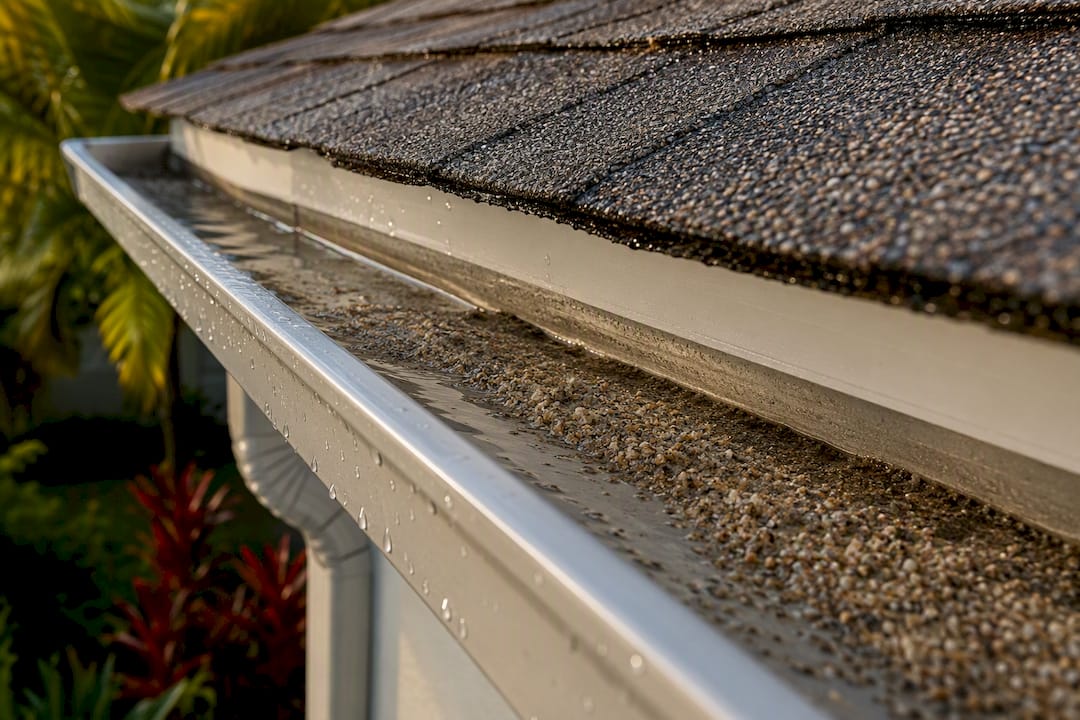
Start on the ground, not the ladder. Walk your gutters and downspouts after a rainstorm and look for a buildup of granules, the sandy grit that coats every shingle. A little shedding is normal on a newer roof, but heavy, sustained granule loss usually means the mat underneath is losing its protection and aging faster than it should.
From the yard, scan the roof slope by slope. Uneven coloring, bald patches, or one side of the roof that looks noticeably rougher than the other often points to sun exposure differences, since south and west facing slopes tend to age faster in hot climates.
If you're comfortable and experienced on a roof, a closer look can reveal more:
- Hairline cracks running across the shingle surface, a classic sign of brittleness.
- Tabs that feel stiff or snap instead of flexing slightly under light pressure.
- Curling or lifted edges where the seal strip has let go.
- Shingles that crumble or feel friable at the corners.
Then check the attic. Daylight visible at deck seams, staining on the underside of the roof deck, or damp insulation all suggest moisture is already getting through, which changes the qualification picture. Granule loss patterns in gutters and on the roof field are one of the clearest ways to separate normal wear from accelerated deterioration.
Photograph everything: wide shots of each slope, close ups of cracked or curled shingles, gutter debris, and any attic staining. A step-by-step guide to restoring shingle flexibility walks through what a technician looks for during a formal visit.
Pro Tip: Take your photos in the morning or late afternoon when the sun is low. Shadows make curling, cracking, and granule loss far easier to spot than they are under direct midday glare.
Skip the ladder entirely if your roof is steep, wet, or you're not confident on it. A trained inspector can safely capture everything a decision requires.
Why Do Roof Shingles Dry Out In The First Place?
Shingle deterioration comes down to sustained heat and light doing chemical damage to the asphalt itself. Ultraviolet exposure triggers photo-oxidation, a slow chemical reaction that hardens the asphalt binder and strips it of the oils that once kept it flexible. Once that binder stiffens, the shingle loses its ability to expand and contract without cracking, a mechanism documented in NIST's laboratory research on asphalt shingle aging.
Heat compounds the problem in a second way. Roofs don't just sit at air temperature. Roof surface temperatures regularly run far hotter than the surrounding air, and IBHS field research on natural weathering shows that this repeated heating and cooling, known as thermal cycling, gradually weakens sealant bonds and reduces wind resistance over time.
A few other drivers push the timeline faster:
- Rapid cooling events, like a sudden afternoon storm hitting sun-baked shingles, can shock brittle asphalt into cracking almost instantly.
- Granule loss exposes the asphalt mat directly to UV rays, which speeds up oxidation in a feedback loop.
- Poor attic ventilation traps heat underneath the deck, raising shingle temperatures from below as well as above.
Sunny, storm-prone climates see this cycle compress into a shorter timeframe than shingles were technically rated for.
Preservation vs. Replacement: Which One Fits Your Roof?
Not every dried out roof needs preservation, and not every one needs replacement. The line between them comes down to how much structural damage has already occurred, not just how old the shingles look.
A good candidate for rejuvenation typically shows:
- Shingles that are aging and brittle but still intact, with no widespread tears or missing sections.
- Limited areas of exposed mat, not spread across an entire slope.
- A solid, dry roof deck underneath.
- Curling or lifted tabs confined to isolated spots rather than the whole roof.
A roof usually needs full replacement instead of treatment when it shows active, widespread leaks, soft or rotted decking, more than roughly a quarter of a given section with exposed mat, or granule erosion severe enough to leave the asphalt bare and crumbling. Restoring rheological flexibility only works on binder that hasn't already failed structurally.
For qualifying roofs, bio-based rejuvenation treatments penetrate the shingle surface, replenish lost oils, and can restore flexibility and granule adhesion, extending usable roof life. Architectural shingles respond a bit differently than three-tab styles, which is worth understanding before assuming a rejuvenation treatment will behave the same way on every shingle type.
Pro Tip: A rejuvenation treatment restores flexibility to the asphalt binder. It does not repair a rotted deck or fix a leak that's already active, so those issues need to be resolved separately, before or during the same visit.
What Does A Professional Inspection And Renewal Actually Cost?
A legitimate preservation assessment follows three steps: inspect, assess, qualify. An inspector walks the roof, documents every slope with photos, checks the attic for moisture intrusion, and evaluates granule loss and cracking severity before making a recommendation either way.
Cost is where the decision usually gets made. Full roof replacement commonly runs into the tens of thousands of dollars depending on size and material, while a qualifying preservation treatment costs a fraction of that, since you're paying for a restorative treatment instead of a full tear-off, disposal, and rebuild. That gap is the main reason it pays to get an honest assessment before assuming replacement is the only option, a comparison covered in more detail in this breakdown of cost-effective ways to extend shingle roof life.
The typical job timeline looks like this:
- Inspection and photo documentation, usually completed in a single visit.
- Pre-cleaning, if biological growth or heavy debris would block the treatment from penetrating.
- Treatment application, timed around dry weather.
- Post-job documentation, including before and after photos and a written condition report.
That documentation matters beyond peace of mind. A written report paired with a transferable warranty gives future buyers, insurers, and the homeowner a paper trail showing the roof received real, professional maintenance rather than a quick surface fix. Poor attic airflow accelerates the same drying process a rejuvenation treatment is meant to slow, which is why addressing ventilation problems alongside a preservation job protects the investment longer.
Why Early Inspection Beats Waiting For The Roofer
Homeowners tend to wait until a roof is visibly failing before calling anyone, and that habit costs money. Dried out shingles rarely fail overnight. They deteriorate gradually, which means there's usually a window, sometimes years long, where preservation is still on the table and replacement isn't yet necessary.
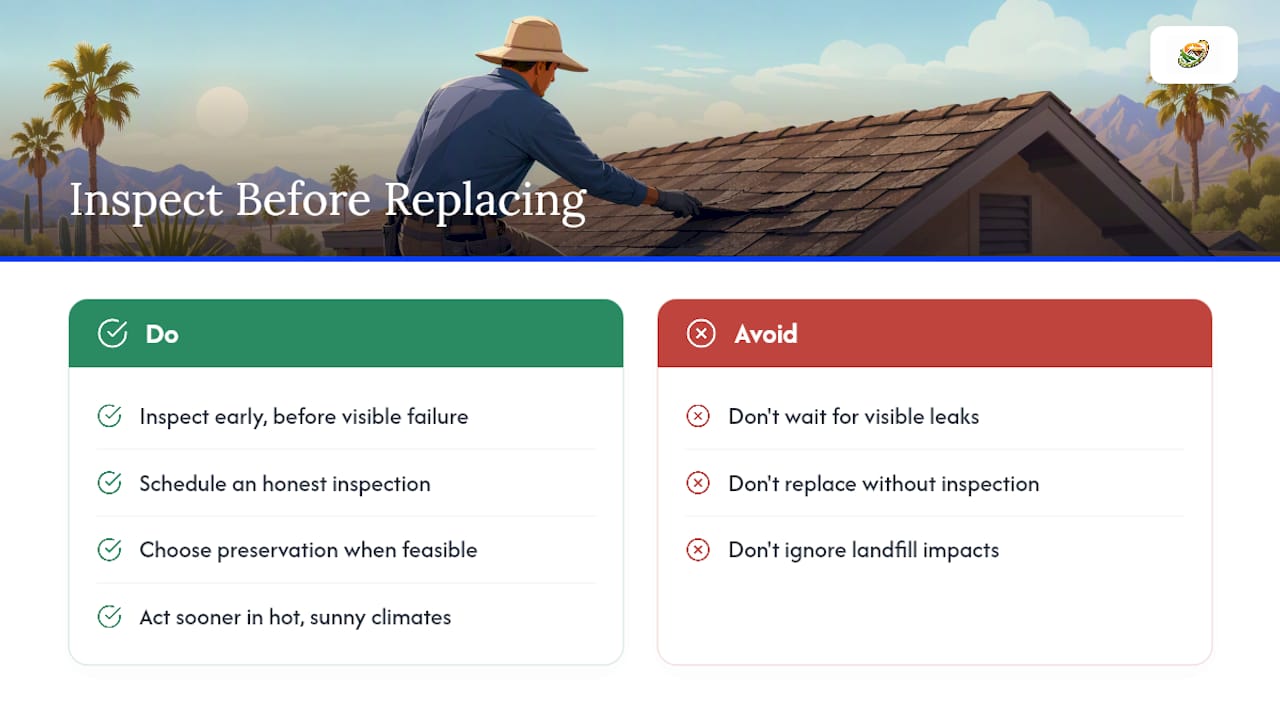
That window closes faster in hot, sunny climates than most homeowners expect, which is exactly why "call us before you call the roofer" is not just a slogan so much as a sequencing argument. An honest inspection costs you nothing but time, and it tells you definitively which category your roof falls into.
There's an environmental angle here too, one that gets overlooked. Every roof preserved instead of torn off is asphalt and fiberglass mat that doesn't end up in a landfill years before it had to. Multiply that across a neighborhood of aging roofs, and preservation starts to look like the more responsible default, not just the cheaper one.
— Daniellison
Get A Free Roof Assessment Before You Assume Replacement
There are alternatives to a full tear-off for South Florida homeowners facing costly replacement estimates they haven't fully confirmed is necessary. Using a certified rejuvenation technology, a typical process includes inspecting the roof, assessing its actual condition, and qualifying it honestly for preservation when appropriate.

If your roof qualifies, you walk away with photo documentation, a written condition assessment, a price estimate, and a 6-year transferable warranty backing the work, all while saving significantly compared to full replacement. If it doesn't qualify, we tell you that too, because that's the entire point of an honest inspection.
Homeowners in Delray Beach and Plantation can schedule a free roof inspection today and find out, with documentation in hand, whether their roof qualifies for renewal before spending a dollar on replacement.
Sources
- Natural Weathering and Hazard Exposure – Insurance Institute for Business & Home Safety
- Long-term durability of asphalt shingle roof coverings: laboratory degradation characteristics – NIST
- Durability of Asphalt Shingles (AIF report)
- Asphalt shingle granule loss: When to repair or replace – InspectApedia