
A free roof inspection is worth it when you request it from a licensed, insured contractor you chose yourself. It becomes risky the moment it arrives uninvited on your doorstep right after a storm. The two rules that decide which category you're in: know who the inspector reports to, and never sign anything the day they show up. The sections below cover when free inspections make sense, when to pay instead, the scam patterns to watch for, and a vetting checklist you can run before anyone climbs your ladder.
TL;DR:
- Free roof inspections are most useful for routine checks, post-storm damage triage, and comparing repair bids, but lack detailed documentation for disputes.
- Paying for an independent inspection is advisable when buying or selling a home, resolving insurance disputes, or handling large claims, as it provides a signed, comprehensive report.
- Scammers exploit storm anxiety by pressuring homeowners to sign contracts or assign benefits immediately, often under false pretenses or without proper licensing.
- Verify a contractor’s license, insurance, and references before permitting inspection, and always refuse to sign contracts or assignments on the initial visit.
- Homeowners should treat free inspections as one data point, confirm damage with insurers, and hire paid experts if discrepancies or disputes arise.
Table of Contents
- When Is a Free Contractor Inspection Actually Useful?
- When Should You Pay for an Independent Inspection Instead?
- How Do Free-Inspection Scams Actually Work?
- How Do You Vet an Inspector Before Letting Them on Your Roof?
- What Should You Do After the Inspection Wraps Up?
- Why We Say Call Us Before You Call the Roofer
- How to Schedule Your Free Assessment With Shingleroofrenewal
- Trusted Consumer-Protection and Industry Resources
- Sources
When Is a Free Contractor Inspection Actually Useful?
A typical free roof inspection is a visual walk of the roof surface, sometimes paired with a drone flyover or a quick look in the attic. Expect it to run 30 to 60 minutes, followed by a verbal summary or a short written estimate rather than a formal report. That scope is fine for a lot of situations, but not all of them.
Free inspections earn their keep in three scenarios:
- Routine seasonal checks, especially before or after hurricane season, to catch cracked or curling shingles early.
- Post-storm triage, when you need a fast read on whether you have visible damage worth reporting.
- Collecting competing repair bids after you already suspect something is wrong and want pricing from a few contractors.
Where free inspections fall short is documentation. Most contractors won't hand you a signed, dated report you could use in a dispute, and few include the attic moisture checks or infrared scanning that a real damage assessment sometimes requires. If a contractor tells you a free inspection is "just as good" as a paid one for an insurance claim, that's a signal to slow down, not speed up.
When Should You Pay for an Independent Inspection Instead?
Money changes the incentive structure. A contractor who profits from repairs has a built-in reason to find damage. An independent inspector, paid a flat fee regardless of outcome, doesn't.
Four situations where paying is the smarter move:
- Buying or selling a home, where a neutral report protects both sides of the deal.
- Insurance disputes, where your carrier's adjuster and the contractor's estimate disagree.
- Escrow or legal situations, where you need documentation that can hold up outside a handshake agreement.
- Large claims, where the cost of being wrong dwarfs the inspection fee.
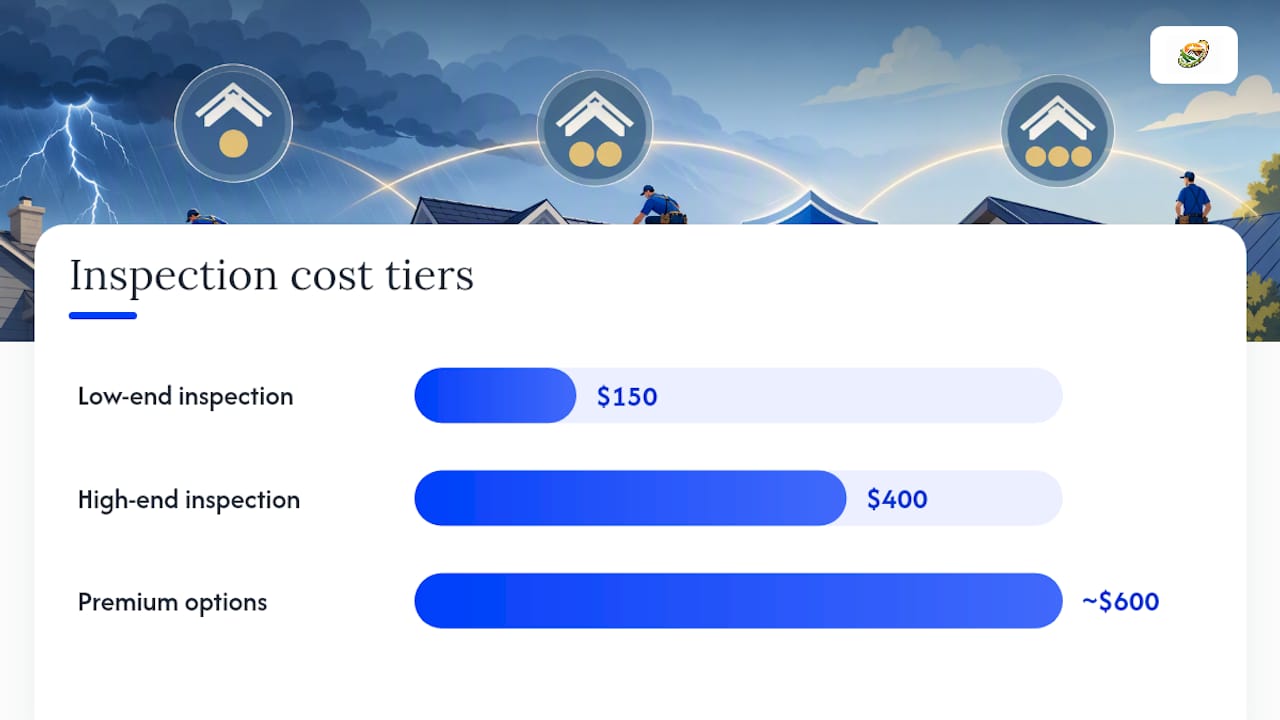
A paid independent inspection typically runs $150 to $400, and higher-tier options with drone imaging, thermal scanning, or an engineer's stamp can push toward $600. That range buys you a signed report, often with attic checks and moisture readings a basic walk-and-look skips entirely.
Here's the number that matters: when you're deciding between a home purchase or a five-figure insurance claim, a $150 to $400 inspection fee is a rounding error compared to the risk of relying on an estimate from someone with a financial stake in the outcome.
How Do Free-Inspection Scams Actually Work?
Storm chasers follow a predictable script, and it works because it exploits urgency. Here's the typical sequence:
- A crew knocks on doors in a storm-affected neighborhood, often within days of the event.
- They climb the roof alone, sometimes creating or exaggerating damage rather than just documenting it.
- They show you photos on a phone, sometimes recycled from a different house entirely.
- They push you to sign a contract or an assignment of benefits (AOB) before they leave.
- Once the AOB is signed, they can negotiate directly with your insurer and control the payout.
The Better Business Bureau warns homeowners specifically about unsolicited free roof inspection offers, noting that scammers count on storm anxiety to shortcut normal due diligence. Reporting on roofing scams shows these schemes spike predictably after every major weather event, which is exactly why vigilance matters most when you least feel like exercising it.
Watch for these red flags: pressure to sign an AOB on the spot, refusal to leave without a signature, no listed license number, a vague or out-of-state business address, and any request to "handle the insurance company for you" before you've agreed to hire them.
Pro Tip: If someone refuses to leave your property until you sign something, that alone is grounds to end the conversation and call your local police non-emergency line if they won't go.
How Do You Vet an Inspector Before Letting Them on Your Roof?
Run this check before anyone touches a ladder:
- Confirm the contractor's license number and general liability insurance directly with your state licensing board, not just what's printed on their truck.
- Search their name on the BBB and check for a pattern of complaints, not just a star rating.
- Look for a physical business address you can verify, not a P.O. box or a number that only rings a cell phone.
- Ask for two or three local references from jobs completed in the past year.
During the visit itself, your leverage is highest before anyone signs anything. Ask for a written, dated report with photos that include a recognizable landmark on your property, not a close-up crop that could be from any roof. Get the inspector's name and license number printed on whatever document they leave with you. And refuse, calmly and firmly, to sign an AOB or a repair contract during that first visit, no matter how good the discount sounds.
Pro Tip: A legitimate contractor will not flinch if you say, "I need 24 hours to review this before I sign." A scammer usually will.
What Should You Do After the Inspection Wraps Up?
Treat the free inspection as one data point, not the final word. Here's the sequence that protects you:
- If the damage is storm-related, call your insurer first and request an adjuster visit before authorizing any repair work.
- Compare the contractor's findings against the adjuster's report, since discrepancies are common and worth questioning.
- If the numbers don't line up, or if a claim gets disputed, that's your cue to hire a paid independent inspector or a licensed engineer for a defensible third opinion.
- Save every dated photo and signed report in one folder, digital or physical, so you have a paper trail if a disagreement drags on.
Never sign an assignment of benefits without understanding what it hands over. State consumer protection guidance is blunt on this point: an AOB can transfer control of your insurance payout to a contractor, and unwinding that after the fact is far harder than declining it up front.
Why We Say Call Us Before You Call the Roofer
Most homeowners assume a damaged or aging roof means one thing: replacement. That assumption is usually premature. Our process is deliberately simple: inspect, assess, and determine whether the roof qualifies for preservation using Fresh Roof Green Soy Technology, which restores flexibility to brittle shingles and helps lock in granules that Florida sun and storms strip away over time.
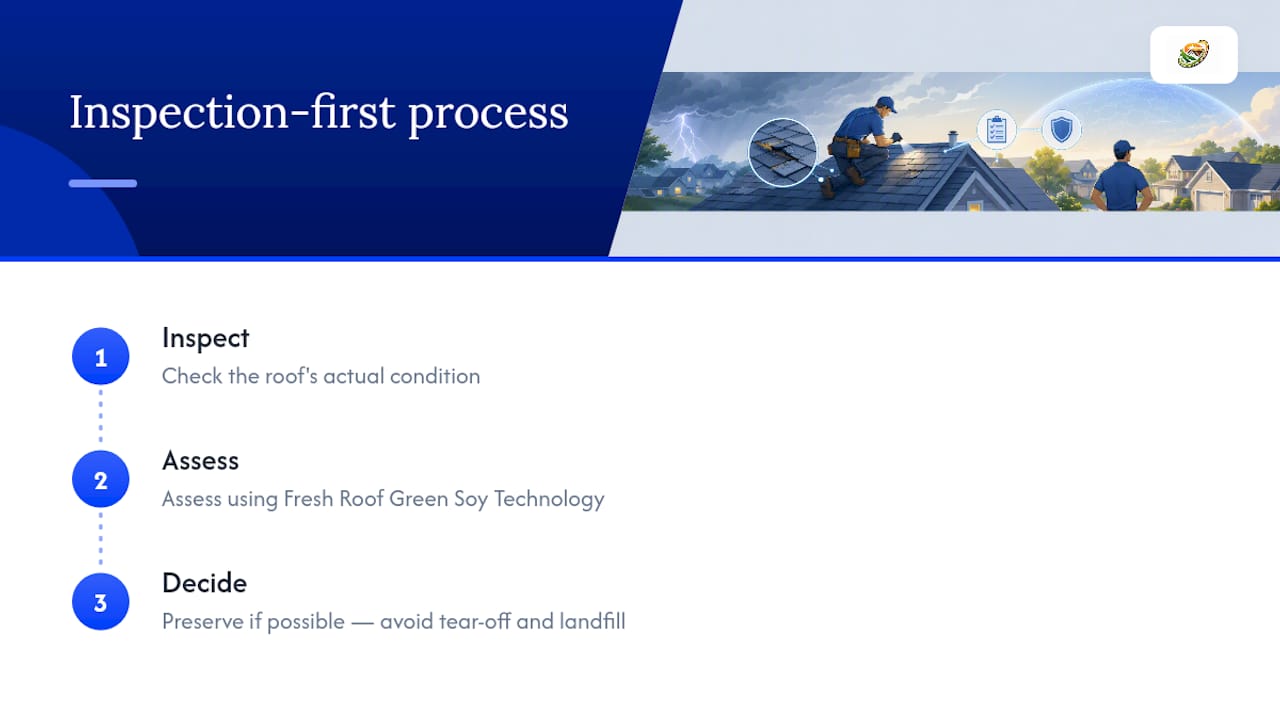
Not every roof qualifies. But when one does, preservation can mean avoiding a full tear-off you didn't actually need yet, and keeping usable material out of the landfill in the process. That's the whole point of getting the inspection question right in the first place: a good one tells you the truth about your roof's real condition before you spend money you might not have needed to spend.
We built our post-storm inspection checklist around that same principle. Check first. Understand what you're actually looking at. Then decide.
— Daniellison
How to Schedule Your Free Assessment With Shingleroofrenewal
Shingleroofrenewal's free assessment works the way a homeowner-initiated inspection should: you schedule it, we show up, and we give you a straight answer. That's the visit includes an on-site inspection, a condition assessment, and a determination of whether your roof qualifies for preservation instead of replacement. No storm-chasing, no unsolicited knock on the door.
The difference between our visit and a predatory door-knock offer comes down to three things: no pressure to sign anything on the spot, written findings with dated photos you keep, and clear next-step options that are yours to decide on. If your roof qualifies for renewal, you could save significantly compared to a full replacement. Before your visit, clear access to your attic if possible and jot down any leaks, stains, or missing shingles you've noticed. Then schedule your free roof inspection and find out whether your roof can be saved instead of torn off.
Trusted Consumer-Protection and Industry Resources
- BBB scam alert on free roof inspections: verify a business before hiring.
- State consumer protection guidance: learn AOB risks and predatory tactics.
- Roof inspection cost breakdown: understand free-versus-paid pricing tiers.
- Contract review basics: spot red flags before signing any service agreement.
Sources
- BBB scam alert: Watch out for 'free roof inspections' — look for BBB seal
- Roof Inspection Cost & Checklist 2026: Free vs Paid (The Roofing Brief)
- Roof Inspection Cost & Checklist 2026 (WeatherShield Roofing)
- Offers of free roof inspection might be a scam | USA TODAY / BBB reporting