

A granule loss insurance claim can succeed, but only when a covered, sudden peril caused functional damage, not routine aging. The evidence that wins these claims is specific: exposed fiberglass mat, fractured shingle cores, and dents in soft metals like gutters or vents. Photograph everything now, preserve any loose granules or damaged sections, and get a professional inspection if the damage pattern looks storm-related rather than uniform and gradual.
TL;DR:
- Proper documentation of storm impact, including photographs of impact patterns and dented soft metals, is crucial within 72 hours after damage occurs.
- Evidence must clearly distinguish localized storm damage from uniform aging signs, focusing on fractured mat exposure and impact patterns.
- Building a strong claim involves collecting local storm data, maintenance history, and possibly removing test-square samples for expert analysis.
- Hiring a forensic roofing engineer increases the chances of success in disputed claims by providing precise measurements of damage and mat fractures.
- A professional roof assessment before filing a claim or replacement decision can help homeowners determine if preservation is viable and avoid unnecessary disputes.
Table of Contents
- What Does Homeowners Insurance Actually Cover for Roof Damage?
- Cosmetic or Functional: How Adjusters Decide
- What Evidence Do You Need to Build a Strong Claim?
- Do You Need a Forensic Engineer, Public Adjuster, or Inspector?
- How Do You File, Supplement, and Appeal a Granule Loss Claim?
- Why Get a Preservation Assessment Before Deciding on Replacement?
- Why Most Homeowners Fight the Wrong Battle
- Get a Free Roof Assessment Before You File or Replace
- Sources
What Does Homeowners Insurance Actually Cover for Roof Damage?
Standard HO-3 and HO-5 policies pay for roof damage only when a sudden, accidental, covered peril causes it, such as hail, wind, or a falling tree. Normal wear and tear is excluded, and that single clause is why so many granule loss claims get denied before an adjuster even walks the roof.
The cause-of-loss question gets more complicated when aging and a storm both play a role. Many states apply the "efficient proximate cause" doctrine, which can preserve coverage if the storm was the dominant triggering event, even on an older roof. But insurers increasingly write anti-concurrent causation clauses into policies, letting them deny a claim entirely if age contributed at all, regardless of how severe the storm event was.
Deductibles add another layer. Wind and hail often carry a percentage deductible tied to your dwelling coverage, rather than a flat dollar amount, and your payout depends on whether your policy settles at actual cash value or replacement cost. A 20-year-old roof at ACV can leave you covering thousands out of pocket even after approval.
Cosmetic or Functional: How Adjusters Decide
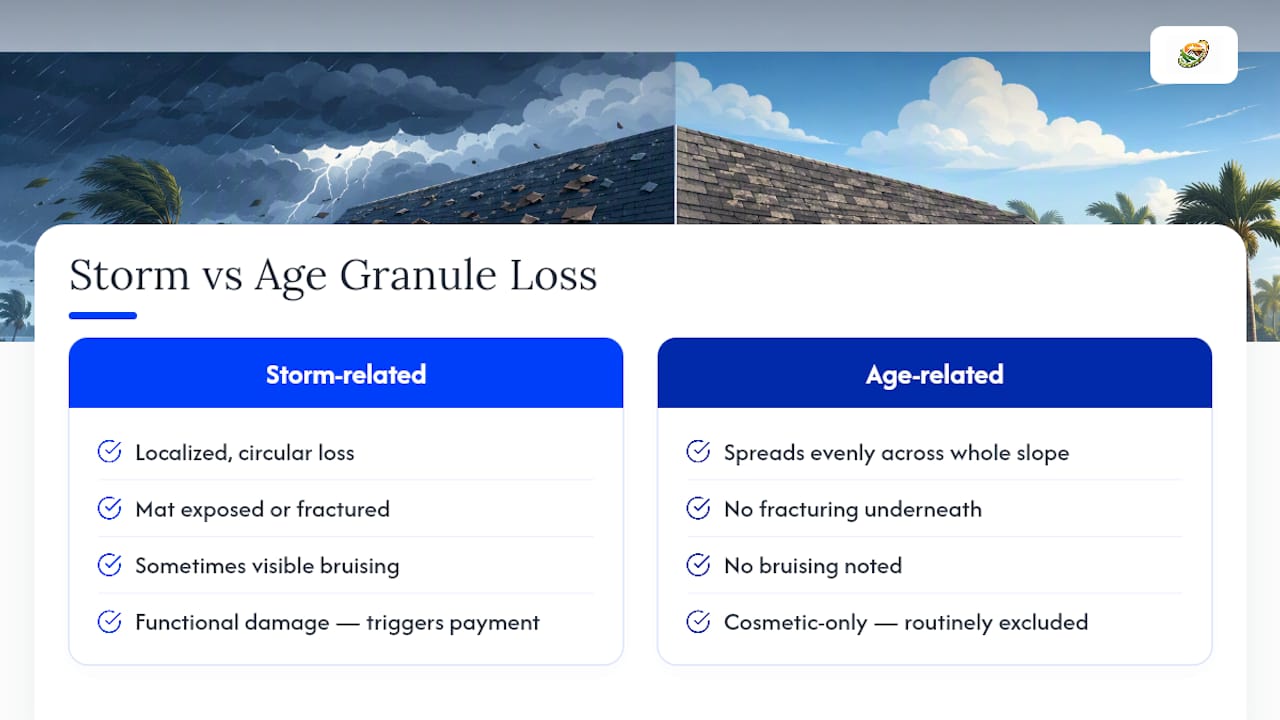
Adjusters draw a hard line between cosmetic damage, which affects only appearance, and functional damage, which shortens the roof's service life or lets water in. Cosmetic-only losses are routinely excluded under cosmetic damage endorsements, while functional damage is what triggers payment.
The evidence that separates the two comes down to the mat, the layer of fiberglass beneath the granules. Storm impact tends to produce localized, circular loss patterns with the mat exposed or fractured, sometimes with visible bruising. Age-related loss, by contrast, spreads evenly across the whole slope with no fracturing underneath.
Expect insurers to push back with a few standard defenses: pointing to uniform granule loss as proof of aging, citing the roof's age against manufacturer life expectancy, or leaning on a cosmetic damage exclusion written into the policy itself. Knowing these defenses in advance lets you document around them before you ever file.
What Evidence Do You Need to Build a Strong Claim?
The strength of a granule loss coverage claim comes down almost entirely to what you can document in the first 48 to 72 hours after a storm. Adjusters and forensic reviewers respond to specifics, not impressions.
- Photograph systematically. Take wide shots of each slope, close-ups of bare spots with a ruler or coin for scale, and make sure your phone's date stamp is turned on.
- Capture the pattern, not just the damage. Random, scattered impact marks read as storm-caused; even, gradual thinning across the whole roof reads as age.
- Document soft-metal impacts. Dented gutters, bent vent caps, and marked flashing are cheap to photograph and carry real weight as corroborating proof of storm severity.
- Pull local storm data. A National Weather Service hail or wind report for your ZIP code and date ties your damage to a verified event.
- Gather your roof's history. Prior inspection reports, maintenance receipts, and the shingle's original ASTM D3462 granule-retention spec give an inspector something concrete to measure against.
- Consider a test-square sample. For disputed claims, a technician removes one square foot of shingle to check for a fractured mat underneath, then logs it with dated photos for chain of custody.
Once you have this material, assemble it into a single organized PDF, arranged chronologically, with a short cover page tying each photo to the specific policy provision it supports.
Pro Tip: Never write "cosmetic" or "just looks bad" anywhere in your own notes or claim narrative. Insurers quote homeowners' own language back to them during disputes, so stick to functional terms like "exposed mat" and "impaired coverage."
For a walk-through of what this looks like on the roof itself, this post-storm inspection checklist breaks the photo protocol down by roof section.
Do You Need a Forensic Engineer, Public Adjuster, or Inspector?
Which professional you hire depends on whether your dispute is about cause, amount, or both.
- Public adjuster. Advocates for you directly with the insurer, files supplements, and typically works on a contingency fee of roughly 5 to 15 percent depending on your state. They make sense when the insurer has acknowledged the peril but lowballed the payout, not when coverage itself is being denied outright.
- Licensed roofing inspector. Can identify visible damage and recommend repairs, but isn't an objective third party in a dispute the way a forensic consultant is.
Check licensing, ask for sample reports, and request references before hiring anyone in any of these three categories.
How Do You File, Supplement, and Appeal a Granule Loss Claim?
Timing and sequence matter as much as the evidence itself.
- Document immediately. Photograph the damage within 48 to 72 hours, before rain or wind alters the pattern.
- File the initial claim fast. Most policies require notice within a set window, sometimes as short as a year, and delays are a common reason insurers question causation.
- Submit a supplement with your full evidence packet if the initial payout undervalues the damage or the claim is denied as cosmetic.
- Request a reinspection with your forensic report or public adjuster present, so the same adjuster can't repeat the same call in isolation.
- Invoke appraisal if the dispute is purely about the dollar amount, or escalate to your state insurance department or a NAIC complaint if you suspect bad faith or a coverage misread.
Watch for the pitfalls that sink otherwise valid claims: missing the filing window, submitting photos with no scale reference, and using soft, cosmetic-sounding language in your written claim narrative.
Pro Tip: Keep a dated log of every call and email with your insurer. If you end up filing a state complaint, that timeline is often more persuasive than the photos themselves.
Why Get a Preservation Assessment Before Deciding on Replacement?
Not every granule-loss roof needs to end in a claim fight or a full tear-off. Shingleroofrenewal built its process around a simple sequence: inspect the roof, assess its actual condition, then determine whether it still qualifies for preservation rather than replacement.
Roofs with early to moderate granule loss, where the mat is still intact and the shingles haven't fully lost flexibility, are often candidates for restoration using certified Green Soy Technology, which can help lock in remaining granules and extend service life. Roofs with widespread mat exposure or brittle, cracked shingles are past that point, and replacement becomes the honest recommendation. Either way, that assessment belongs before the bigger financial decision, not after.
Why Most Homeowners Fight the Wrong Battle
The instinct after a storm is to focus on the granules themselves, pointing an adjuster toward a gutter full of grit as proof of damage. That's the wrong evidence. Gutter granules alone almost never win a claim, because insurers correctly note that shingles shed granules gradually over their entire lifespan. The real fight is over the mat underneath, and homeowners who skip straight to demanding a payout without documenting mat exposure or impact patterns are handing the adjuster an easy cosmetic denial.
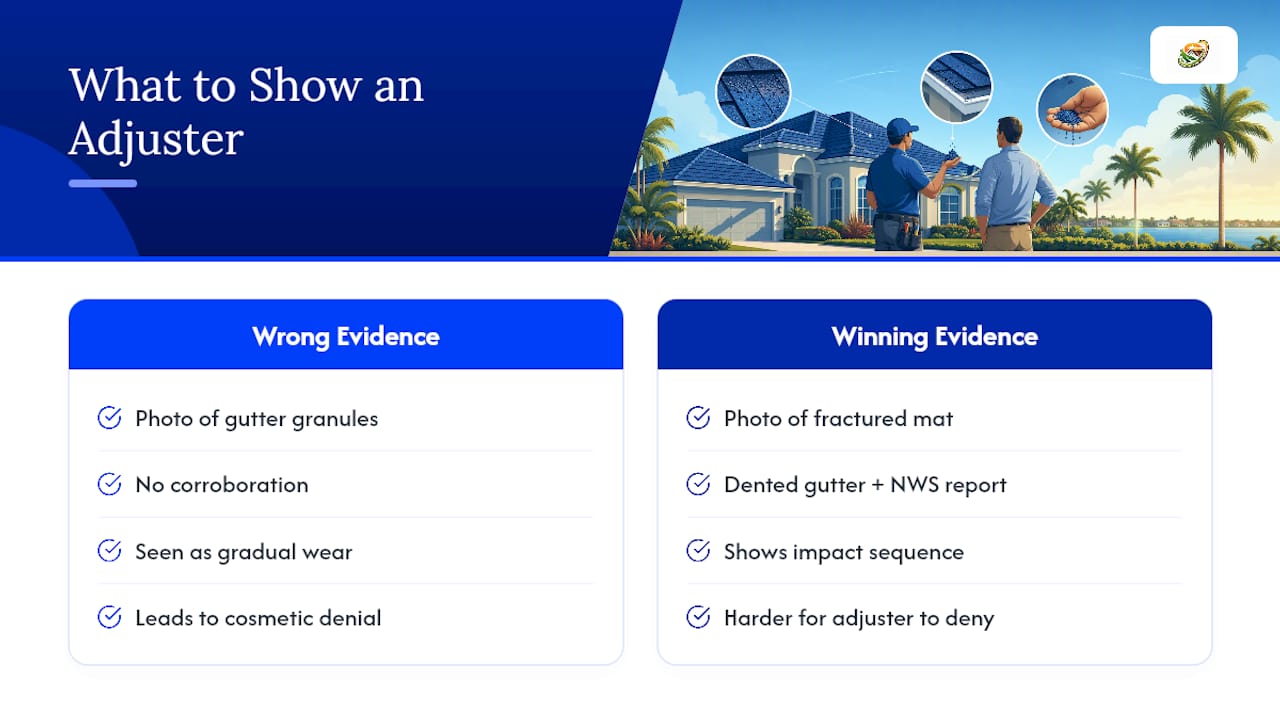
The conventional advice online treats "take photos" as sufficient. It isn't. A photo of bare granules proves nothing about cause. A photo of a fractured mat, paired with a dented gutter and a matched NWS storm report, proves a sequence of events an adjuster can't easily wave away.
My honest read: homeowners should stop treating the claim and the roof's actual health as separate questions. Before you spend weeks building an appraisal case, find out whether the roof is even worth fighting to save through insurance, or whether it's a better candidate for preservation than for a payout. That question comes first, not last.
— Daniellison
Get a Free Roof Assessment Before You File or Replace
Shingleroofrenewal is the option South Florida homeowners call before hiring a roofer or filing a claim they aren't sure they'll win. Instead of guessing whether granule loss means your roof is done, a free inspection gives you a straight answer: does this roof qualify for preservation, or is replacement genuinely the only path forward.

Our certified Green Soy Technology restores flexibility to aging asphalt shingles, helps lock in remaining granules, and can extend roof life by years, all backed by a 6-year transferable warranty on qualifying jobs. Homeowners who qualify often save thousands compared to full replacement. The inspection itself also generates documentation, photos, and condition notes, that can support an insurance conversation if you're weighing a claim alongside preservation.
If you're in Delray Beach, schedule your free inspection here. Plantation-area homeowners can book their assessment on this page. Either way, call us before you call the roofer.