
TL;DR:
- Roof cleaning chemicals kill algae, moss, and lichen through chemical reactions that preserve asphalt shingles. Proper application of sodium hypochlorite with surfactants and low-pressure soft washing extends roof lifespan by preventing biological and UV damage. Regular maintenance and adherence to environmental regulations are essential for effective and safe roof preservation in South Florida.
Roof cleaning chemicals work by killing algae, moss, and lichen through targeted chemical reactions that break down organic growth at the cellular level, without stripping or damaging asphalt shingles. The industry term for this process is soft washing, and it relies on four core mechanisms: oxidation, biocidal action, surfactant emulsification, and chelation. For South Florida homeowners in Broward and Palm Beach County, understanding how roof chemicals work is the difference between a roof that lasts 25 years and one that fails at 15. The right chemical, applied correctly, does not just clean your roof. It preserves it.
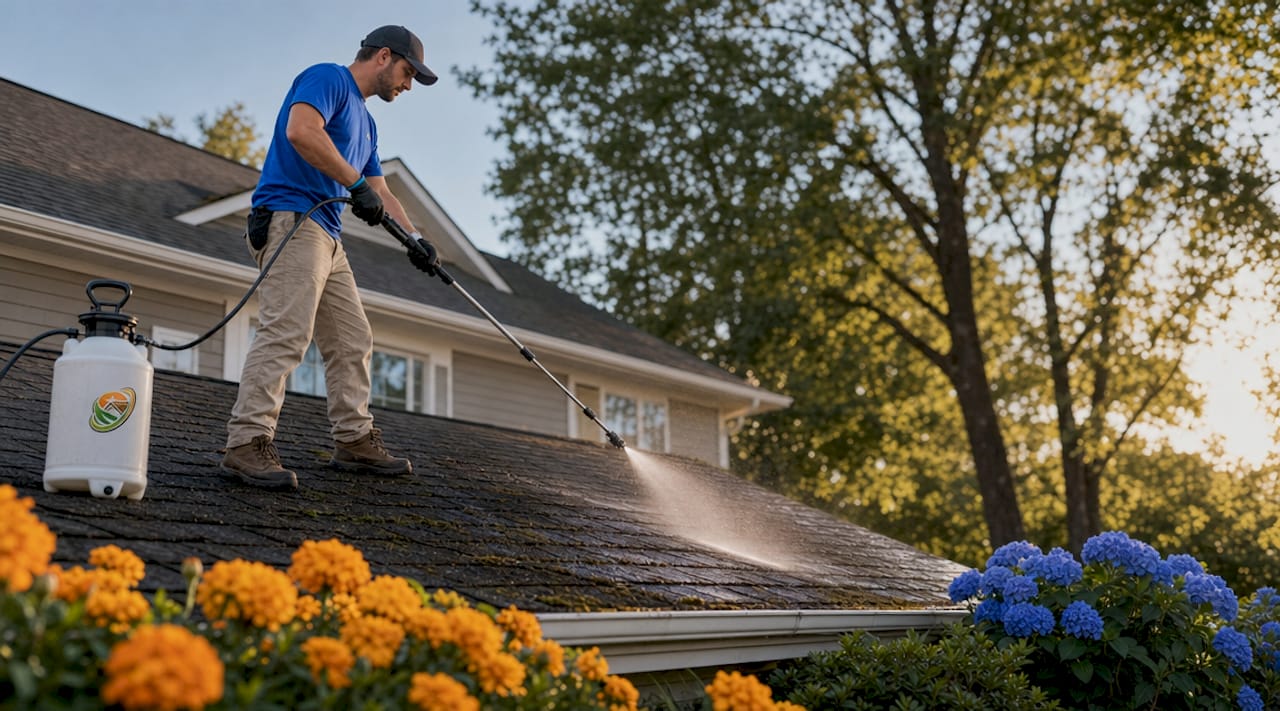
How do roof cleaning chemicals actually work?
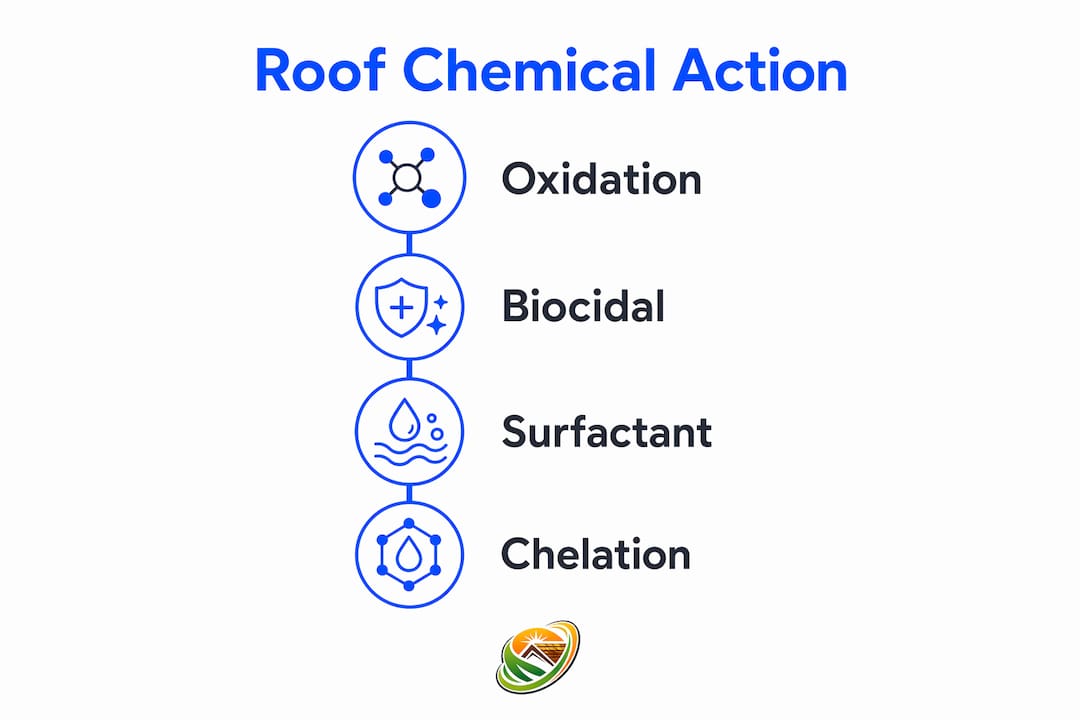
Roof cleaning chemicals work through four distinct mechanisms, each targeting a different type of roof contaminant. Knowing which mechanism does what helps you understand why professional application matters more than just spraying something on and rinsing it off.
- Oxidation: Sodium hypochlorite, the active ingredient in chlorine bleach, releases chlorine radicals that destroy the cell walls of algae, mold, and lichen on contact. This is the fastest and most effective method for killing Gloeocapsa magma, the black-streaking algae common across South Florida roofs.
- Biocidal action: Biocides go beyond killing existing growth. They leave a residual chemical barrier that prevents regrowth for weeks or months after treatment. This is why a properly treated roof stays cleaner longer than one that was simply pressure washed.
- Surfactant emulsification: Surfactants reduce the surface tension of water, allowing the chemical solution to spread evenly across shingle surfaces and penetrate into crevices where algae colonies hide. Without surfactants, the cleaning solution beads up and runs off before it can do its job.
- Chelation: Chelating agents bind to mineral ions in hard water stains and rust deposits, pulling them off the shingle surface without abrasion. This is particularly relevant in South Florida, where mineral-rich water and iron-containing debris leave stubborn stains that oxidizers alone cannot remove.
Pro Tip: Never skip the surfactant. In South Florida's heat, a sodium hypochlorite solution without a surfactant evaporates too quickly to achieve the dwell time needed for full algae kill.
How are roof chemicals safely applied on asphalt shingle roofs?
Safe chemical application on asphalt shingles follows a specific process. Skipping any step risks either an ineffective clean or real damage to your roof.
- Pre-wet surrounding vegetation. Before applying any roof cleaning chemical, saturate plants, grass, and shrubs around the home with plain water. This dilutes any runoff that reaches them and reduces chemical uptake through roots.
- Mix sodium hypochlorite to the correct concentration. Sodium hypochlorite at 1.5% to 3% is the recommended range for asphalt shingles. Higher concentrations accelerate granule degradation and void most shingle warranties.
- Apply with low-pressure equipment. Soft washing operates at 500 PSI or less, which is roughly the pressure of a garden hose. High-pressure washing physically blasts granules off shingles, permanently reducing their UV protection.
- Allow proper dwell time. The solution needs 15 to 30 minutes of contact time to fully penetrate and kill algae colonies. Rinsing too early leaves live organisms behind, which means regrowth within weeks.
- Rinse thoroughly with low pressure. After dwell time, rinse the roof and all surrounding surfaces with clean water. This removes dead organic matter and neutralizes residual chemical before it reaches storm drains.
- Manage runoff actively. Florida's Department of Environmental Protection classifies chlorine compounds as regulated pollutants under stormwater rules. Containing or neutralizing runoff is not optional. It is a legal requirement.
Pro Tip: Apply roof cleaning chemicals in the early morning or on overcast days. Direct South Florida sun causes sodium hypochlorite to degrade rapidly, cutting its effectiveness before it reaches full dwell time.
Sodium hypochlorite vs. oxygen-based roof cleaners
Choosing the right chemical depends on your roof's condition, the type of growth present, and your tolerance for environmental impact. Here is how the two main categories compare:
| Factor | Sodium hypochlorite | Oxygen-based cleaners (sodium percarbonate) |
|---|---|---|
| Kill speed | Fast (minutes to hours) | Slow (hours to days) |
| Effectiveness on algae | High | Moderate |
| Effectiveness on lichen | High | Low to moderate |
| Environmental risk | Higher. Toxic to aquatic life above 1% concentration | Lower. Breaks down into water and oxygen |
| Shingle compatibility | Safe at 1.5% to 3% | Generally safe at recommended concentrations |
| Repeat applications needed | Usually one treatment | Often two or more treatments |
| Cost per treatment | Lower | Higher per effective result |
Sodium hypochlorite achieves fast kill rates but carries runoff toxicity risk, while oxygen-based cleaners like sodium percarbonate are more eco-friendly but require more time and repeat applications. For South Florida homes where algae growth is aggressive and fast-moving, sodium hypochlorite remains the professional standard. That said, oxygen-based cleaners provide safer alternatives in sensitive environments, particularly homes near canals, retention ponds, or protected wetlands common throughout Palm Beach and Broward counties.
A few additional points worth knowing:
- Sodium hypochlorite is most effective at a pH between 9 and 11. Acidic surfaces or runoff degrade its chlorine radical activity, reducing the kill rate significantly.
- Oxygen-based cleaners work best on fresh, light algae growth. For heavy black streaking or established lichen, they rarely deliver a single-treatment result.
- Mixing chlorine and oxygen-based cleaners is dangerous. Never combine them on the roof or in the same tank.
Common mistakes homeowners make with roof chemicals
Most roof chemical damage is self-inflicted. These are the mistakes that cost South Florida homeowners the most:
- Using too high a concentration. Doubling the sodium hypochlorite concentration does not double the cleaning power. It accelerates granule loss and can bleach shingles unevenly. Stick to the 1.5% to 3% range for asphalt shingles.
- Pressure washing instead of soft washing. Soft washing with pressure at or below 500 PSI avoids roofing damage. Anything above that strips granules, which are the shingle's primary defense against UV radiation. Once granules are gone, they do not come back.
- Skipping the pre-wet and post-rinse on vegetation. In South Florida's landscape, many homes have mature palms, ornamental plants, and grass directly below the roofline. Chlorine runoff without a pre-wet and thorough rinse kills vegetation and can contaminate nearby water features.
- Treating the wrong material. Sodium hypochlorite is formulated for asphalt shingles. Metal roofs, clay tiles, and wood shakes each require different chemical approaches. Using the wrong product damages the material and may void your warranty.
- Ignoring regrowth cycles. A single treatment is not a permanent solution. South Florida's humidity and heat create ideal conditions for algae to return within 12 to 24 months. Building a regular maintenance schedule is the only way to stay ahead of biological growth.
Pro Tip: Check your shingle manufacturer's warranty before any chemical treatment. GAF, Owens Corning, and CertainTeed all specify approved cleaning methods. Using an unapproved method can void coverage.
How roof chemicals contribute to extending your roof's lifespan
Chemical cleaning does more than make your roof look better. It directly extends the functional life of your asphalt shingles by removing the organisms that cause physical deterioration.
Gloeocapsa magma, the algae behind those black streaks on South Florida roofs, feeds on the limestone filler in asphalt shingles. Left untreated, it slowly consumes the material that holds granules in place. Moss and lichen go further. They physically lift shingle edges as they grow, creating gaps that allow water infiltration and accelerate cracking. Soft washing kills algae at the cellular level without granule erosion, preserving the UV protection that keeps shingles flexible under South Florida's intense sun.
Granule preservation is the critical link between chemical cleaning and roof longevity. Granules reflect UV radiation. When they are lost, whether through pressure washing or biological erosion, the asphalt beneath heats up faster, dries out, and becomes brittle. Brittle shingles crack, curl, and lose their waterproofing ability. That is the sequence that turns a maintainable roof into a replacement.
"Regular chemical treatment is not a cosmetic service. It is a structural maintenance practice that directly delays the biological and UV degradation that leads to premature roof failure."
For homeowners who want to go beyond cleaning and actually restore shingle flexibility, understanding how shingle flexibility is restored gives a clear picture of what is possible before replacement becomes the only option.
Key takeaways
Roof chemicals work by killing organic growth through oxidation, biocidal action, surfactant emulsification, and chelation, and when applied correctly at 1.5% to 3% sodium hypochlorite with soft washing below 500 PSI, they preserve granules, slow UV degradation, and extend asphalt shingle roof life in South Florida's demanding climate.
| Point | Details |
|---|---|
| Four chemical mechanisms | Oxidation, biocidal action, surfactant emulsification, and chelation each target different roof contaminants. |
| Correct concentration matters | Sodium hypochlorite at 1.5% to 3% cleans effectively without stripping granules from asphalt shingles. |
| Soft washing is non-negotiable | Pressure at or below 500 PSI protects granules and maintains the shingle's UV defense layer. |
| Florida runoff rules apply | Chlorine compounds are regulated pollutants under Florida DEP stormwater rules and must be neutralized. |
| Cleaning extends roof life | Removing algae and moss prevents the biological erosion that leads to granule loss, cracking, and early failure. |
What I've learned watching South Florida roofs age
I have seen a lot of roofs in Broward and Palm Beach County. The ones that fail early almost always share the same story: black streaks ignored for years, a pressure wash that stripped the granules, and then a replacement bill that nobody saw coming.
What most homeowners do not realize is that the chemistry behind roof cleaning is actually straightforward. Sodium hypochlorite kills the organisms. Surfactants make sure the chemical reaches them. Biocides keep them from coming back. The problem is not the chemistry. It is the application. Too much pressure, too high a concentration, or no runoff management, and you have traded a dirty roof for a damaged one.
South Florida's climate makes this more urgent than anywhere else in the country. The combination of heat, humidity, and year-round rain creates a near-perfect environment for Gloeocapsa magma and moss. A roof that looks clean in January can have visible black streaking by June. That is not a cleaning problem. That is a maintenance schedule problem.
My honest advice: treat chemical cleaning as part of your regular South Florida roof care routine, not a one-time fix. And before you spend anything on cleaning, have someone assess whether your shingles are still in a condition worth treating. Cleaning a roof that is already past its preservation window is money spent on the wrong problem.
— Daniellison
How Shingleroofrenewal helps you protect your roof before it's too late
If your roof has visible black streaks, moss, or granule loss, the question is not whether to act. It is whether your roof still qualifies for preservation.

At Shingleroofrenewal, we are certified applicators of Fresh Roof's Green Soy Technology, a soy-based formula that works at the molecular level to restore shingle flexibility, lock in granules, and extend roof life. We are not roofers and we are not a cleaning crew. We are the team you call before the roofer. Our three-step renewal process starts with a free inspection to determine whether your roof qualifies. If it does, you could save thousands compared to full replacement, backed by a 6-year transferable warranty. Serving Broward and Palm Beach County homeowners, schedule your free inspection today.
FAQ
What chemicals are used to clean asphalt shingle roofs?
Sodium hypochlorite is the most widely used active ingredient in professional roof cleaning, applied at 1.5% to 3% concentration with surfactants to improve coverage. Oxygen-based cleaners like sodium percarbonate are used as a lower-risk alternative, particularly near water features or sensitive vegetation.
How long does a roof chemical treatment take to work?
Sodium hypochlorite solutions require 15 to 30 minutes of dwell time to fully kill algae and organic growth on contact. Oxygen-based cleaners work more slowly and may need several hours or repeat applications to achieve the same result.
Is soft washing safe for asphalt shingles?
Soft washing at or below 500 PSI is the recommended method for asphalt shingles and does not cause granule loss when performed correctly. High-pressure washing above that threshold physically strips granules and permanently reduces the shingle's UV protection.
How often should South Florida homeowners treat their roofs with chemicals?
South Florida's heat and humidity allow algae to return within 12 to 24 months after treatment, so annual or biannual chemical treatments are the standard maintenance interval for homes in Broward and Palm Beach County.
Can roof cleaning chemicals damage plants or the environment?
Sodium hypochlorite above 1% concentration is toxic to aquatic life, and Florida DEP classifies chlorine compounds as regulated stormwater pollutants. Pre-wetting vegetation and actively managing runoff are required steps to protect plants and comply with local environmental regulations.