

Open metal valleys are generally the better choice where heavy runoff and debris are a concern, because the exposed metal channel sheds water and pine needles faster and is easier to inspect than a shingle-covered valley. Closed-cut valleys work fine on typical residential roofs with moderate slopes. Woven valleys, though still technically allowed, rarely make sense with today's thicker architectural shingles. Building code and your shingle manufacturer's warranty terms can override personal preference, so read on before you decide.
TL;DR:
- Open metal valleys typically last longer and handle debris and water more efficiently than closed-cut or woven valleys, especially on steep or wide roof sections.
- Building codes require at least 24-inch-wide metal flashing or 36-inch-wide ice-and-water shield centered in the valley, with no fasteners within the flow zone to prevent leaks.
- Heavy rainfall and debris exposure favor open metal valleys, while aesthetic preferences may lead homeowners to choose closed-cut valleys for a seamless roofline.
- Woven valleys are discouraged with modern laminated shingles due to their tendency to trap debris and crack under weight, making them less durable overall.
- Regular checks after storms and during seasonal maintenance can catch early signs of valley failure, and most issues can be repaired by replacing underlayment or upgrading to metal flashing.
Table of Contents
- Open vs Closed Valley Construction: What's Actually Different
- What Building Codes and Manufacturers Require
- Open vs Closed Valley Performance: Water, Debris, Cost, and Looks
- A Homeowner's Checklist for Choosing a Valley Type
- Valley Maintenance: What to Check and When
- Fixing a Failing Valley: Repair vs Replacement
- Why We'd Rather See Your Roof Before It Needs Replacing
- Shingle Roof Renewal: A Free Assessment Before You Spend on Replacement
- Sources
- FAQ
Open vs Closed Valley Construction: What's Actually Different
A roof valley is the internal angle where two slopes meet and funnel water down toward the gutter. How that channel gets built determines whether it becomes your roof's strongest seam or its weakest point.
Open metal valleys work like a miniature gutter built into the roof. Installers run the underlayment and a minimum-width ice-and-water membrane up the valley center, then lay a metal flashing strip over it, usually galvanized steel, aluminum, or painted steel. Shingles from both roof planes are cut back from the centerline and never nailed into that flow zone. The metal stays visible as a straight, shiny channel running from ridge to eave.
Closed-cut valleys hide the metal or membrane entirely. One roof plane's shingles run continuously across the valley first. Then the opposite plane's shingles get cut along a line offset a couple of inches from center, and their edges are embedded in sealant against the first layer. From the ground, a closed-cut valley just looks like shingles meeting at an angle. No metal shows.
Woven valleys interlace shingles from both planes over each other, alternating courses so neither side gets fully cut. This method predates today's thick, laminated architectural shingles, and it shows: weaving those heavier shingles creates uneven bulk that can crack the laminate and trap water underneath. Most contractors and manufacturer guidance from IKO now discourage weaving on anything but thin three-tab shingles.
A California valley is essentially an open-metal valley with a slightly different name, sometimes used interchangeably by regional contractors. If a quote mentions it, ask whether they mean the same open-metal construction described above.
Identifying what you have from a driveway view is straightforward:
- A visible metal strip running down the valley centerline means open metal.
- A clean diagonal cut line with no exposed metal usually means closed-cut.
- A basket-weave pattern of overlapping shingle courses means woven.
- Cracked or lifted shingles right along a cut line often signal a closed-cut valley under stress.
Knowing which one you're looking at gives you the vocabulary to describe the problem accurately to a contractor, which matters more than most homeowners realize.
What Building Codes and Manufacturers Require
The International Residential Code sets the floor, not the ceiling, for valley construction. Under IRC 2024 Section R905.2.8, open, closed-cut, and woven methods are all technically permitted. But the code attaches specific minimums that a lot of installers skip on cheaper jobs.
- Valley lining must be either a minimum 24-inch-wide metal flashing or a minimum 36-inch-wide ice-and-water shield membrane, centered on the valley.
- No nails or fasteners are allowed within the valley's designated flow zone near the centerline.
- Nailing setbacks apply on both sides of the valley to keep shingle fasteners clear of the concentrated water path.
In practice, exposed open-metal width often runs 4 inches at the top of the valley widening to 6 inches near the eave, though trade guidance notes some installers widen that eave exposure to 6 to 8 inches on long valleys collecting runoff from wide roof sections, which slows water velocity and reduces granule scour right where it matters most.
Pro Tip: Ask your contractor to state the membrane width and valley method in writing on the contract, not just verbally. "24-inch minimum metal flashing, no fasteners within 6 inches of centerline" is a sentence any inspector can hold them to.
Manufacturer rules add another layer. IKO recommends open metal valleys for the best long-term performance and notes that some valley construction methods can affect limited warranty coverage. That's worth confirming before installation, not after a leak shows up.
Open vs Closed Valley Performance: Water, Debris, Cost, and Looks
Every valley type handles the same job differently, and the differences show up fastest under heavy rain or a pile of oak leaves.
Water handling. The smooth metal channel in an open valley moves water faster and with less friction than a shingle surface, which matters a lot on steep, long valleys collecting runoff from wide roof areas. Closed-cut valleys handle typical rainfall fine but rely on the shingle seal and underlayment doing more of the work.
Debris and inspectability. Metal sheds leaves and pine needles readily and lets you spot rust, buckling, or granule loss at a glance. Closed and woven valleys trap debris in the shingle overlap, and you can't see the flashing underneath at all without pulling shingles.
Durability. Open metal frequently outlasts the shingles around it, especially with corrosion-resistant materials. Closed-cut lifespan tracks closely with the shingle and underlayment quality. Woven valleys age fastest on modern laminated shingles, and trade inspections increasingly flag them as a liability rather than a feature.
Cost and labor. Open metal costs more in materials and installation time. Closed-cut sits in the middle. Woven installs fastest but that speed advantage evaporates the moment it fails early with today's shingle products.
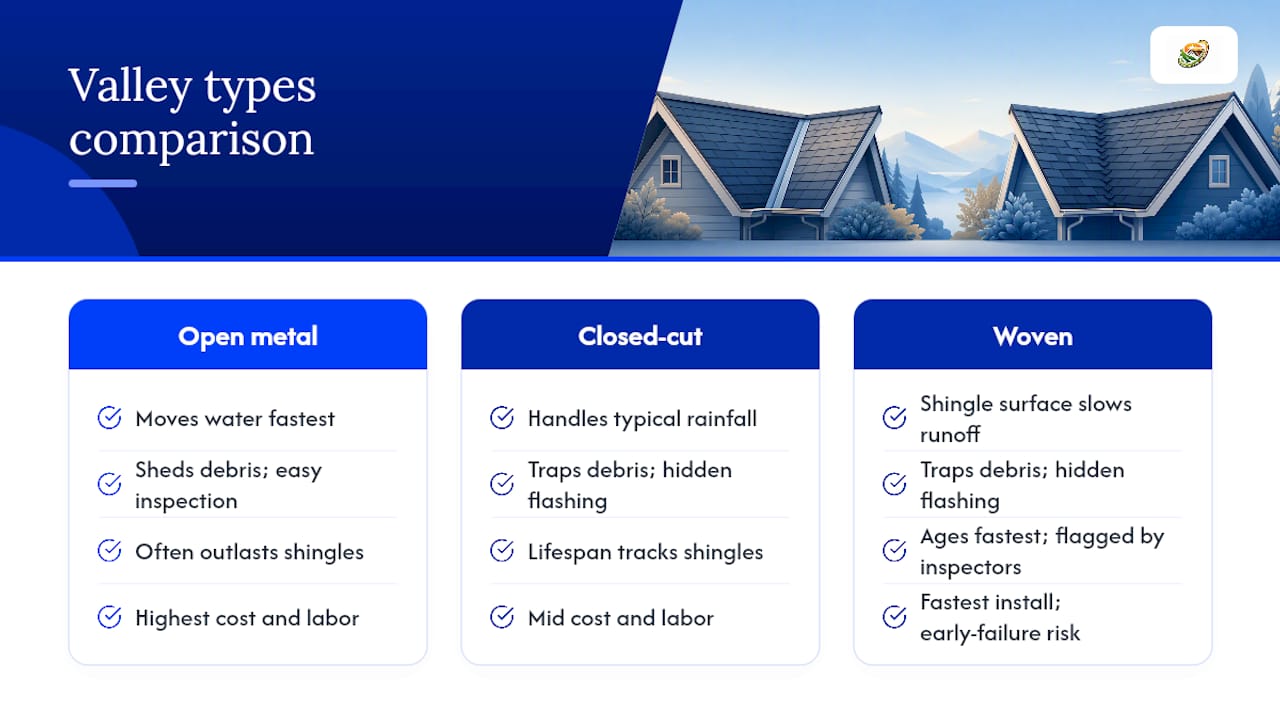
Appearance. Closed-cut wins on curb appeal since no metal interrupts the shingle field. Homeowners who care most about a seamless roofline tend to accept closed-cut on visible front-facing valleys and reserve open metal for less prominent ones.
A Homeowner's Checklist for Choosing a Valley Type
Matching valley type to your specific roof takes more than a preference for looks. Walk through these factors before you sign anything.
- Roof pitch. Steeper roofs move water faster and benefit more from a smooth open-metal channel.
- Contributing drainage area. A valley collecting runoff from two large roof planes needs more capacity than one draining a small dormer.
- Debris exposure. Overhanging oaks or pines make open metal's self-clearing surface worth the extra cost.
- Snow and ice risk. Regions with freeze-thaw cycles benefit from the wider ice-and-water membrane and metal's resistance to ice damming.
- Shingle type. Architectural, laminated shingles pair poorly with woven valleys; save weaving for thin three-tab products only, if at all.
- Visual prominence. A valley facing the street may call for closed-cut; one hidden behind a garage roofline is a good candidate for open metal without any curb-appeal tradeoff.
- Manufacturer warranty language. Confirm whether your shingle brand's limited warranty favors or requires a specific method.
Some contractors mix approaches on the same roof, running closed-cut on shorter, low-runoff valleys and reserving open metal for the longest or steepest one. It's a reasonable cost-performance compromise rather than an all-or-nothing decision.
A useful contract line to request: "Valley construction to meet IRC R905.2.8 minimums, including 36-inch ice-and-water membrane centered on valley and no fasteners within the flow zone."
Valley Maintenance: What to Check and When
Valleys fail quietly at first. Catching the early signs saves you from a much bigger repair bill later.
Walk your roofline (from the ground, with binoculars if needed) and check for:
- Rust spots, buckling, or reversed laps in exposed metal flashing.
- Bare patches or heavy granule loss concentrated in the valley channel.
- Lifted or curling shingle edges right along a closed-cut line.
- Leaf and debris buildup sitting in the valley trough.
- Any dark staining that suggests underlayment showing through worn shingles.
Do this after major storms, and again as a routine check each spring and fall, especially after heavy leaf drop. Storm frequency and insured losses from severe weather have climbed in recent years, which makes post-storm valley checks worth the ten minutes they take.
Pro Tip: Never walk directly in the valley trough itself. It's the most fragile, most water-exposed part of the roof, and stepping there can crack shingles that were otherwise fine. Use a roof-safe rake from the ground or a ladder to clear debris instead.
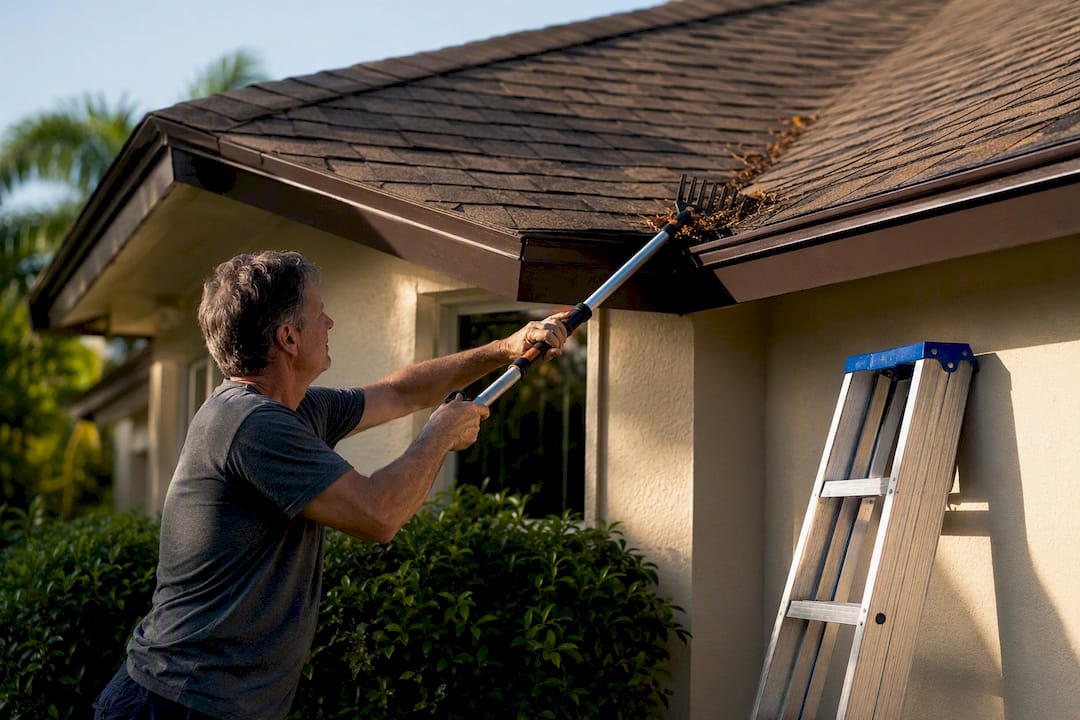
Small debris buildup and minor granule loss are maintenance issues. Persistent leaks, widespread bare spots, or visible underlayment mean you've crossed into repair territory, and it's time to call a professional rather than keep clearing leaves.
Fixing a Failing Valley: Repair vs Replacement
Most valley leaks trace back to the underlayment, not the visible shingle method. Trade sources point to narrow membranes, misplaced nails near the centerline, and reversed metal laps as the usual culprits, and all three are fixable without tearing off the whole roof.
A typical valley repair involves lifting the shingles at the edges, replacing the underlayment and ice-and-water shield underneath, then installing new flashing or re-cutting and re-sealing the shingle edges. For a deeper dive into diagnosing valley leaks specifically, this homeowner guide walks through the process step by step.
When a valley has failed more than once, or was woven with architectural shingles from the start, converting to open metal is often the smarter long-term move rather than repeating the same repair. Galvanized steel, aluminum, and copper are the common flashing choices; just avoid letting dissimilar metals touch, since that combination accelerates corrosion at the seams.
Budget-wise, one solid conversion on a chronically problematic valley usually costs less over five years than three separate patch repairs on the same spot.
Why We'd Rather See Your Roof Before It Needs Replacing
A failing valley doesn't always mean the whole roof is done. If the deck is sound and the surrounding shingles still have flexibility, preservation can extend their life by restoring flexibility and locking in granules rather than replacing shingles that still have useful years left.
Preservation has real limits, though. It can't rebuild missing flashing, fix rotted decking, or reverse a valley that's already leaking into the attic. What it can do is buy time on a roof that's brittle and losing granules but structurally sound. That's exactly why an honest assessment matters more than a quick sales pitch. Get the roof looked at before assuming replacement is your only option.
— Daniellison
Shingle Roof Renewal: A Free Assessment Before You Spend on Replacement
If a roofer just quoted you $15,000 to $30,000 for a full tear-off over a valley problem, get a second opinion first. It is advisable to call a roof preservation specialist before contacting a roofer. Our process is simple: we inspect the roof, assess its actual condition, and tell you honestly whether it qualifies for renewal with our certified Green Soy Technology.

This isn't rejuvenation in the generic sense. The treatment restores shingle flexibility at the molecular level, helps lock in granules, and can extend roof life by 10 to 15 years on qualifying roofs, backed by a 6-year transferable warranty. It won't fix a rotted deck or replace missing valley flashing. But if your shingles are brittle rather than failed, you could save thousands compared to a full replacement, all while keeping usable material out of a landfill. For homeowners in Delray Beach or Plantation, schedule your free roof inspection and find out whether your roof qualifies before you commit to a tear-off you may not need.
Sources
- Open Roof Valley vs. Closed Valley - IKO
- Roof Valley Flashing Details: Open, Woven & Closed-Cut Methods | TRB
FAQ
What Is an Open Valley in Roofing?
An open valley is a roof valley where the metal flashing stays exposed and visible, running down the centerline where two roof planes meet, with shingles cut back from each side rather than covering the metal.
What Are the Two Types of Closed Valleys?
Closed valleys are typically built as either closed-cut, where one plane's shingles run through and the other is cut and sealed against them, or woven, where shingles from both planes interlace over each other without any cutting.
What Are the Three Main Types of Valley Shingle Installation?
The three main methods are open metal, closed-cut, and woven, and IRC R905.2.8 permits all three, though woven is rarely recommended with today's laminated architectural shingles.
What Is the 25% Rule for Roofing?
Definitions of this rule vary by jurisdiction and aren't addressed by the code sources referenced here, so check with your local building department or roofing contractor for the specific replacement threshold that applies in your area.
Which Valley Type Lasts the Longest?
Open metal valleys generally outlast the other methods because the metal channel resists wear better than shingle surfaces and is easier to inspect for early problems like rust or granule loss.