
Professional shingle rejuvenation is a legitimate way to delay full roof replacement across an HOA community, but only for roofs that meet clear age and condition thresholds. On qualifying roofs, certified treatments using specialized rejuvenation technology can extend useful life by years and cut costs sharply compared to tear-off and replacement. The next move for any board is simple: schedule a professional inspection before budgeting for a full reroofing project.
TL;DR:
- Rejuvenation is suitable only for roofs that are between 8 and 18 years old and still flexible, with signs of wear like curling or granule loss.
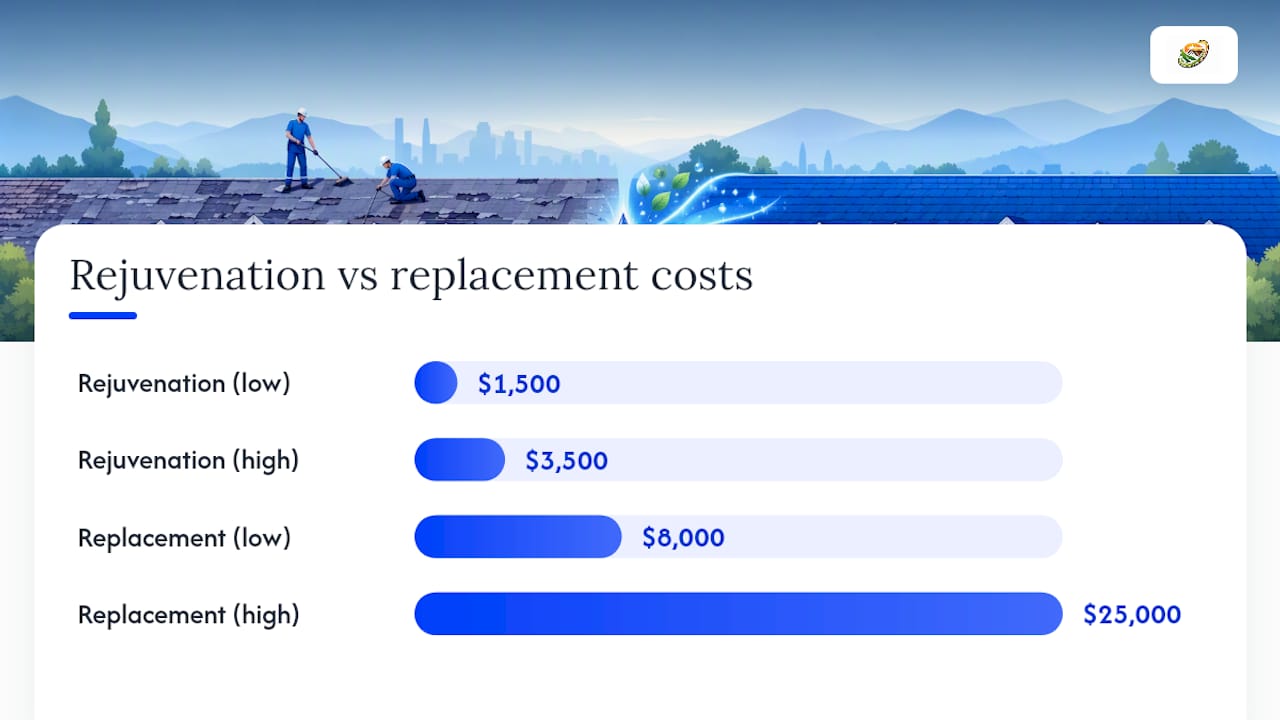
- The treatment costs around $1,500 to $3,500 per home, offering a cost-effective extension of roof lifespan compared to replacement costs of $8,000 to $25,000.
- A thorough professional inspection is essential for qualification, checking roofing components, and documenting condition before scheduling any treatments.
- Rejuvenation can add 3 to 15 years of life, but roofs with active leaks, brittle shingles, or structural issues should undergo replacement instead.
- Community-wide programs require careful planning, approval, detailed documentation, warranty transferability, and scheduling by building groups to ensure consistency and legal compliance.
Table of Contents
- What Is Rejuvenation for HOA Communities and How Do You Know Which Roofs Qualify?
- What Does Rejuvenation Cost Compared to Full Roof Replacement?
- How Do You Run a Rejuvenation Program Across an Entire Community?
- How Should HOAs Maintain Roofs After Rejuvenation Treatment?
- When Should a Community Choose Replacement Instead of Rejuvenation?
- What Documentation and Warranty Backing Should HOAs Expect?
- How Do HOAs Get Approval for a Community Rejuvenation Project?
- Lessons From the Field on Community Roof Programs
- How Shingleroofrenewal Can Help Your HOA Community
- Sources
- FAQ
What Is Rejuvenation for HOA Communities and How Do You Know Which Roofs Qualify?
Not every shingle roof in your community is a candidate, and pretending otherwise wastes money. The industry generally treats roofs between 8 and 18 years old as the practical window for rejuvenation to make sense, since shingles in that range still have enough oil and structural integrity left to respond to treatment. Roofs past 20 years, or ones with brittle shingles, usually don't qualify no matter how good the sales pitch sounds.
The single most useful field test a property manager can run is the corner-bend flexibility check. Lift a shingle corner gently. If it bends without cracking, the roof is likely still flexible enough to treat. If it snaps or crumbles, that roof is past the point rejuvenation can help.
Beyond flexibility, look for these disqualifying signs before you even call an inspector:
- Heavy granule loss visible in gutters or on the ground below downspouts
- Curling, cupping, or clawing shingle edges
- Bald patches where the asphalt mat shows through
- Missing or displaced shingles anywhere on the slope
- Any history of active leaks inside the attic or ceiling
A proper professional inspection goes further than a curbside glance. It should check decking condition, flashing integrity around vents and chimneys, attic ventilation, and any documented leak history for each building.
Pro Tip: Before scheduling inspectors, have your maintenance team walk the property with binoculars and a phone camera. Photograph any granule buildup near downspouts and any visibly curling shingles. That documentation speeds up the qualification process and gives your board a paper trail for every building in the portfolio.
What Does Rejuvenation Cost Compared to Full Roof Replacement?
Board members care about one thing above all else: the math. Rejuvenation treatments typically run $1,500 to $3,500 per average residential roof, or roughly $0.50 to $1.20 per square foot depending on roof complexity and access. Full replacement runs $8,000 to $25,000 per home in most markets, and qualifying homeowners can save significantly by choosing renewal over replacement.
Here's a simple way boards can frame the comparison for homeowners:
- Rejuvenation at $2,500 with a 5 year benefit window costs roughly $500 per year of extended roof life.
- Replacement at $18,000 with a 20 year expected lifespan costs roughly $900 per year.
- A second rejuvenation cycle after the first wears off can still land well under half the annual cost of replacement, as long as the roof still qualifies.
Rejuvenation restores shingle flexibility and typically adds 3 to 5 years of service life per application, though professional soy-based programs with warranty backing have produced 5 to 15 years of added life depending on the roof's age at treatment, according to Shingle Hero.
The math flips once repeated treatments start approaching the cost of replacement, or once a roof crosses into the age range where it no longer qualifies. GAF's own guidance suggests that when repair costs exceed roughly 25% of full replacement, replacement is usually the more responsible call. Boards should build this threshold into their reserve study language so future committees aren't guessing. For a deeper cost breakdown by roof size, see this roof rejuvenation cost guide.
How Do You Run a Rejuvenation Program Across an Entire Community?
Treating one house is straightforward. Treating forty buildings on a shared calendar is a logistics project, and boards that skip the planning stage end up with angry homeowners and inconsistent results.
Start with procurement. Some boards send out a request for proposal to multiple vetted applicators; others work with a single certified contractor for consistency across the whole property. Either way, the contract should require:
- A written pre-treatment inspection report for every building
- A documented repairs list separate from the rejuvenation scope
- A clear scope of work specifying which roofs qualify and which don't
- Warranty terms in writing, including transferability if units change ownership
Governance matters too. Check your CC&Rs for language on exterior alterations and get board approval documented in meeting minutes before signing any bulk contract. Homeowner consent may be needed depending on whether the roofs are owned individually or held in common.
On the ground, schedule treatments by building group rather than trying to do the whole property at once. Protect landscaping and pool areas near work zones, and build a weather contingency window into the schedule since these treatments need dry conditions to cure properly. When the crew finishes, require an inspection report, before-and-after photos, warranty paperwork, and a written maintenance checklist for every building treated. For repair-related prep work ahead of treatment, this repair steps guide is worth reviewing with your contractor.
How Should HOAs Maintain Roofs After Rejuvenation Treatment?
Treatment day isn't the finish line. It's the start of a maintenance clock that boards need to track just as carefully as reserve fund contributions.
- Schedule a visual inspection every 12 months to catch new granule loss or shingle lifting early.
- Plan for retreatment within the 3 to 5 year window most applications provide, sooner in harsh climates.
- Pair any retreatment with ventilation checks, flashing repairs, and gutter cleanouts rather than treating the shingles in isolation.
Coastal and high-UV exposure accelerates oil depletion and granule loss, which shortens the benefit window for buildings facing south or sitting near salt air. Communities in those conditions should plan on the shorter end of the retreatment range rather than assuming every roof behaves the same.
Pro Tip: Keep a simple spreadsheet logging treatment dates, warranty numbers, and inspection photos by building address. When a unit sells, that record makes warranty transfer painless instead of a scramble through old email threads.
When Should a Community Choose Replacement Instead of Rejuvenation?
Rejuvenation changes shingle binder chemistry. It cannot fix what's underneath the shingles, and no amount of marketing changes that fact. Watch for these red flags that mean a roof is done, not delayed:
- Active leaks with visible water staining inside the unit
- Missing shingles or exposed decking anywhere on the slope
- Brittle, cracked, cupped, or delaminating shingles across large sections
- Structural sagging or soft spots in the decking
- Granule loss severe enough to expose the asphalt mat over more than a small fraction of the roof
A responsible applicator will decline treatment on roofs that have crossed these thresholds, because applying rejuvenation to a failing system just delays a decision without fixing anything underneath it. Useful triage math: if repair and patch history on a given roof already exceeds roughly a quarter of what full replacement would cost, per GAF's guidance, that building belongs in the replacement bucket, not the treatment queue. Always get a certified inspector's written assessment before signing off on either path.
What Documentation and Warranty Backing Should HOAs Expect?
A certified applicator of Fresh Roof Green Soy Technology typically runs a straightforward three-step process: inspect the roof, assess its condition, and determine whether it qualifies for preservation. That order matters. No treatment happens before qualification.
Laboratory accelerated-weathering testing on this rejuvenator category found treated shingles lost significantly fewer granules and showed reduced oxidative aging compared to untreated shingles under identical conditions. That's the kind of evidence a board should ask for, not just take on faith.
What an HOA should receive as part of any program includes:
- A written pre-treatment inspection report identifying qualifying and non-qualifying roofs
- Documented qualification notes explaining why each roof passed or failed
- A 6-year transferable warranty, per Shingleroofrenewal's stated program terms
- Before-and-after documentation suitable for board records and future resale disclosures
Homeowners consistently report the same concern before signing on: skepticism that a spray-on treatment can really do what a full reroof does. Honest answers about which roofs qualify, backed by written inspection findings, address that concern faster than any brochure.
How Do HOAs Get Approval for a Community Rejuvenation Project?
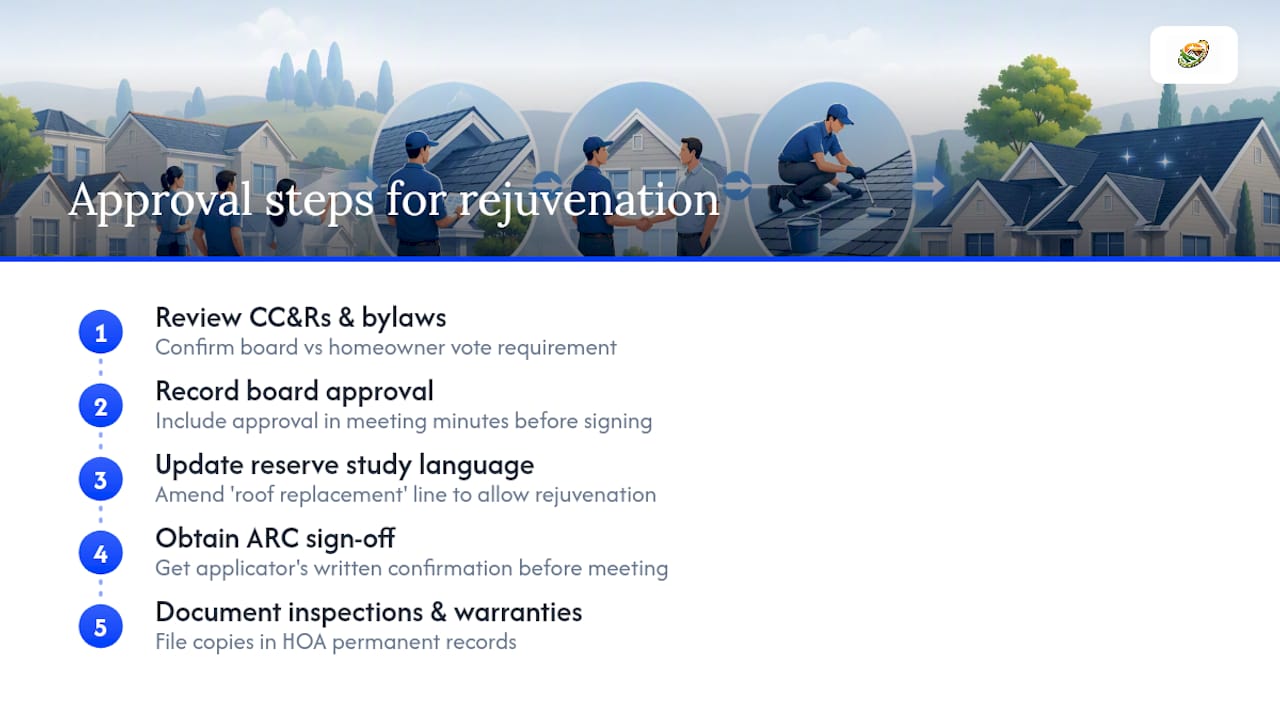
Most CC&Rs treat roof work as an exterior alteration, which means it typically needs board approval documented in meeting minutes before any contract gets signed. Some governing documents also require a homeowner vote for bulk exterior projects above a certain dollar threshold, so pull your specific declaration and bylaws before assuming a simple board vote is enough.
Reserve study language matters here too. If your community's reserve study already earmarks funds for "roof replacement" without mentioning preservation or rejuvenation as an alternative, boards should amend that language at the next update. This protects the board legally when choosing a lower-cost preservation path over the assumed replacement line item, and it gives future boards the flexibility to make the same call.
Architectural review committees, where they exist, should weigh in on any visible changes to roof appearance, though soy-based rejuvenation treatments typically don't alter shingle color or texture in a way that triggers aesthetic review. Still, get that confirmation in writing from your applicator before the committee meeting, not after.
Insurance carriers sometimes ask about roof age and condition during renewal underwriting. A documented rejuvenation program, with inspection reports and warranty paperwork on file, gives your community's insurance agent something concrete to point to instead of a guess about roof age. Keep copies of every inspection report and warranty document in the HOA's permanent records, not just in the property manager's inbox, since these documents may matter years later during a sale or an insurance dispute. For communities weighing architectural shingle specifics, this rejuvenation effectiveness review covers the nuances worth raising with your committee.
Lessons From the Field on Community Roof Programs
Boards almost always raise the same objection first: "How do we know this isn't a stopgap that costs us more later?" The honest answer is that it can be, if a board skips inspection and treats roofs that don't qualify. That's why the qualification step exists, and why a written report matters more than a sales pitch.
Three things save boards real time: getting inspection reports in writing before any vote, requiring warranty transferability up front so unit sales don't stall, and scheduling treatment by building cluster instead of trying to coordinate an entire property in one week — avoiding the common pitfalls that DIY approaches often encounter, as explained in this challenges of DIY door replacement resource. None of that is complicated. It just has to happen in order: inspect first, document everything, and treat only the roofs that actually qualify.
— Daniellison
How Shingleroofrenewal Can Help Your HOA Community
There are alternative options to a full reroofing contract for South Florida communities weighing rejuvenation against replacement. Instead of a tear-off crew and a large invoice, an HOA can obtain a free roof assessment, an honest qualification call, and, for roofs that pass, a certified rejuvenation treatment backed by a transferable warranty.
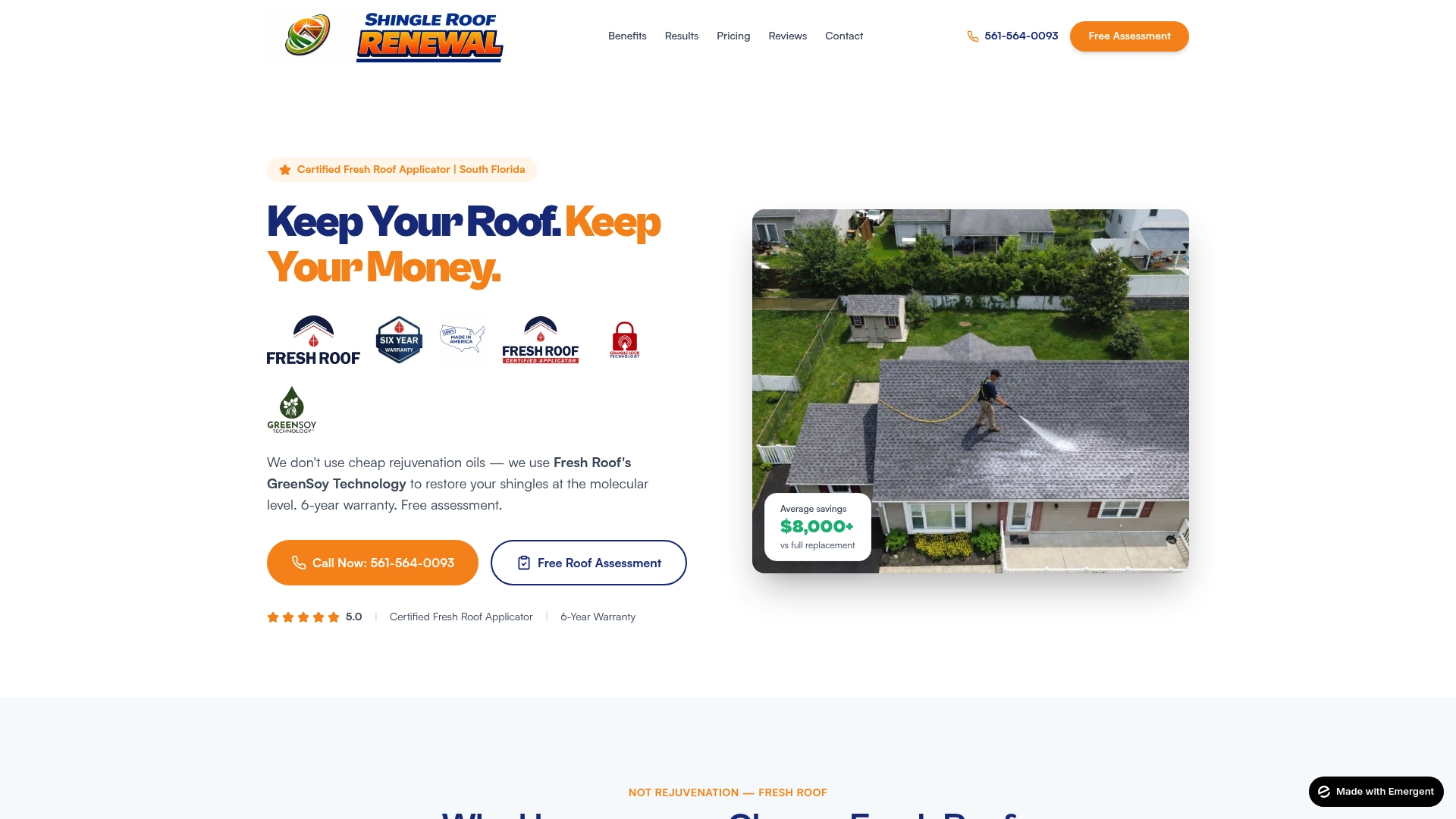
The process starts with a request for a community assessment. Shingleroofrenewal inspects the roofs, documents which ones qualify for Shingle Roof Renewal treatment, and sends the board a written report with photos and recommendations before anyone signs anything. That means no guessing about which buildings need full replacement and which ones can be preserved for a fraction of the cost. Boards in Palm Beach and Broward counties can also review city-specific service pages, including Boca Raton, Delray Beach, and Plantation, for local context on savings and service scope.
If your community's roofs are approaching that 8 to 18 year window, the smart move is a free inspection before your reserve study locks in a replacement budget nobody has verified yet. Schedule a roof assessment and find out which buildings in your portfolio actually qualify.
Sources
- Understanding residential roof repairs: how do I know if my roof needs to be replaced? — GAF
- Shingle rejuvenation: what it does, doesn't, and who qualifies — Can This Roof Be Saved
- Does roof rejuvenation spray actually work? — Shingle Hero
- GSR vs Un-Treated Shingles Study Short-2023 — Roof Rejuvenate USA (laboratory report)
FAQ
How Old Can a Shingle Roof Be and Still Qualify?
Most roofs qualify for rejuvenation between 8 and 18 years of age, provided the shingles still pass a corner-bend flexibility test without cracking. Roofs past roughly 20 years or already brittle generally don't qualify regardless of appearance.
How Much Does Rejuvenation Save Compared to Replacement?
Rejuvenation typically costs $1,500 to $3,500 per home versus $8,000 to $25,000 for full replacement, and qualifying homeowners can save significantly by choosing renewal over a full tear-off.
How Long Does a Rejuvenation Treatment Last?
A single application typically extends useful roof life by 3 to 5 years, though professional programs with warranty backing report 5 to 15 years of added life on qualifying roofs. Shingleroofrenewal backs its Fresh Roof Application with a 6-year transferable warranty.
What Disqualifies a Roof From Rejuvenation?
Active leaks, missing shingles, brittle or delaminating shingles, and structural decking problems all disqualify a roof. Rejuvenation changes shingle flexibility, not structural integrity, so a certified inspection has to confirm the roof qualifies before any treatment happens.
Does Our HOA Need Board Approval Before Scheduling Treatment?
Most CC&Rs classify roof work as an exterior alteration requiring documented board approval, and some communities require a homeowner vote above certain cost thresholds. Check your governing documents and reserve study language before signing a community-wide contract.