
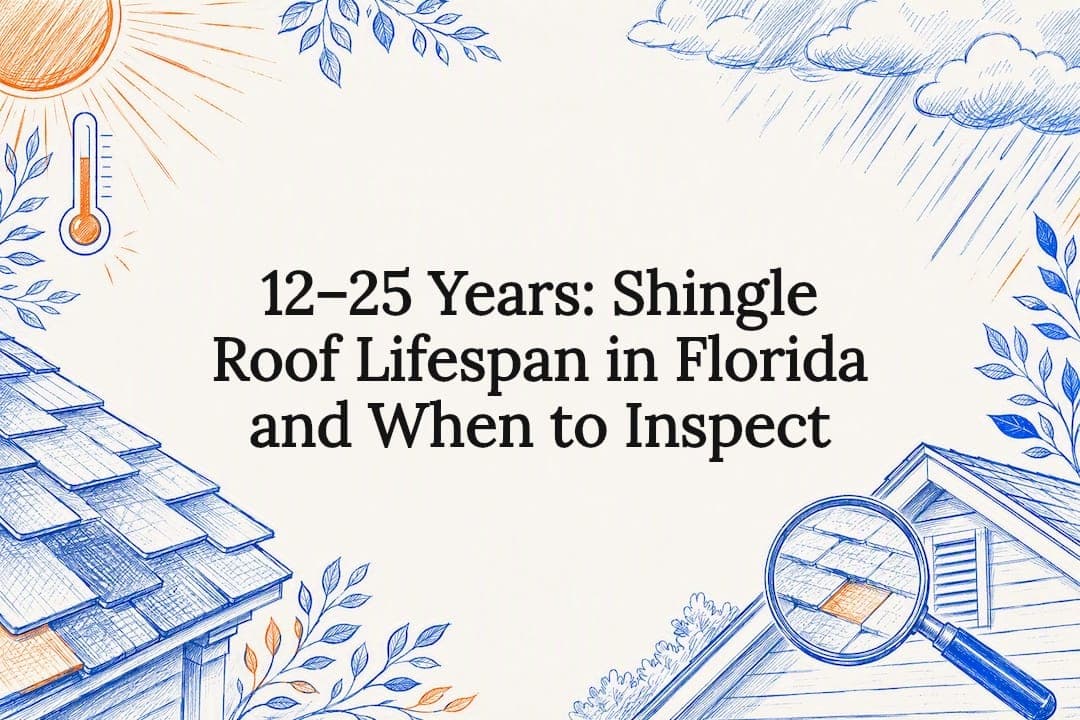
Most asphalt shingle roofs in Florida last 12 to 25 years, depending on shingle type and how close your home sits to the coast, well short of the 30-year mark printed on the shingle wrapper. Florida's sun, heat, and storm cycles do the shortening. If your roof is 10 years or older, or you notice granules piling up in the gutters, cracked shingles, or curling edges, schedule a professional inspection before you assume replacement is your only option.
TL;DR:
- Shingle roofs in Florida typically last 10 to 28 years, depending on shingle type and proximity to saltwater, with coastal homes experiencing faster deterioration.
- Proper attic ventilation can add five or more years to a roof’s lifespan by reducing heat and moisture buildup that accelerate shingle aging.
- Signs of aging include granule loss, curling, cracking, exposed mat, loose shingles, and attic moisture, requiring prompt inspection and maintenance.
- Regular cleaning, checking fasteners, and documenting inspections help extend roof life and support insurance claims or resale efforts.
- Roof preservation treatments can be a cost-effective alternative to replacement for roofs showing early wear but without structural damage.
Table of Contents
- How Long Do Shingle Roofs Last in Florida by Type?
- Why Does Florida's Climate Shorten Shingle Life?
- What Are the Warning Signs of an Aging Shingle Roof?
- What Maintenance Actually Extends Shingle Life in Florida?
- Should You Repair or Replace Your Florida Shingle Roof?
- Is Roof Preservation a Real Alternative to Replacement?
- A Practical Take on Roof Planning in Florida
- Sources
How Long Do Shingle Roofs Last in Florida by Type?
The 30-year rating stamped on most architectural shingle bundles is a lab number, not a Florida number. Manufacturers test in controlled conditions that don't replicate year-round UV exposure or hurricane-season wind loading, so local roof lifespan tends to run well under the printed rating. Knowing where your roof actually falls on that curve matters more than what the packaging promised.
Here's how the realistic ranges break down by shingle type and location:
- 3-tab shingles: 10 to 18 years statewide. These thinner, single-layer shingles have the least mass to resist UV degradation and wind uplift, and they're increasingly rare on new installations for that reason.
- Architectural (laminated) shingles, inland: 20 to 28 years. The extra thickness and layered design hold up noticeably better away from salt exposure.
- Architectural shingles, coastal: 18 to 22 years. Homes within a mile or so of the water lose several years off that inland range.
- Premium impact-rated shingles: Often near or above the 25-year mark, particularly inland, thanks to reinforced mats and higher-grade asphalt.
Coastal proximity is the biggest wild card. Properties within roughly 1,500 feet of the ocean face accelerated wear on shingles and metal fasteners alike, and that salt exposure timeline shortens further the closer you get to open water. If you're in West Palm Beach, Fort Lauderdale, or anywhere along the barrier islands, plan your budget around the lower end of these ranges rather than the manufacturer's headline number.
Why Does Florida's Climate Shorten Shingle Life?
Florida doesn't just wear down shingles faster than other states, it attacks them from several directions at once. UV radiation and roof-deck surface temperatures that regularly climb past 150°F break down the asphalt binder that holds each shingle's mat and granules together, and that breakdown shows up first as granule loss.
Add daily thermal cycling, hot afternoons followed by sudden storm-cooled evenings, and shingles expand and contract repeatedly until seams and edges start to crack. Poor attic ventilation makes this worse by trapping heat directly under the deck, which is one reason Florida repair guidance flags UV and heat as the primary drivers of premature shingle failure.
Humidity brings its own problems. Moisture feeds algae and mold growth on the shingle surface and can compromise underlayment if ventilation is inadequate. Near the coast, salt-laden air corrodes exposed fasteners and flashing faster than inland homes ever experience.
Hurricanes add a cumulative, often invisible cost. Wind uplift can loosen shingle seals and stress fastener lines without knocking a single shingle off the roof, and that hidden wear compounds year over year. Contractors who inspect after every named storm consistently find:
- Lifted or resealed shingle edges with no visible gaps from the ground
- Fastener backing-out at ridge lines and hip caps
- Micro-cracking around flashing points that wasn't there before the storm
One documented factor works in your favor: proper attic ventilation can add roughly five or more years to a shingle roof's service life by keeping deck temperatures and moisture in check. It's one of the few variables a homeowner actually controls.
What Are the Warning Signs of an Aging Shingle Roof?
Catching failure early is almost always cheaper than catching it late. Work through these checks in order:
- Check your gutters and downspouts for granules. A steady buildup of gritty, sand-like debris means the shingle surface is wearing away and losing its UV protection.
- Scan the roof from the ground for curling, cracking, or bald spots. Curled edges and cracked mats are strong signs the shingle is approaching or past its functional lifespan.
- Look for exposed fiberglass mat. Once you can see the mat through worn asphalt, that shingle has essentially no wind or water resistance left.
- Note any loose, missing, or lifted shingles, along with flashing that's pulled away from chimneys, vents, or roof-to-wall transitions.
- Check the attic for daylight, damp insulation, or condensation on the underside of the deck, all signs water is getting past the shingle layer.
- Watch ceilings and walls for new stains after heavy rain, a delayed but reliable indicator of an active leak.
Granule loss and curling call for a scheduled inspection soon. Exposed mat, active leaks, or storm-lifted shingles need attention immediately, before the next heavy rain finds the gap.
What Maintenance Actually Extends Shingle Life in Florida?
A maintenance plan doesn't need to be complicated to work. It needs to happen on schedule, and it needs to focus on the few factors that actually move the needle.
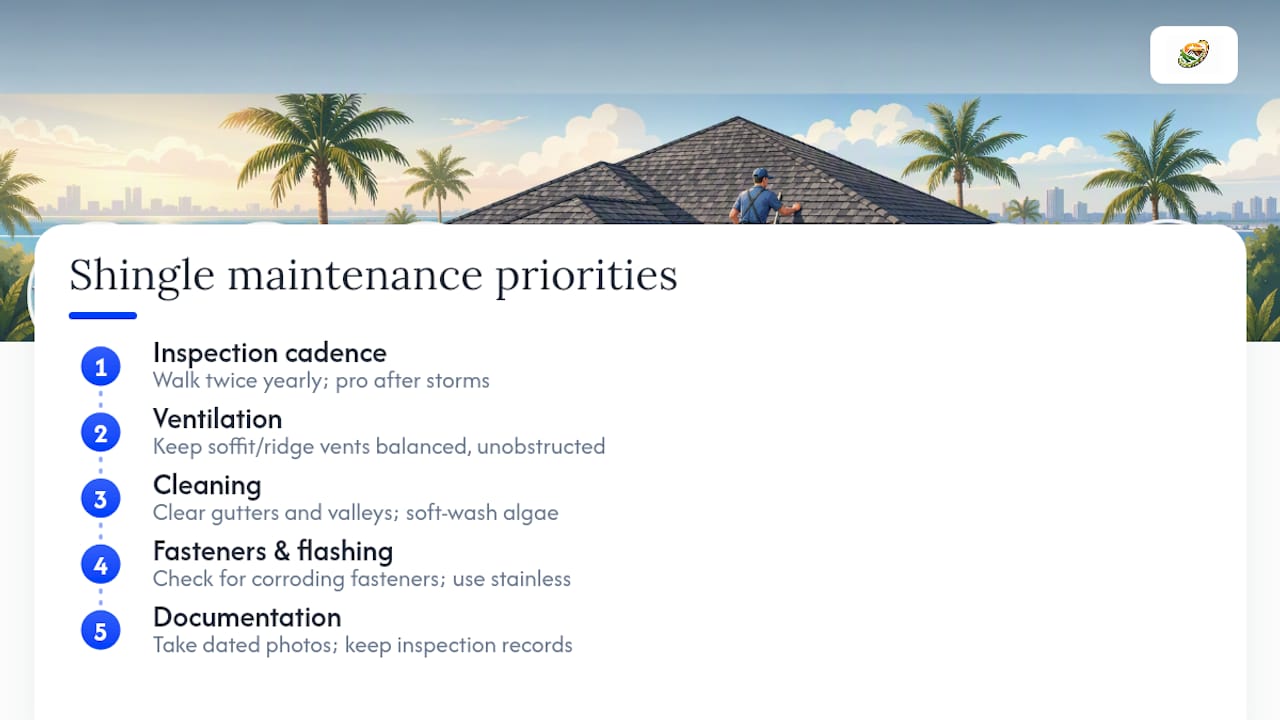
Inspection cadence: Walk the roofline yourself twice a year, and bring in a professional after any storm with sustained winds. Treat the 10-year and 15-year marks as milestones, not just birthdays. That's typically when insurers start scrutinizing roof condition more closely and when hidden fastener or underlayment issues tend to surface.
Ventilation: Confirm your soffit and ridge vents are balanced and unobstructed. Blocked soffit vents are a common, easily fixed culprit behind shortened shingle life. Reducing attic heat gain elsewhere, including window shading that cuts indoor heat load, takes some pressure off the roof deck too.
Cleaning: Clear gutters and valleys of debris regularly so water doesn't pond against shingle edges. For algae staining, use a soft-wash method rather than pressure washing, which strips protective granules and shortens the shingle's remaining life.
Fasteners and flashing: Ask your inspector to check for corroding fasteners, especially within a few miles of the coast, and consider stainless steel replacements where practical.
Documentation: Keep dated photos and written records of every inspection and repair. Maintenance records support insurance claims and resale value, and they're the first thing an adjuster or buyer's inspector will ask for.
Pro Tip: Take timestamped photos from the same four roof corners every time you inspect. Side-by-side comparisons make it obvious when granule loss or curling is accelerating, long before it's visible from the driveway.
Our roof longevity checklist walks through this same routine in more detail if you want a printable version for your own records.
Should You Repair or Replace Your Florida Shingle Roof?
The decision usually comes down to scope and age, not gut feeling. If damage is limited, repair can be cost-effective. When multiple areas are affected or repair costs grow large relative to replacement, a full replacement may be more practical.
Age changes the calculation too. Insurers commonly tighten scrutiny once a roof passes the 10 to 15-year mark, sometimes requiring a certified inspection before renewing or writing a policy. Check current state and local roof replacement guidance before committing either way.
On cost, a full asphalt shingle replacement for a 2,000-square-foot Florida home typically runs somewhere in the $15,000 to $30,000 range depending on material grade, deck condition, and permitting. Architectural shingles generally offer the best lifecycle value for the price; metal and tile cost more upfront but can outlast several shingle replacement cycles.
Whatever you decide, document the roof's condition right after every storm. That record is often the difference between a smooth insurance claim and a denied one.
Is Roof Preservation a Real Alternative to Replacement?
Not every aging roof needs a tear-off. Roof preservation treatments, restorative applications designed to re-flex brittle shingles, seal down lifting edges, and lock in loose granules, can add meaningful years to a roof that's showing wear but hasn't failed structurally. The best candidates are typically roofs in the 10 to 20-year range with granule loss or early curling but no widespread mat exposure or deck damage.
A legitimate preservation process follows a straightforward sequence:
- Inspect the full roof surface and attic for structural and moisture issues.
- Assess whether the shingles still have enough integrity to respond to treatment.
- Recommend either preservation or replacement based on that assessment, honestly.
A legitimate preservation process should follow a straightforward sequence, using certified restorative applications to restore flexibility to qualifying shingles, sometimes backed by a transferable warranty. Author Daniellison covers this approach in more depth in a breakdown of shingle lifespan extension methods, including which roofs typically qualify.
A Practical Take on Roof Planning in Florida
Homeowners tend to treat roof age as the only number that matters. It isn't. Two 15-year-old roofs on the same street can be in completely different condition depending on attic ventilation, storm history, and whether anyone ever checked the gutters for granules. That's why an inspection beats a guess every time, and why I'd rather see a homeowner call for an assessment at year 10 than wait for a stain on the ceiling at year 18.
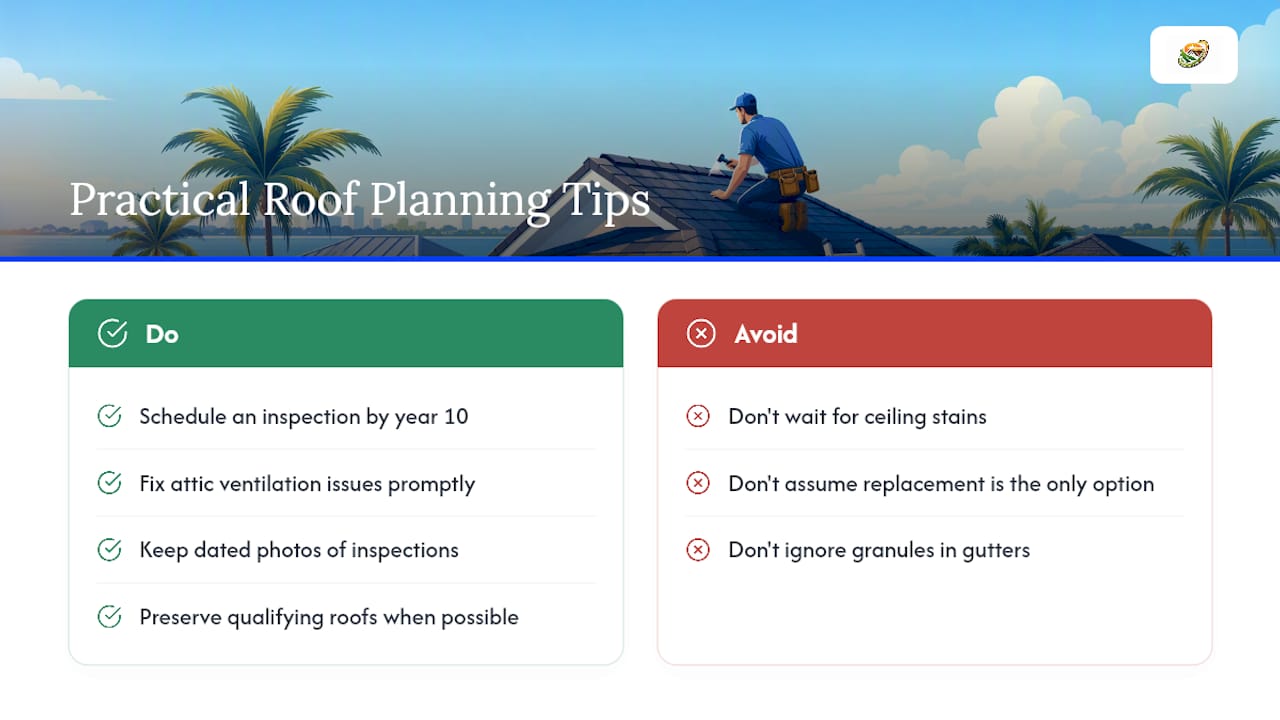
If I had to pick the two highest-return habits, they'd be fixing attic ventilation and keeping dated photos of every inspection. Neither costs much. Both change the outcome when a roof is borderline and both change what an insurer or buyer sees on paper.
There's an environmental angle too, one that gets overlooked. A qualifying roof that's preserved instead of torn off is one less load of shingles in a landfill. That's worth factoring in before assuming replacement is the only responsible move.
— Daniellison
Sources
- Shingle roofing guidance — Florida Disaster/Housing Repair Guide
- How Long Do Roofs Last in Florida? Lifespan by Material (2026) — NEXGEN Roofing
- How Long Does a Roof Last in Florida? Lifespan by Material (2026) — Gimo's Roofing
- Florida PACE — Home insurance roof requirements