
Lifted shingle corners are usually a sign that the adhesive bond under the shingle has failed, from wind, age, moisture or a poor installation. In South Florida, where sun, heat and storms work on a roof year-round, the cause decides the next step: a small repair, an insurance claim, or a roof that still qualifies for preservation. Call us before you call the roofer. We inspect your roof for free and tell you whether it is a good candidate for renewal instead of a $15,000–$30,000 replacement.
TL;DR
- Corners lift first because wind pressure is highest at corners, rakes, eaves and ridges, and an aged or unsealed shingle has little holding it down.
- A lifted shingle with creases, folds or tears points to wind. A lifted shingle with none of those usually points to a failed or aged bond.
- Do not walk a roof with loose shingles. Check from the ground and have the roof looked at after a storm.
- Unsealed shingles rarely reseal on their own, so small lifting tends to grow with each wind event.
- If your asphalt shingles are aging but still intact, we can assess whether they qualify for preservation before you commit to replacement.
Table of Contents
- Why shingle corners lift first
- The four usual causes
- Lifting or curling: how to tell
- What to do when shingles lift in wind
- Why small lifting does not stay small
- How lifted shingles are repaired
- Will insurance cover it?
- Perspective
- Find out if your roof qualifies
- FAQ
- Sources
Why shingle corners lift first
Asphalt shingles are held down by a strip of factory sealant that bonds each shingle to the one below. Wind pressure on a roof is not even. Engineers at Haag report that uplift is highest along windward corners, rakes, eaves and ridges. The loose tab acts a bit like a wing: once it bends upward, it catches more air and lifts further.
So the corner is simply where a weak bond shows first. The question is why the bond is weak.
The four usual causes
Wind
Strong wind can break the seal on a tab. According to IIBEC's review of wind damage, a sealed shingle affected by wind leaves lasting evidence: creases, folds, tears, or missing pieces. A shingle that is merely unbonded, with none of those marks, is not evidence of wind damage.
QXO notes that slight damage can begin around 45 mph, which South Florida sees in many summer thunderstorms and tropical systems.
Age
As asphalt ages it dries out, shrinks and cracks, and the sealant strip deteriorates, which lowers wind resistance, as Haag's research explains. The same paper notes heat and moisture reduce tear strength and that darker shingles deteriorate faster than lighter ones. University of Florida research cited by IIBEC found shingles tend to stay sealed for the first 4 to 5 years, with unsealing becoming more frequent afterward.
This is the cause we see as most relevant to our service. Florida sun and heat dry out asphalt, and the shingle loses flexibility, curls and sheds granules.
Moisture and ventilation
InterNACHI explains that shingles take on moisture, expand and contract, and that edges lose volatile oils faster than centers. That causes curling, cupping and clawing at the edges. Moisture moving up from the attic through the deck can do the same.
Installation
Under-driven nails in the sealant strip, debris, or release tape that stuck can keep a shingle from ever bonding. Cold-weather installation and contaminated sealant can too. A roof that is only a couple of years old and lifting usually has an installation or deck-moisture story behind it.
Lifting or curling: how to tell
| What you see | Likely cause |
|---|---|
| Creased, folded or torn tab, missing pieces | Wind event |
| Corner lifted, no crease or tear | Failed or aged sealant bond |
| Curled corners across large areas of the roof | Aging shrinkage or moisture from below |
| Curling at regular three-foot spacing | Excess tab shrinkage |
| Lifting in a repeating vertical pattern | Installation (racked pattern) |
The curling patterns come from this wind-damage evaluation. Widespread curling is not wind damage. It is a sign of age, and that is the stage where preservation can still make sense.
What to do when shingles lift in wind
- Stay off the roof during and right after the storm. QXO advises checking from the ground first, and never walking on a wet roof or one with loose shingles.
- Walk the yard. Look for shingle pieces on the ground, flipped or missing shingles, dark spots where granules have worn off, and loose flashing. IKO's inspection checklist covers this ground-level walkaround.
- Check inside. In daylight, look at ceilings and, if you can reach it safely, the attic for stains, streaks, sagging or daylight through the roof.
- Photograph everything before anything is moved.
- Cover openings. A tarp over an open area limits further damage.
- Book an inspection. Do not try repairs yourself unless it is an emergency. NRCA warns that most wind damage starts at roof edges and grows through repeated wind cycles, and that puncturing blisters or spreading mastic can cover up evidence a contractor needs.
For a deeper look at checking bonds, see our guide to checking shingle adhesion before calling a roofer, and why self-sealing can take months.
Why small lifting does not stay small
GAF's technical bulletin on wind events notes that broken sealant bonds are unlikely to re-seal on their own, and warns of latent damage that can cause deterioration months or years later. Once a tab is loose, wind suction raises it and pressure pushes it further, exposing the underside to rain.
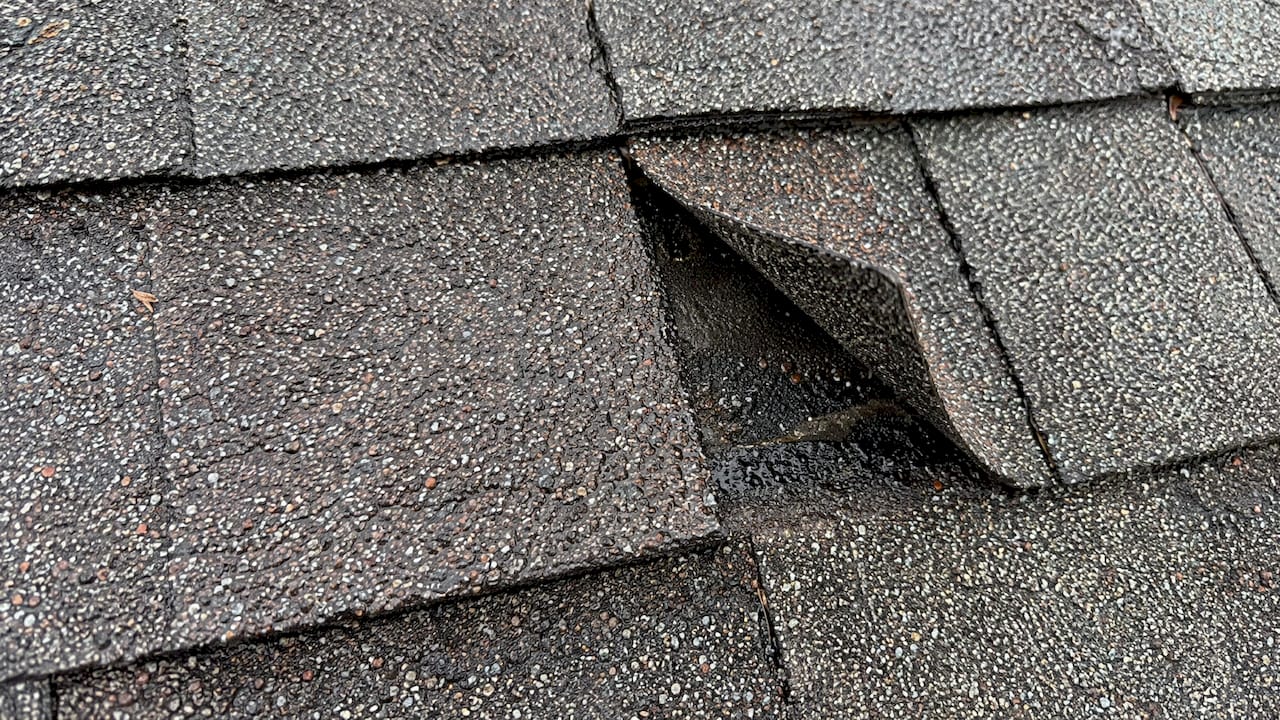
That is why a few lifted corners deserve attention before storm season, not after. A seasonal check helps: ARMA recommends professional inspections in spring and fall. For a similar view on timing, see this note on seasonal roof inspections. In South Florida, the weeks before hurricane season are the natural moment.
How lifted shingles are repaired
Shingle roofs are repairable because sealed shingles can be separated by hand. The standard fix is hand-sealing: for three-tab shingles, quarter-sized dollops of asphalt roofing cement under the lower corners of the tabs, and for laminated shingles, four dollops about an inch in from the ends. Haag's tests found hand-sealed dollops exceeded the original sealant strength by more than 70% after a 30-day cure.
Creased or torn shingles cannot be sealed back down and reused. They are replaced with matching shingles, and fasteners and flashing are reset. The Roofing Brief describes this sequence and notes the code minimum of four nails per shingle.
Roofing cement over a puncture is only a temporary fix, and ARMA says repairs belong with a qualified professional.
Spot repair or something bigger?
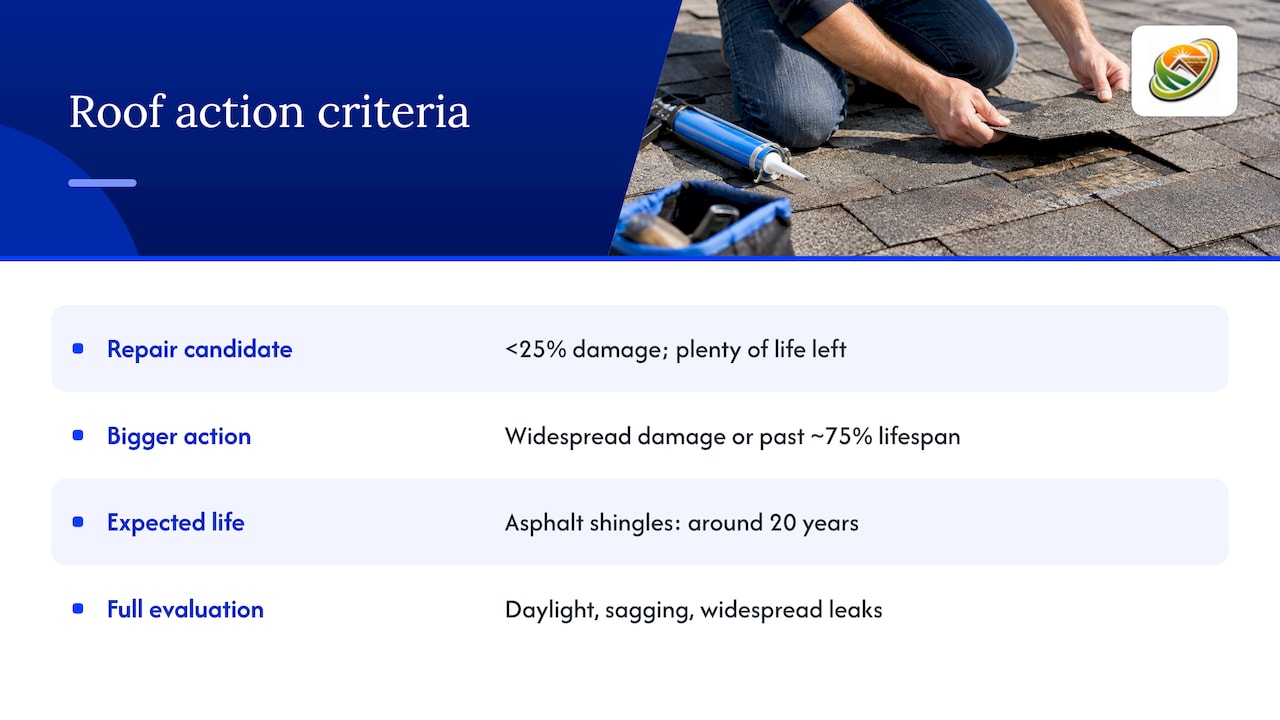
A common rule of thumb is that a roof with less than 25% damage and plenty of life left is a repair candidate, while widespread damage or a roof past about 75% of its lifespan points toward bigger action, according to The Roofing Brief. Asphalt shingles are generally expected to last around 20 years per NAHB figures cited by Haag. Daylight in the attic, sagging, or widespread leaks are different: those need a full evaluation right away.
The middle ground is the roof that is aging, curling and losing granules but is still intact. That is the roof most homeowners assume must be replaced. Our guides on curling shingles and telling leaks from aging shingles show how to sort one from the other.
Will insurance cover it?
Often, if wind did it. Under the standard homeowners form, windstorm is generally covered less your deductible, while wear, deterioration and faulty workmanship are excluded, as this claims overview explains. The same source notes the policy requires prompt notice, protection from further damage and records of repair costs. Florida's hurricane claim rules also tie interior rain damage to wind first creating an opening.
The distinction matters for lifted corners. TWIA's evaluation guidelines say lifted or unsealed tabs alone are not necessarily an indication of wind damage. A shingle that was sealed before the storm and unsealed by it is covered damage. One that never sealed is a different case. Document the storm date, photos from the ground, your roof's installation date and neighbors' damage. For policy questions, talk to your insurance agent. Our piece on hurricane wind damage to shingles goes further.
Perspective
Most homeowners who call about lifting corners expect to hear "you need a new roof." Often the roof is aging, not failed. Florida sun and heat dry out the asphalt, the shingles stiffen, and the bond lets go.
That is where we come in, before the roofer. Our certified Fresh Roof Green Soy Technology is designed to restore flexibility, slow deterioration and lock in granules on qualifying asphalt shingle roofs. We inspect, assess the condition, and tell you honestly whether the roof qualifies. If it does, you could save up to 80% compared to full replacement, backed by a 6-year transferable warranty. It also keeps a tear-off out of the landfill.
Catching it early is the whole point. A roof assessed at the first sign of lifting has more options than one assessed after the next storm.
Daniellison
Find out if your roof qualifies
We serve homeowners in Broward and Palm Beach counties. Our free roof assessment covers the inspection, the condition assessment, and a recommendation on whether your asphalt shingle roof qualifies for Shingle Roof Renewal. Local pages cover Boca Raton, Delray Beach and Plantation.

Schedule your free roof inspection through our main page and find out where your roof stands before storm season.
FAQ
Can I glue lifted shingle corners down myself?
NRCA advises homeowners not to attempt roof repairs except in extreme situations, and roofs with loose shingles are unsafe to walk on. A professional can seal the shingle correctly and spot problems around it. Start with a ground-level look and a free inspection.
Are lifted shingles always wind damage?
No. Wind damage leaves creases, tears or missing pieces. Lifting without those marks usually comes from age, a failed sealant bond, moisture or installation. Widespread curling points to aging.
How long before lifted shingles cause a leak?
There is no fixed timeline. Lifted tabs let wind and rain reach the underside, and the damage grows with each wind cycle. Interior stains, peeling paint or damp rafters mean water is already getting in.
Can an aging roof with lifting corners be saved?
Sometimes. If the shingles are intact and the roof still qualifies, preservation can restore flexibility and slow deterioration. Our asphalt shingle maintenance guide explains what South Florida roofs need.
Sources
- IIBEC: Misconceptions of Wind Damage to Asphalt Composition Shingles
- Haag Engineering: Wind Effects on Asphalt Shingles
- InterNACHI: Asphalt Composition Shingles, Part 31
- Evaluating Wind Damage in Asphalt Shingles
- QXO: Identifying Wind Damage on the Roof and Shingles
- IKO Roof Inspection Checklist
- NRCA: Roof Repair After Strong Winds
- GAF Technical Bulletin TAB-R-143
- ARMA Technical Bulletin: Asphalt Shingle Roofs Are Repairable
- The Roofing Brief: Wind Damage Roof Repair
- The Roofing Brief: Signs You Need a New Roof
- TWIA and TFPA Property Damage Evaluation Guidelines
- Wind Damage Roof Insurance Claims