
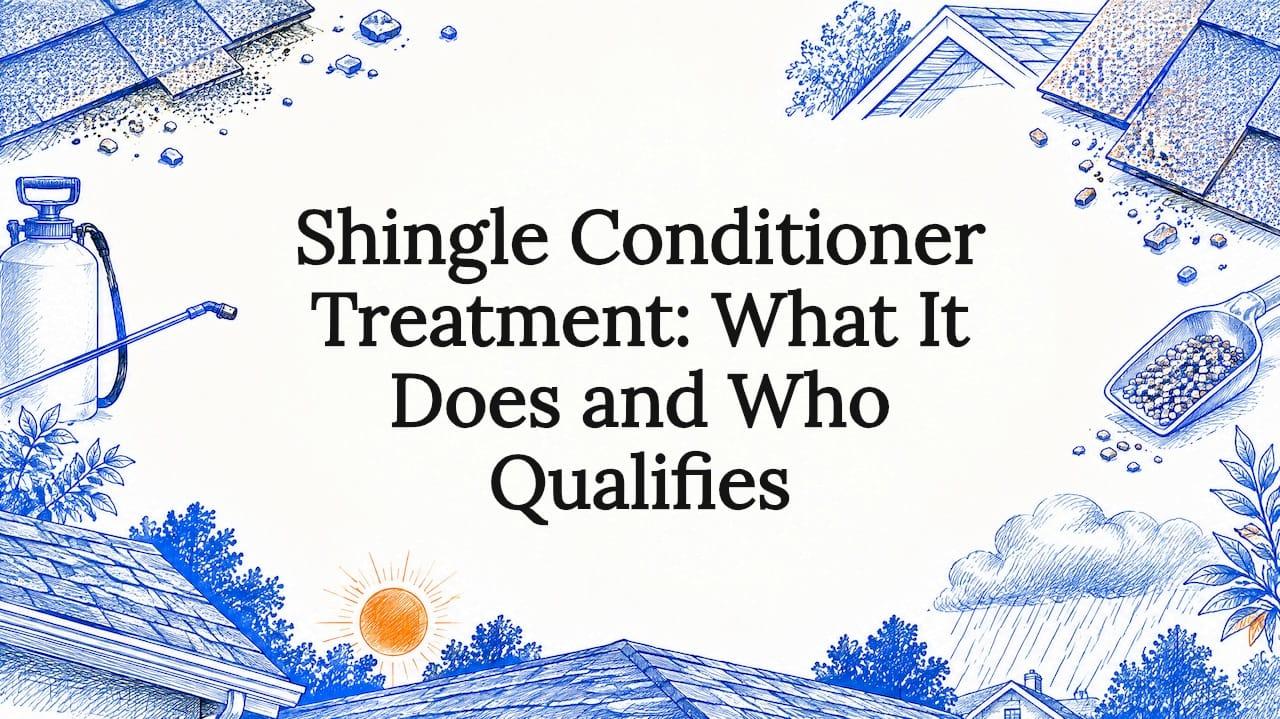
Shingle conditioner treatment is a penetrating, plant-based oil applied to aging asphalt shingles to put back the flexibility that sun and heat take out of them. It works best on roofs that are aging but still sound. It is not a fix for roofs that are already failing. In South Florida, where sun and heat age shingles faster, the first step is an inspection that tells you which group your roof is in.
We are Shingle Roof Renewal. We are not roofers or roof cleaners. We are the company homeowners in Broward and Palm Beach County call before they replace a roof. This guide explains how conditioner treatment works, how to tell whether your roof is a candidate, and what to confirm before anyone sprays anything.
TL;DR
- Shingle conditioner treatment (also called shingle rejuvenation) replaces the oils that evaporate from asphalt shingles as they age, so they stay flexible and hold their granules.
- It suits roofs that are aging but intact. Curled edges, many cracked shingles, heavy granule loss, leaks or rotted decking point toward repair or replacement.
- Before treatment, check your shingle manufacturer's warranty terms, your local building code and how your insurer treats a treated roof.
- Replacement in South Florida can run $15,000 to $30,000. A qualifying roof may be renewed for far less, and we offer a free inspection to find out.
Table of Contents
- What shingle conditioner treatment is
- Why South Florida shingles need attention sooner
- What the evidence says about results
- Which roofs qualify
- How the application works
- What to confirm before treatment
- Conditioner treatment vs. replacement: the cost picture
- What the industry says, and how to use it
- Our perspective
- Get a free roof inspection
- FAQ
- Sources
What shingle conditioner treatment is
An asphalt shingle is built on an asphalt binder that contains light oils. Those oils let the shingle expand and contract with temperature swings without cracking. Over years of sun and heat, the oils slowly evaporate through oxidation. The shingle gets stiffer and more brittle, and it starts shedding the granules that protect it.
A conditioner (or rejuvenator) is typically a soy-based bio-oil. It is sprayed on the roof surface and absorbs into the asphalt over the following day or two. The idea is the same as conditioning dried-out leather: the product does not add a new surface, it works to restore the original material from within. Soy-based rejuvenator makers describe it as a moisturizer for the roof, restoring oils lost to evaporation so the shingle can last longer instead of being replaced.
Two points help you separate treatments from other roof products:
- It is not a paint or a sealant coat. A conditioner penetrates the shingle. A coating sits on top of it.
- It is not a repair. It does not replace missing shingles, fix flashing or dry out wet decking.
Our own process uses Fresh Roof's Green Soy Technology, and we are certified applicators. Fresh Roof is designed to work at the molecular level, restoring flexibility and locking in granules. In the company's lab results, it restored about 50% of shingle flexibility, compared with roughly 20% for standard rejuvenation oils. You can see how we describe the difference on our Fresh Roof vs. rejuvenation page.
Why South Florida shingles need attention sooner
Shingle life is not the same everywhere. Broward and Palm Beach County roofs deal with strong year-round UV, heat that swings sharply between dawn and mid-afternoon, wind-driven rain and a long storm season. Salt air adds wear near the coast. Hot, poorly ventilated attics bake shingles from underneath at the same time.
The result is a familiar pattern: granules collect in gutters and at downspouts, edges start to curl, and shingles lose the flexibility that lets them ride out thermal cycling and wind. A roof that is only 10 or 12 years old can already show it.
That is exactly why early action matters. Conditioner treatment is a preventative tool. It is most useful while the shingle still has material worth restoring, which is before cracking and curling become widespread. For a deeper look at how this plays out locally, see our guide to restoring asphalt shingle flexibility on Florida homes.
What the evidence says about results
Most of the published testing looks at flexibility, granule retention and fire and hail behavior.
- A 2025 academic preprint studying soybean oil-based emulsions on aged shingles reported improved grit retention. Aged samples treated at 10 wt% had values comparable to new shingles. Those samples also showed restored ductility and hail resistance, and reduced flame spread compared with untreated specimens.
- Researchers connected to the soybean industry note that the application window is typically shingles five to 20 years old.
- Contractors who apply conditioners describe the benefit as rehydrated shingles that stay flexible, resist cracking and shed water better.
Lab numbers are not a promise for any single roof. Results depend on the shingle, its age, how much oil it has lost and how it was installed. That is why we do not treat every roof. We inspect first, and we tell you honestly whether yours qualifies.
Which roofs qualify
A conditioner needs shingles that still have structure. The general eligibility picture looks like this:
| Roof condition | Usually a candidate? | What it means |
|---|---|---|
| 5 to 20 years old, flexible, minor granule loss | Yes | Early or mid-life aging is where treatment has the most to work with |
| Surface crazing, small micro-cracks, edges still flat | Often | Oil can penetrate the upper layer most damaged by UV |
| Curled edges or many cracked shingles | Usually not | These may disqualify a roof |
| Granule loss above about 30 percent | Usually not | The same source says loss typically cannot exceed 30 percent |
| Active leaks, bad flashing, missing shingles, rotted decking | No | These need repair or replacement first |
| Past its rated life | Rarely | Treatment does not address what is wrong with a roof that has run its course |
A roofing industry association makes the timing point this way: a treatment in the back half of a shingle's rated life, on a roof with no other defects, has something to work with. A roof that is past its term, or leaking at a flashing, is a different story.
We cover this in more detail in Roof Rejuvenation Eligibility: Does Your Shingle Roof Qualify? and in our piece on architectural shingles.
A quick self-check from the ground
Before you call, walk the property after a dry day and look for:
- Granules in gutters, at downspout outlets and on walkways.
- Edges that lift, curl or cup.
- Cracks or crazing across the shingle face.
- Dark streaks or moisture-holding shaded areas.
- Ceiling stains or attic daylight, which point to a leak that needs repair first.
This is only a screening step. Never climb an aging roof to check it yourself. A trained inspector can see what you cannot from the ground.
How the application works
A professional application is quick compared with a tear-off. The oil is sprayed across the roof surface. For a typical home, application usually takes under a day, and absorption continues for about a day or two afterward. During that time the shingles may look darker or slightly glossy, which fades as the oil is absorbed.
Preparation matters just as much as spraying:
- Inspect and mark problem areas. Loose, broken or missing shingles and flashing issues are handled before treatment.
- Clean gently. Avoid high-pressure washing. Water at pressures commonly cited between 1,500 and 3,000 PSI can strip granules from asphalt shingles.
- Watch the weather. Application needs a dry window, which in South Florida means planning around afternoon storms.
- Protect landscaping and surfaces. Plants, cars and pool areas need covering or moving before work starts.
We walk you through the schedule at the inspection so you know what to expect on the day.
What to confirm before treatment
A good decision starts with three checks. None of them are hard, and all of them protect you.
Your shingle warranty
Shingle makers write their warranties around the product as installed. The Asphalt Roofing Manufacturers Association notes that many manufacturers do not recommend field treatments on their shingles. One manufacturer's published guidance says an after-market coating on shingles with a protective algae-resistance feature is not approved and may affect coverage under the algae warranty and other applicable warranties.
In practice, this means you should pull out your original shingle warranty paperwork, or have us help identify your shingle brand and product line, before treatment. If your roof is still under a manufacturer warranty, ask the manufacturer in writing how treatment would affect it. Many Florida roofs in the treatment age range are already outside their original warranty terms, and our own 6-year transferable warranty on the work stays with the home if you sell.
Your local building code
The same association points out that state or local building codes may prohibit field-applied coatings or rejuvenators. Broward and Palm Beach County have their own roofing requirements, so confirm with your city or county building department, or have your contractor confirm, that treatment is permitted for your address.
Your insurance
Treatment does not reset the roof's installation date, and it does not count as a roof replacement for insurance purposes. Florida insurers often ask about roof age and condition, so keep your inspection report, photos and warranty documents together. We explain what to expect in Roof Rejuvenation and Insurance: What South Florida Homeowners Should Know.
If storm damage has already led to a claim, a firm that handles build-back and insurance claim help can coordinate rebuilding work alongside the paperwork. Roof conditioning is for sound roofs, not for storm-damaged ones.
Conditioner treatment vs. replacement: the cost picture
Full replacement on a South Florida home commonly runs between $15,000 and $30,000, according to our experience with local homeowners. Beyond the cost, a tear-off sends the old shingles to a landfill.
A conditioner treatment is designed to be a fraction of that. One Minnesota applicator describes the math this way: if a replacement costs $20,000, spending 20% or less on treatments that last about five years and can be repeated could nearly double the roof's life. Local pricing is different, and we do not publish a flat price because it depends on roof size, pitch and condition. We quote after the free inspection.
For a qualifying roof, our claim is that you could save up to 80% compared with full replacement. For a broader look at the numbers, read how to extend shingle life on an aging asphalt roof and our cost-effective roofing guide.

What the industry says, and how to use it
Industry groups are cautious about field-applied products in general. The roofing manufacturers' association advised against field application of coatings or rejuvenators in a bulletin published in July 2026, and said it sees little documentation of long-term benefits. The takeaway for you is practical: treat the product as part of a decision, not a shortcut. Choose a certified applicator who inspects first, put the warranty terms in writing, confirm code and insurer requirements, and keep your records.
That is how we work. Every job starts with a free inspection and an honest assessment, and we tell homeowners when a roof is not a candidate.
Our perspective
We built Shingle Roof Renewal around one idea: call us before you call the roofer. Most homeowners hear "your roof is 12 years old" and assume replacement is the only path. A lot of those roofs are still maintainable.
Conditioning is not magic, and we do not pretend it is. What we do is match the roof to the right solution. Some roofs need a roofer, and we say so. Others are aging but sound, and for those the best value is to restore flexibility, lock in granules and slow further wear before cracks and curling set in.
In Broward and Palm Beach County, the sun does most of the damage long before the roof looks bad from the street. Catching it early is what keeps the treatment option open, and it keeps thousands of dollars in your pocket and old shingles out of the landfill.
That is why we use Fresh Roof's Green Soy Technology as certified applicators, why we back the work with a 6-year transferable warranty, and why the first step is always a free look at your roof.
Daniellison
Get a free roof inspection
If your asphalt shingle roof is aging but not failing, a short inspection can tell you whether conditioning is a good fit or whether you should start planning for a roofer. We inspect the roof, assess its condition and tell you whether it qualifies for renewal. There is no cost for the assessment.
See our roof renewal services or schedule your free roof assessment. We serve homes across Broward and Palm Beach County, including Boca Raton, Delray Beach and Plantation.
FAQ
How long does a shingle conditioner treatment last?
Published estimates for soy-based conditioners range around three to five years per application, depending on the roof and its exposure. Results vary with shingle type, age and weather, so we assess each roof individually. Our work comes with a 6-year transferable warranty.
Is shingle conditioner the same as a roof coating or sealer?
No. A conditioner is meant to penetrate the shingle and restore oils, while a coating forms a layer on top. Manufacturers' guidance treats coatings and rejuvenators with caution, so confirm warranty and code questions before any field application.
Will conditioner treatment fix a leaking roof?
No. Leaks, failed flashing, missing shingles and rotted decking need repair first. Conditioning is designed for aging roofs that are otherwise sound, and we will tell you at inspection if repair or replacement is the better path.
Can I apply a shingle conditioner myself?
We do not recommend it. Walking an aging roof is a fall risk, and results depend on matching the product to the roof's condition and applying it evenly. A free inspection with a certified applicator is the safer starting point.
Sources
- Soy oil to roof rescue (Farm Progress)
- Restoring Asphalt Shingle Integrity with Soybean Oil-Based Emulsions (2025 preprint)
- Soy Offers New Life for Aging Roofs (AURI)
- Are Roof Rejuvenation Products Worth It on an Asphalt Roof? (NRCIA)
- Application of Coatings or Rejuvenators on Asphalt Shingles (ARMA)
- Coating of Asphalt Shingles (Atlas Roofing)
- Can a coating really add 10 years to an aging asphalt roof? (Hard Hat Report)
- Does Pressure Washing Damage Your Roof? A Florida Guide