
Modern fiberglass asphalt shingles can earn the top Class A fire rating under ASTM E108 / UL 790 testing, but a label alone doesn't guarantee protection. Most real-world roof fires start from wind-blown embers landing in gutters, valleys, or gaps, not direct flame contact. Check your bundle label or product spec sheet today, then walk your roofline and clear debris from valleys and vents. If your shingles are aging or the assembly doesn't match what was tested, a company like Shingle Roof Renewal can assess whether preservation still makes sense before you call a roofer.
TL;DR:
- A Class A fire rating for shingles depends on the entire tested assembly, not just the shingles, and mismatched components can void that rating.
- Embers landing in gutters, valleys, or gaps cause most home fires, making debris removal and vent screening essential for wildfire protection.
- Maintaining the roof by removing debris, repairing shingles, sealing gaps, and considering ember-resistant underlayment can significantly extend fire resistance over time.
- Roof design influences ember accumulation; steep slopes shed debris better, but complex shapes and open eaves increase vulnerability requiring extra upkeep.
- Most aging roofs can often be preserved or renewed through inspection, debris clearing, retrofit upgrades, and flexibility treatments, avoiding costly full replacements.
Table of Contents
- How Roof Fire Ratings Work (ASTM E108 / UL 790)
- Where Shingles Sit in the Fire-Resistance Hierarchy
- How Roofs Actually Ignite: Embers, Radiant Heat, and Direct Flame
- How to Check Your Shingles' Fire Rating and Assembly Match
- Homeowner Maintenance and Retrofit Steps That Reduce Ignition Risk
- When to Preserve, Repair, or Replace: A Homeowner Decision Guide
- Real-World Fire Performance: What the Data Actually Shows
- How Roof Design and Slope Affect Fire Resistance
- Maintenance Tips to Preserve Your Shingles' Fire Rating Over Time
- Why the Rating on the Bundle Isn't the Whole Story
- Schedule Your Free Roof Assessment
- Sources
- FAQ
How Roof Fire Ratings Work (ASTM E108 / UL 790)
Roofing fire ratings come from a specific pair of test methods: ASTM E108 and UL 790, which are nearly identical and used interchangeably by code officials across North America. These tests aren't a single pass/fail check. They combine three separate exposures to see how a roof covering holds up under different fire conditions.
- Spread-of-flame test. Measures how far flame travels across the roof surface once ignited.
- Burning-brand test. Drops a lit wood brand onto the roof to simulate an ember landing and burning in place.
- Intermittent-flame test. Applies repeated flame exposure to check for delayed ignition or flare-up.
Products that pass all three at the highest severity earn a Class A rating, the most fire-resistant tier, followed by Class B and Class C. These classifications only measure how a roof reacts to fire from outside the structure. They say nothing about how a roof performs in an attic fire or how long the structure below will hold.
Here's the detail most homeowners miss: some shingles only reach Class A as part of a tested assembly, meaning the shingle, underlayment, and deck type were tested together. Swap the underlayment or install over a different deck, and you may void that rating even though the shingle itself never changed, a point ARMA's product standards make explicit.
Where Shingles Sit in the Fire-Resistance Hierarchy
Asphalt shingles get an unfair reputation as the weak link in fire performance, but that reputation is outdated. Fiberglass mat shingles, the standard in most homes built or reroofed in the last two decades, commonly meet Class A criteria by material alone when installed correctly, according to ARMA. Older organic-mat shingles, still found on some aging roofs, typically do not carry the same rating.
Here's how the broader materials landscape breaks down:
- Tile and slate are noncombustible by nature and generally rate Class A without needing a tested assembly.
- Metal roofing is also noncombustible, though it transfers heat differently. A metal roof can still allow attic ignition if the deck and underlayment beneath it aren't protected.
- Wood shakes rate lowest among common roofing materials unless treated, and even treated versions require ongoing maintenance to hold their rating.
- Fiberglass asphalt shingles land solidly in Class A territory when the full assembly, not just the shingle, has been tested and matched.
The takeaway: shingle roofing isn't the fire hazard people assume. What matters more is whether the installed roof matches what was actually tested.
How Roofs Actually Ignite: Embers, Radiant Heat, and Direct Flame
Direct flame contact is the exception, not the rule, in most home roof fires. The primary cause of home ignitions during wildfires is windborne embers, sometimes called firebrands, that travel well ahead of an actual fire front and settle into any spot that will hold them long enough to smolder.
Three exposure types put a roof at risk, and they behave very differently:
- Ember and firebrand exposure. Embers land in gutters, roof valleys, the gap where a roof meets a wall, dormers, and open eaves, then smolder against debris or dry vegetation until they ignite something combustible.
- Radiant heat. Heat from a nearby fire can dry out and eventually ignite materials without any direct contact, especially when vegetation or a structure sits close to the roofline.
- Direct flame contact. This happens when flames physically reach the roof, often from a burning tree, fence, or adjacent structure touching the eaves or overhangs.
Embers cause the overwhelming share of structure ignitions, which is why gutter and valley debris matters so much more than most homeowners assume.
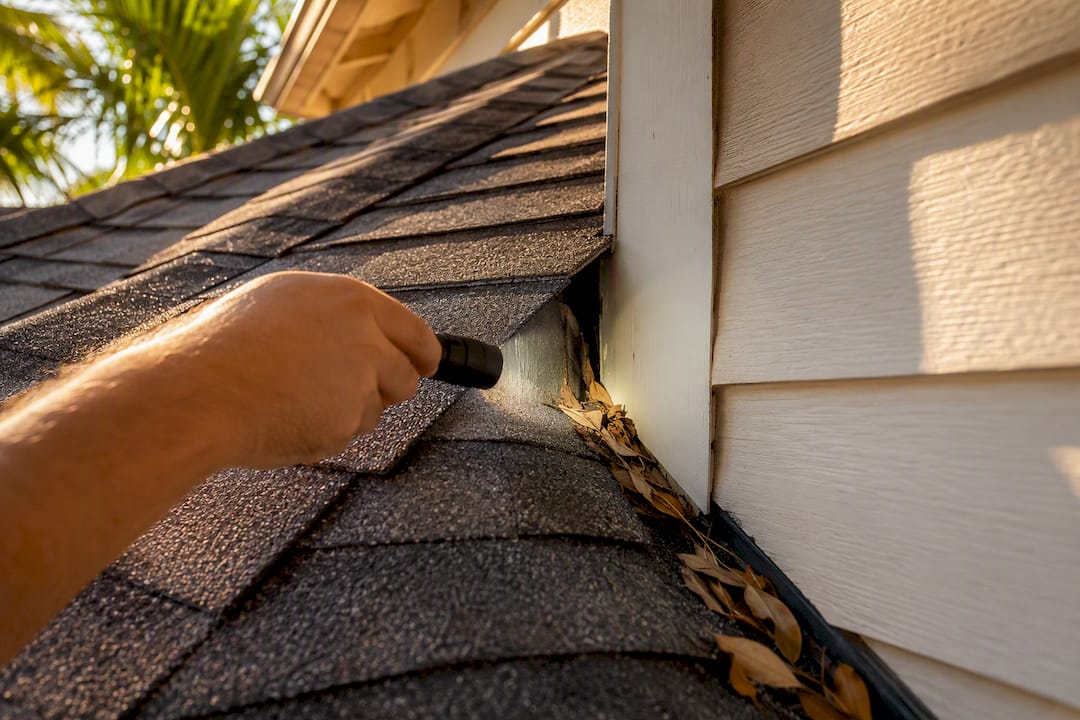
Pro Tip: Grab a flashlight and check your roof-to-wall gaps and dormer corners twice a year. These tight, shaded spots collect leaf litter fastest and are exactly where a stray ember would settle undetected.
How to Check Your Shingles' Fire Rating and Assembly Match
Confirming your roof's actual fire performance takes about fifteen minutes and a few photos. Start with the paperwork, because the rating lives on paper before it lives on your roof.
- Look for the fire rating printed directly on the bundle label, saved from installation, or request the product spec sheet from the manufacturer if you don't have it.
- Search the shingle's model number against its UL or ASTM listing to confirm what specific assembly earned that Class A designation.
- Photograph the bundle label and keep the original invoice. Insurance adjusters and building officials both accept this as proof during claims or permit reviews.
- Confirm the underlayment and deck type on your roof matches what the manufacturer's installation instructions specify for that rating, since a mismatched assembly can quietly void a Class A claim, as ARMA and independent analysis of Class A assemblies both note.
If you're unsure, ask a contractor or your local building official for the assembly's listing number directly rather than accepting a verbal assurance that "it's Class A." Paper trails settle disputes; memory doesn't.
Homeowner Maintenance and Retrofit Steps That Reduce Ignition Risk
Most ignition risk on an otherwise sound roof comes down to accumulated debris and small gaps, not the shingle material itself. That's good news, because it means the fixes are mostly cheap and doable in an afternoon.
Start with routine maintenance:
- Remove pine needles, leaves, and other debris from the roof surface and gutters every few months, more often near trees.
- Repair or replace loose, curling, or cracked shingles as soon as you spot them.
- Replace damaged flashing around chimneys, skylights, and vents where gaps commonly form.
- Keep gutters clear year round. Debris buildup here is a documented ember trap, according to wildfire threat guidance.
From there, a few retrofits meaningfully lower risk without a full roof overhaul:
- Screen attic and roof vents with 1/8 inch metal mesh to physically block embers from entering.
- Seal gaps at roof-to-wall joints and other interfaces with fire-resistant caulk. FEMA's structure-ignition guidance singles out these joints as high-priority spots.
- Consider ember-resistant underlayment on your next reroof or major repair if your region carries elevated wildfire exposure.
Pro Tip: Vent screening is one of the cheapest retrofits on this list, and it's often the one homeowners skip. Embers can't ignite what they can't reach.
Bring in a contractor when you're dealing with complex roof geometry, suspected deck damage, or a full underlayment swap; check examples of roof inspection and contractor work in the RidgeCap GC roofing project gallery to understand common vulnerabilities and remediation options. Those jobs go beyond a weekend fix and can affect your fire rating if done incorrectly.
When to Preserve, Repair, or Replace: A Homeowner Decision Guide
Not every aging roof needs to come off. The decision usually comes down to how much of the damage is surface-level versus structural.
Run through this quick self-check before assuming replacement is your only option:
- Age: Roofs under 15 years old with no deck issues are often strong preservation candidates.
- Granule loss: Light to moderate granule loss can often be addressed; bare mat exposure over large areas is a bigger concern.
- Brittleness and curling: Shingles that are cracking or curling at the edges but not broken through may still respond to flexibility-restoring treatment.
- Localized versus widespread damage: A few damaged shingles point to repair; sagging, soft decking, or leaks throughout point to replacement.
Full replacement typically runs $15,000 to $30,000 for most homes, a cost that pushes many homeowners toward preservation options when the roof still qualifies. Preservation also keeps usable shingle material out of the landfill, a real consideration given how much tear-off waste ends up there unnecessarily.
Shingle Roof Renewal's own approach follows a straightforward three-step path: inspect the roof, assess its actual condition, then recommend whether it qualifies for renewal rather than replacement. Homeowners whose roofs qualify can save a substantial portion compared to full replacement, backed by a multi-year transferable warranty. It's worth exploring common upgrade options that extend shingle life before assuming your roof is beyond saving.
Real-World Fire Performance: What the Data Actually Shows
Fire investigators consistently point to the same pattern after wildfire events: homes with Class A roofing and clean, well-maintained roof surfaces survive at meaningfully higher rates than homes with debris-choked gutters and unscreened vents, even when the roofing material itself is comparable. The roof covering matters, but it's rarely the only variable that decides whether a structure ignites.
One consistent finding worth sitting with: homes with complex rooflines, multiple valleys, dormers, and tight roof-to-wall intersections show higher ignition rates than simpler roof shapes, even carrying the same Class A shingle, according to UC ANR's wildfire building research. More intersections mean more places for embers to lodge and smolder undisturbed. A Class A roof with a dozen ember traps built into its geometry isn't necessarily safer than a Class B roof with a clean, simple design and diligent maintenance.
This is the gap between lab testing and real-world performance. ASTM E108 and UL 790 evaluate the material and assembly under controlled conditions. They don't account for a decade of accumulated pine needles in a valley, a gap in flashing that's widened with age, or vents that were never screened during original construction. The rating tells you what the roof is capable of. Maintenance and roof design determine whether that capability actually gets tested during a real fire event.
How Roof Design and Slope Affect Fire Resistance
Roof shape influences ember accumulation more than most homeowners realize. Steep-slope roofs shed debris more effectively than low-slope designs, since gravity does some of the maintenance work for you. Needles, leaves, and embers that would sit and smolder on a flat or gently pitched roof tend to roll off a steeper pitch before they can ignite anything.
Complexity matters just as much as pitch. A simple gable roof with few valleys presents far fewer ember-collection points than a roof with multiple dormers, cross-gables, and roof-to-wall junctions. Every valley, every intersection where two roof planes meet, and every point where a roof butts against a vertical wall creates a natural catch basin for wind-blown debris and embers.
Open eaves add another layer of vulnerability. Unenclosed eaves give embers direct access to the attic space and roof sheathing from underneath, bypassing the shingle's rating altogether. Boxed or enclosed eaves close off that pathway.
None of this means a complex or low-slope roof is unsafe. It means those designs need more frequent debris removal and tighter attention to vent screening and flashing seals than a simple, steep roof would. If your home has a complicated roofline, treat the maintenance checklist in the previous sections as a baseline, not an occasional chore. Combine a well-rated shingle with smart design awareness and consistent upkeep, and you close most of the gaps embers rely on.
Maintenance Tips to Preserve Your Shingles' Fire Rating Over Time
A Class A rating isn't permanent. It reflects the roof's condition at the time of testing and installation, and that condition degrades with age, sun exposure, and neglect.
Granule loss is the biggest silent threat to a fire rating over time. Those granules provide part of the shingle's protective surface, and as they wear away, the underlying asphalt becomes more exposed and more vulnerable to heat and ember exposure. Regularly check gutters and downspouts for granule buildup. Heavy accumulation is an early warning sign, not just cosmetic wear.
Brittleness matters too. Shingles that have dried out under years of Florida sun lose flexibility, crack more easily, and can lift at the edges, creating small gaps where embers and debris settle. Roofs that qualify for preservation treatments like Shingle Roof Renewal's Green Soy Technology can regain flexibility and slow this deterioration, which helps maintain the roof's fire performance closer to its original installed condition instead of letting it degrade unchecked.
Keep an annual habit: inspect flashing for gaps, confirm vent screens are intact, and document any shingle repairs with photos and dates. That record helps you or a future inspector confirm the roof's assembly hasn't drifted from what was originally installed and rated.
Why the Rating on the Bundle Isn't the Whole Story
Homeowners tend to treat a Class A sticker like a finish line. It isn't. It's a snapshot of how a specific material, installed a specific way, performed in a controlled test years before your roof ever went up in the actual weather it now deals with every day.
What gets underestimated constantly is how much maintenance quietly does the real work of fire protection. A Class A shingle sitting under three inches of dry pine litter in a valley is not performing like a Class A shingle. It's performing like whatever's sitting on top of it. The rating describes potential, not guaranteed outcome, and the gap between the two is filled entirely by upkeep decisions homeowners make or skip every season.
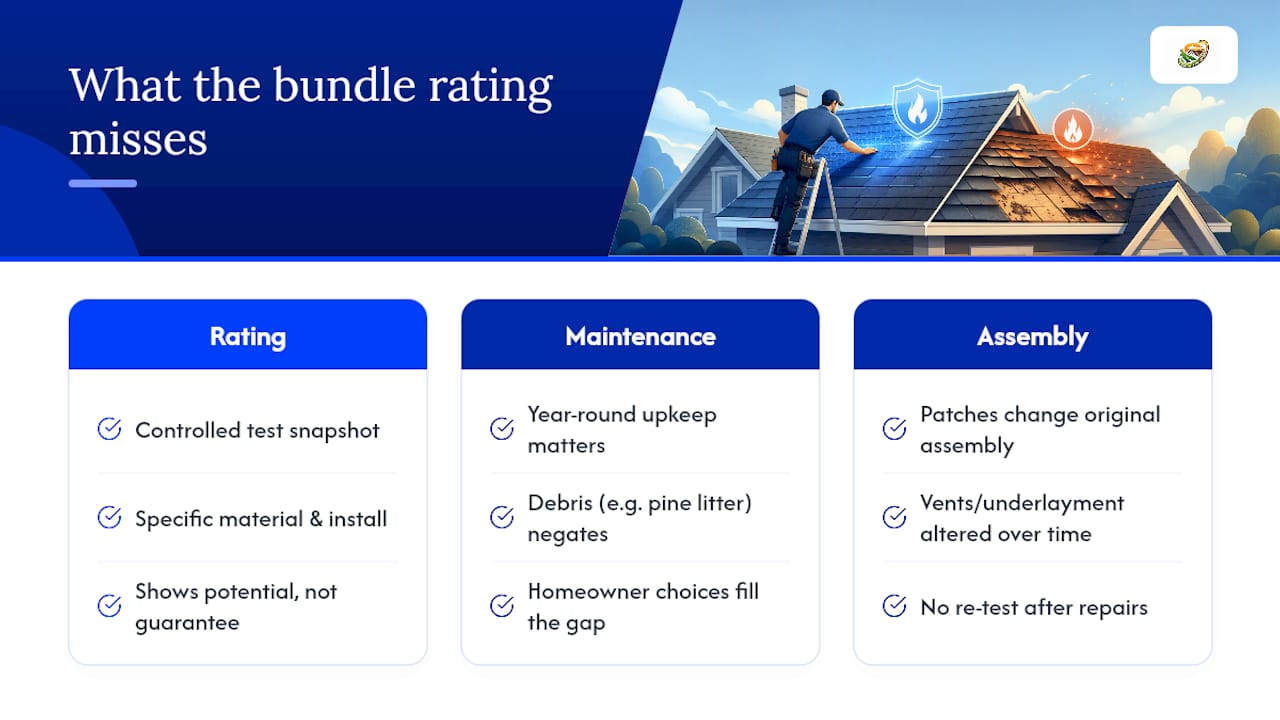
The other blind spot is assembly drift. Roofs get patched, vents get added, underlayment gets replaced piecemeal over the years by different contractors who may not have known or cared what assembly earned the original rating. Nobody re-tests a roof after a patch job. That means a huge share of "Class A roofs" in the field are, technically, unverified assemblies wearing an old rating like a hand-me-down jacket that may or may not still fit.
None of this is an argument against asphalt shingles. It's an argument for treating fire resistance as an ongoing responsibility rather than a one-time purchase decision. A well-maintained shingle roof with intact flashing and screened vents will often outperform a neglected roof carrying a technically higher rating. That's the part the label can't tell you, and it's the part worth checking twice a year with your own eyes.
— Daniellison
Schedule Your Free Roof Assessment
If you've read this far wondering whether your own roof still has fire-resistant life left in it, that question deserves a real answer, not a guess. Shingle Roof Renewal offers a free inspection specifically to figure that out: we check for granule loss, brittleness, curling, and flashing gaps, then tell you honestly whether your roof qualifies for renewal instead of replacement.
Roofs showing moderate wear, aging shingles, or early curling are usually the best candidates. If yours qualifies, our certified Green Soy Technology can restore flexibility, extend roof life by 10 to 15 years, and help you avoid a $15,000 to $30,000 replacement, backed by a 6-year transferable warranty. It also keeps usable shingle material out of the landfill instead of an unnecessary tear-off. Schedule your free roof inspection today and find out if your roof qualifies before you call a roofer.
FAQ
What Type of Roof Is the Most Fire-Resistant?
Noncombustible materials like tile, slate, and metal are the most inherently fire-resistant by material, but properly installed fiberglass asphalt shingles that meet Class A criteria under ASTM E108 / UL 790 offer comparable exterior fire protection in real-world use.
What Is a Class A Fire Rating for Shingles?
Class A is the highest fire-resistance classification a roof covering can earn under ASTM E108 / UL 790 testing, meaning it performed best across spread-of-flame, burning-brand, and intermittent-flame exposures.
Should I Get Class 3 or Class 4 Shingles?
Class 3 and 4 typically refer to impact resistance ratings for hail and debris, not fire ratings. For fire performance specifically, confirm the shingle's separate Class A, B, or C rating on the product spec sheet.
Are Asphalt Shingles Considered Combustible?
Asphalt itself is combustible, but modern fiberglass-mat shingles are engineered and layered to meet noncombustible-level performance in standardized fire tests when installed as part of a matched, tested assembly.
How Do I Know if My Roof Still Qualifies for Preservation Instead of Replacement?
A free inspection is the most reliable way to check. Shingle Roof Renewal evaluates granule loss, brittleness, curling, and flashing condition to determine whether your roof is a strong candidate for renewal rather than full replacement.