

Professionally applied eco friendly roof treatment made from soy-based rejuvenators can add years back into an aging asphalt shingle roof, but only when the roof still qualifies. The right move isn't guessing. It's booking a professional inspection to confirm your shingles are a candidate before you spend a dime on replacement. Certified applicators of Fresh Roof Green Soy Technology exist specifically to make that call for you.
TL;DR:
- Only roofs in a mid-age window, showing stiffness but no severe damage or extensive granule loss, qualify for soy-based rejuvenation treatments.
- Rejuvenation can add approximately three to five years of lifespan, with optimal results when the roof is properly inspected and treated before critical deterioration occurs.
- A professional process includes inspection, calibrated spray application, absorption period, and aftercare, with scheduling during dry weather being crucial for success.
- Soy-based treatments penetrate the shingle, restoring flexibility and reducing water permeability, but cannot repair torn or delaminated shingles or replace lost granules.
- Rejuvenation offers a cost-effective extension of roof life, especially in climates like South Florida, and helps reduce environmental waste from premature full roof replacements.
Table of Contents
- What Is Eco-Friendly Roof Rejuvenation and How Does It Work?
- Is Your Roof Old Enough (and New Enough) to Qualify?
- How Many Years of Life Can Rejuvenation Actually Add?
- What Happens During a Roof Rejuvenation Service?
- How Much Can You Save Compared to Full Roof Replacement?
- What's the Environmental Payoff of Soy-Based Roof Treatment?
- Does Eco-Friendly Treatment Work on Wood, Tile, or Other Roofing?
- How Do You Maintain a Roof After Rejuvenation Treatment?
- Eco-Friendly vs. Chemical Roof Treatments: What's the Real Difference?
- How Should Leftover Treatment Materials Be Handled and Disposed Of?
- Why Preservation-First Thinking Beats the Rush to Replace
- Ready to Find Out If Your Roof Qualifies for Renewal?
- Sources
What Is Eco-Friendly Roof Rejuvenation and How Does It Work?
Asphalt shingles fail from the inside out. Every shingle contains maltenes, the light oily compounds that keep the asphalt binder flexible. Florida sun and heat cook those maltenes off over years of UV exposure, and once they're gone, the shingle mat stiffens, cracks, and sheds the granules that protect it from water and fire. That's the root cause behind almost every "aging roof" complaint homeowners bring to an inspector.
Soy-based rejuvenation, sometimes called soy methyl ester (SME) or semi-epoxidized soybean oil (SESO) treatment, works by replacing what the sun took away. These bio-based oils aren't the vegetable oil in your pantry. Manufacturers engineer them with specific molecular properties, tuning epoxidation and ester content so the oil actually penetrates the asphalt matrix instead of just sitting on the surface as a coating, according to Soylei's breakdown of how engineered rejuvenators work.
Testing at Ohio State University found that SME treatments penetrate the shingle, restore flexibility, and cut water permeability by 60% in lab conditions, while also improving how well granules adhere to the shingle surface, per OSU's rejuvenation study. A separate peer-reviewed study on soybean oil-based polymeric coatings reported similar flexibility and granule retention gains in aged shingles, framing the approach as a genuine rejuvenation method rather than a cosmetic fix.
What this chemistry can't do matters just as much. It won't repair a torn shingle, rebuild a mat that has already delaminated, or replace granules that have already washed into your gutters. Rejuvenation restores flexibility. It doesn't rebuild structure.
Is Your Roof Old Enough (and New Enough) to Qualify?
Not every roof is a good candidate, and that's the whole point of an inspection before treatment. Field programs generally look for roofs in a typical mid-age window where the shingles have lost enough maltenes to be brittle but haven't degraded past the point of no return.
Signs your roof may qualify:
- Shingles feel stiff or brittle when lightly flexed, but aren't cracking apart
- Some granule loss is visible in gutters or downspouts, but bare mat isn't showing through
- No active leaks and no soft spots in the roof deck
- Curling is mild, not severe, at the shingle edges
Signs your roof probably doesn't qualify:
- More than 30% granule loss or visible bare asphalt mat
- Active leaks or a delaminated, spongy shingle mat
- Severe curling or shingles that crack when touched
South Florida's heat, humidity, and storm cycles accelerate maltene loss faster than milder climates, which is exactly why local roofs in that age window tend to be high-priority candidates. A trained inspector makes the final call, not a checklist.
How Many Years of Life Can Rejuvenation Actually Add?
Field reports on professional rejuvenation programs commonly cite 3 to 5 years of added life per application, with some programs reporting extensions of up to 5 to 15 years under ideal conditions, meaning the right roof, the right climate, and a properly calibrated application.
The measured numbers behind those ranges come from lab work, not marketing copy. Separate research on SESO-based reactive emulsions found the oil chemically bonds with oxidized asphalt components, restoring ductility and improving grit adhesion when the formulation is calibrated correctly, according to a 2025 case study on soybean oil-based emulsions.
Here's the honest limit: rejuvenation slows deterioration. It doesn't reverse aging that's already baked into the shingle structure. A roof with 15 years of sun damage doesn't come back to looking new. It comes back to being flexible and watertight enough to keep functioning for years longer than it would have otherwise.
That's why a written, transferable warranty matters. It's not just a sales feature. It's the applicator putting their own documented inspection on the line, which is worth asking about before you sign anything.
What Happens During a Roof Rejuvenation Service?
A legitimate service follows a predictable sequence, and skipping steps is a warning sign in itself.
- Inspection and documentation. The applicator walks the roof, photographs shingle condition, and confirms your roof falls in the qualifying age and condition window.
- Low-pressure spray application. The soy-based rejuvenator is applied at a calibrated rate, generally in the neighborhood of 0.4 to 0.6 gallons per 100 square feet depending on shingle condition and product^source.
- Penetration and curing. The oil absorbs into the shingle over roughly 24 to 48 hours. You may notice a slightly darker, saturated look during this window, which fades as curing finishes.
- Aftercare. Avoid foot traffic on the roof and follow any specific drying-time guidance the applicator gives you.
Pro Tip: Schedule your inspection during dry weather. Applicators need a bone-dry roof surface to get proper penetration, and rain within the curing window can affect results.
How Much Can You Save Compared to Full Roof Replacement?
Full asphalt shingle replacement typically runs thousands of dollars for a South Florida home, depending on size and complexity. Rejuvenation is a fraction of that figure, and in qualifying cases, homeowners can save a significant portion compared to full replacement^source.
The math shifts with roof age and condition. A roof at year 9 with mild brittleness is a strong candidate for maximum savings. A roof at year 17 with moderate granule loss might still qualify, but the cost-effectiveness window is narrower because you're likely buying fewer additional years before replacement becomes unavoidable anyway.
Rejuvenation isn't a permanent substitute for replacement. It's a way to delay that expense by years while you plan and budget for it properly. If your roof has active leaks, structural mat failure, or storm damage, replacement is still the right call, and no amount of soy-based treatment changes that. If you're weighing an insurance claim on storm damage, understanding the repair versus replacement decision from your carrier's perspective helps you figure out which path actually applies to your situation.
What's the Environmental Payoff of Soy-Based Roof Treatment?
Asphalt shingle tear-offs generate millions of tons of landfill waste in the U.S. every year, and every roof that gets preserved instead of replaced is one less tear-off adding to that pile, according to research behind the soybean oil-based polymeric coating study.
The biobased case goes beyond landfill diversion. SME and SESO formulations use agricultural, renewable oil instead of petroleum-derived rejuvenators, and lifecycle assessment work on SESO emulsions points to real carbon and energy savings when extended service life avoids a full replacement cycle. Those LCA numbers depend heavily on formulation and application quality. Over-softened asphalt or an improperly calibrated treatment doesn't deliver the same environmental return, which is exactly why professional, documented application matters more than a DIY approach ever could.
Does Eco-Friendly Treatment Work on Wood, Tile, or Other Roofing?
Soy-based rejuvenation is formulated specifically for asphalt shingles. The chemistry works because it replenishes maltenes, the oil compounds unique to petroleum-based asphalt binder. Wood shakes, clay tile, concrete tile, and metal roofing don't contain maltenes, so the same mechanism simply doesn't apply.
That doesn't mean other roofing materials have no eco-friendly maintenance options. They're just different treatments entirely:
- Wood shake and shingle roofs benefit from breathable, water-repellent sealants that resist moss and rot without trapping moisture inside the wood.
- Clay and concrete tile generally need underlayment inspection and tile resealing rather than any oil-based rejuvenator, since the tile itself rarely degrades the way asphalt does.
- Metal roofing relies on protective coatings for rust and UV resistance, an entirely different chemical category from soy-based asphalt rejuvenators.
If your home has mixed roofing, such as an asphalt shingle main roof with a tile accent or a metal porch cover, each material needs its own evaluation. This is also why a certified applicator inspects before quoting anything. Applying an asphalt-specific rejuvenator to the wrong surface wastes money and can leave a residue that doesn't do what you're paying for. If your roof is straight asphalt shingle, which describes most South Florida homes built in the last few decades, the soy-based approach applies directly and predictably.
How Do You Maintain a Roof After Rejuvenation Treatment?
Rejuvenation buys time, but it doesn't eliminate the need for basic upkeep. Treated roofs still benefit from the same maintenance habits that protect any asphalt shingle roof, just with a longer runway before problems start.
Keep gutters and downspouts clear. Granule buildup in gutters after treatment is normal for a short period as the shingle surface settles, but ongoing heavy shedding after the curing window should prompt a follow-up call to your applicator. Trim overhanging branches that drop debris or create shade patterns that trap moisture, since consistent damp spots undercut the flexibility gains the treatment just restored.
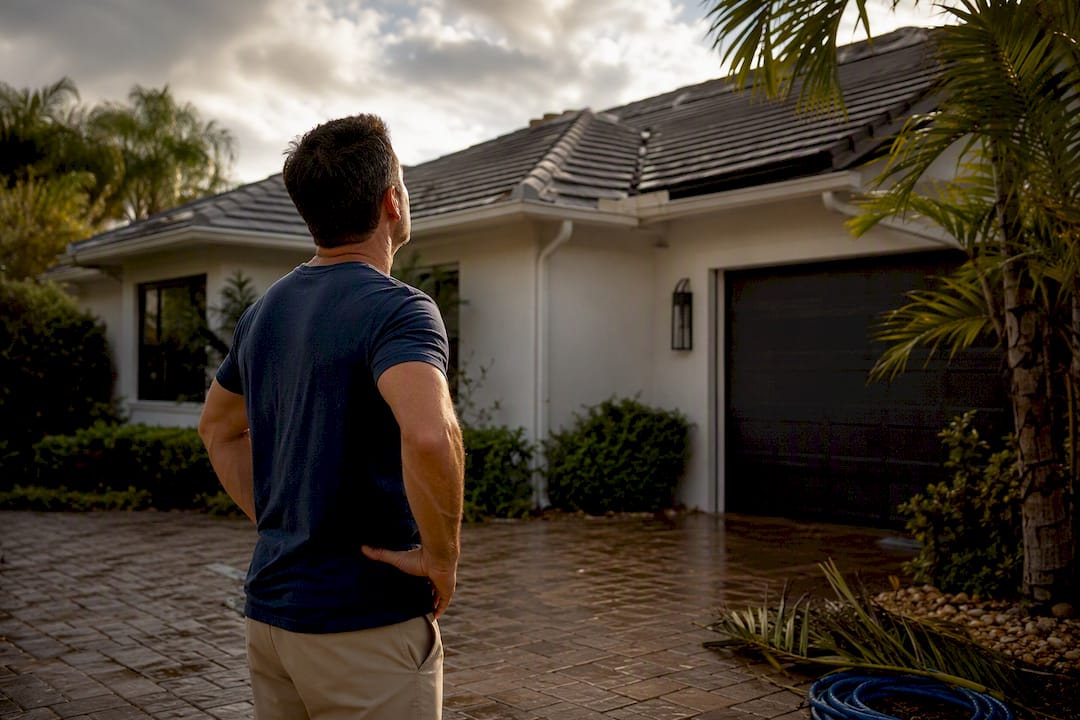
Schedule a visual check after major storms. South Florida's hurricane season puts wind and rain stress on every roof, treated or not, and catching lifted shingles or debris damage early keeps a small problem small.
Most reputable applicators recommend a follow-up inspection every few years to track how the shingles are holding up and whether a second treatment cycle makes sense down the line. Think of it the way you'd think about sealing a wood deck: one application helps, but periodic reapplication is what actually stretches the material's working life toward the upper end of that 5 to 15 year range. Roofs in harsher microclimates, more direct sun exposure, poor attic ventilation, salt air proximity, may need shorter intervals between checks than roofs in more sheltered spots.
Eco-Friendly vs. Chemical Roof Treatments: What's the Real Difference?
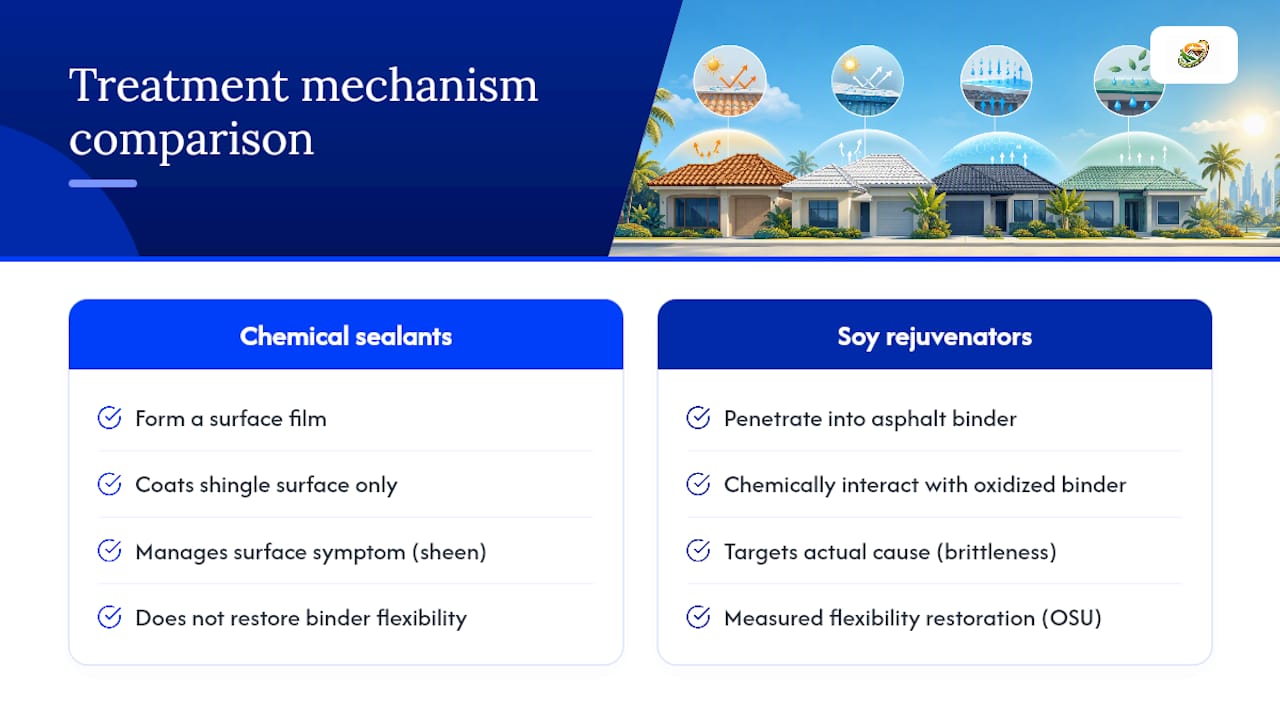
Traditional petroleum-based sealants and coatings work by forming a surface film over the shingle. They can improve water shedding short-term, but they don't address the underlying maltene loss causing the brittleness in the first place, and many contain solvents that raise handling and disposal concerns.
Soy-based rejuvenators work differently and, based on the available lab data, more thoroughly. Instead of coating the surface, engineered SME and SESO formulations penetrate the shingle and chemically interact with the oxidized asphalt binder itself, which is why OSU's testing measured actual flexibility restoration rather than just a surface sheen. That penetration-based mechanism is also why over-application is a real risk with soy-based products. SESO research specifically notes the need for optimal concentration ranges to avoid over-softening the shingle, a failure mode that simply doesn't exist with a surface coating.
On safety, soy-based rejuvenators generally carry lower volatile organic compound content than solvent-heavy chemical alternatives, making them easier to handle on an occupied residential roof. That's not a claim that every eco-friendly product is automatically safer than every chemical treatment on the market. It means the biobased chemistry class tends to skew toward gentler handling requirements, which matters when the applicator is working over your family's living space.
The honest comparison isn't "eco beats chemical" in every case. It's that soy-based rejuvenation targets the actual cause of shingle brittleness, while most surface coatings manage a symptom. For a roof that still qualifies by age and condition, that difference in mechanism translates into a difference in results.
How Should Leftover Treatment Materials Be Handled and Disposed Of?
Soy-based rejuvenators are lower-hazard than solvent-based roofing chemicals, but "lower-hazard" isn't the same as "no precautions needed." A few practical rules apply whether you're a homeowner asking questions or simply want to understand what a reputable applicator should already be doing.
Application should happen on a dry roof surface. Wet shingles or rain during the curing window can cause runoff, sending unabsorbed product into gutters, downspouts, and eventually your yard or storm drains instead of into the shingle where it belongs, a point technical explainers on the chemistry of shingle rejuvenation emphasize directly. That's a performance issue and an environmental one.
Because these are bio-based oils rather than petroleum solvents, disposal requirements are generally less restrictive than for traditional chemical roof treatments, but pouring excess product down a storm drain or onto bare soil is never appropriate regardless of the material.
If you're ever handed a spray container or leftover product directly (which shouldn't happen with a professional application), don't assume "eco-friendly" means "dispose of anywhere." Contact your local municipality's household hazardous waste guidance or ask the applicator to remove and dispose of any excess themselves. A properly run service leaves nothing behind for you to manage.
Why Preservation-First Thinking Beats the Rush to Replace
Homeowners get sold on urgency. A roofer walks the roof, points at granule loss, and quotes a full tear-off before anyone's asked whether the shingles could actually be saved. That order of operations is backwards, and it costs people tens of thousands of dollars they didn't need to spend.
The lab data on soy-based rejuvenation isn't marketing fluff. OSU's permeability numbers and the peer-reviewed work on polymeric coatings are real, independently generated findings, not internal company claims. What they prove is narrower than a full replacement guarantee, but it's meaningful: a roof in that 8 to 18 year window, still structurally sound, can get real years of added life for a fraction of replacement cost.
That's the entire premise behind Shingleroofrenewal and the reason the message is "call us before you call the roofer." Preservation only works when someone actually checks eligibility first, honestly, before quoting anything.
— Daniellison
Ready to Find Out If Your Roof Qualifies for Renewal?
If your shingle roof is showing its age but hasn't failed outright, the smartest first call isn't to a roofing crew. It's to a certified applicator who can tell you honestly whether your roof still has years left in it. Certified applicators of Fresh Roof Green Soy Technology, backed by a written, transferable warranty, serve homeowners in South Florida.

The process starts with a free, no-pressure inspection. An applicator documents your shingle condition, checks it against the qualifying age and damage window, and gives you a straight answer, not a sales pitch toward replacement. If it doesn't, you'll know that too, before spending a dollar on a treatment that wouldn't help.
Homeowners in Delray Beach can schedule a free inspection here, and those in Plantation can check eligibility for their roof here. Either way, the roof gets checked before you're stuck paying for a replacement you might not have needed.
Sources
The lab and field data behind this article come from a mix of academic research and applicator-level technical resources. The peer-reviewed study on soybean oil-based polymeric coatings and Ohio State University's testing on soy methyl ester rejuvenation provide the measured performance figures cited throughout, including flexibility gains and permeability reduction.
For the chemistry behind engineered formulations, see Soylei's explainer on how engineered rejuvenators work and the 2025 case study on SESO-based emulsions. Field-reported life-extension ranges come from Shingle Hero's analysis of rejuvenation spray effectiveness, and application-rate guidance is drawn from Can This Roof Be Saved's chemistry breakdown.
For local procedures, savings breakdowns, and step-by-step maintenance guidance, see Shingleroofrenewal's cost-effective roofing solutions guide and its Florida-specific flexibility restoration walkthrough.
- Soybean oil-based polymeric coatings for the rejuvenation of old asphalt shingles (DOI)
- How Engineered Roof Rejuvenators Work - Soylei
- Does Roof Rejuvenation Spray Actually Work? Honest 2026 Answer | Shingle Hero