
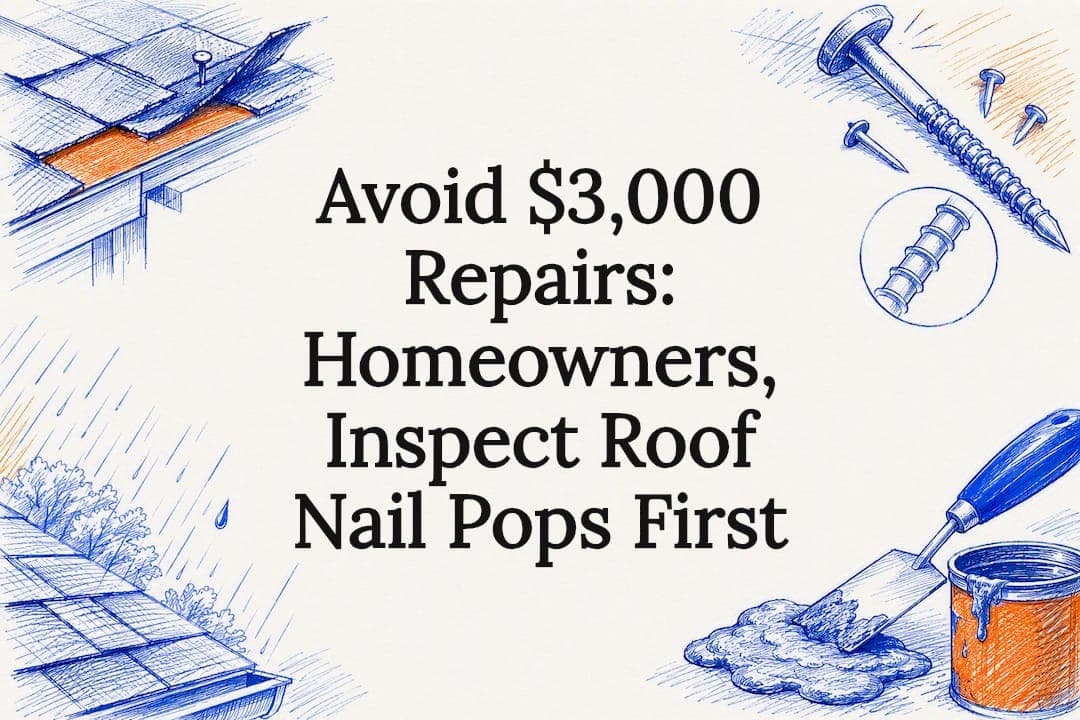
A nail pop happens when a roofing fastener backs out of the decking and pushes the shingle above it upward, breaking the watertight seal. One or two isolated pops on an older roof usually aren't urgent, but you should still photograph each one, note its location, and get the roof inspected before any rain can exploit that gap.
TL;DR:
- Nail pops are caused by fasteners working loose due to thermal cycling, incorrect installation, or decking deterioration, leading to slow leaks over time.
- Ground inspection with sun, shadow, and granule loss helps identify nail pops without roof access, but spotting clusters or straight lines indicates more serious underlying issues.
- Proper repair involves removing the popped nail, sealing the hole, and installing a new ring-shank nail in the correct zone, rather than simply hammering the nail back in.
- Repair costs range from $50 to $300 for isolated pops, but widespread or decking-related problems often require extensive work or partial reroofing, which is more costly.
- Addressing attic ventilation, using correct fasteners, and monitoring roof condition can prevent nail pops and extend the roof's lifespan, emphasizing inspection over immediate replacement.
Table of Contents
- What Roof Nail Pops Actually Are
- Why Do Nail Pops Occur?
- How to Identify Nail Pops on Your Roof
- How to Fix a Nail Pop the Right Way
- When Nail Pops Signal a Bigger Problem
- What Nail Pop Repairs Typically Cost
- Preventing Nail Pops Before They Start
- Why We Start Every Nail Pop Call With an Inspection, Not an Estimate
- The Real Lesson in a Popped Nail
- Sources
What Roof Nail Pops Actually Are
A nail pop is a roofing fastener that has backed out of the decking and pushed the shingle above it upward, creating a small dome or ridge you can often feel with your hand. That upward push does something specific: it lifts the shingle just enough to break the factory seal strip, and it can push the nail head through the shingle's surface entirely.
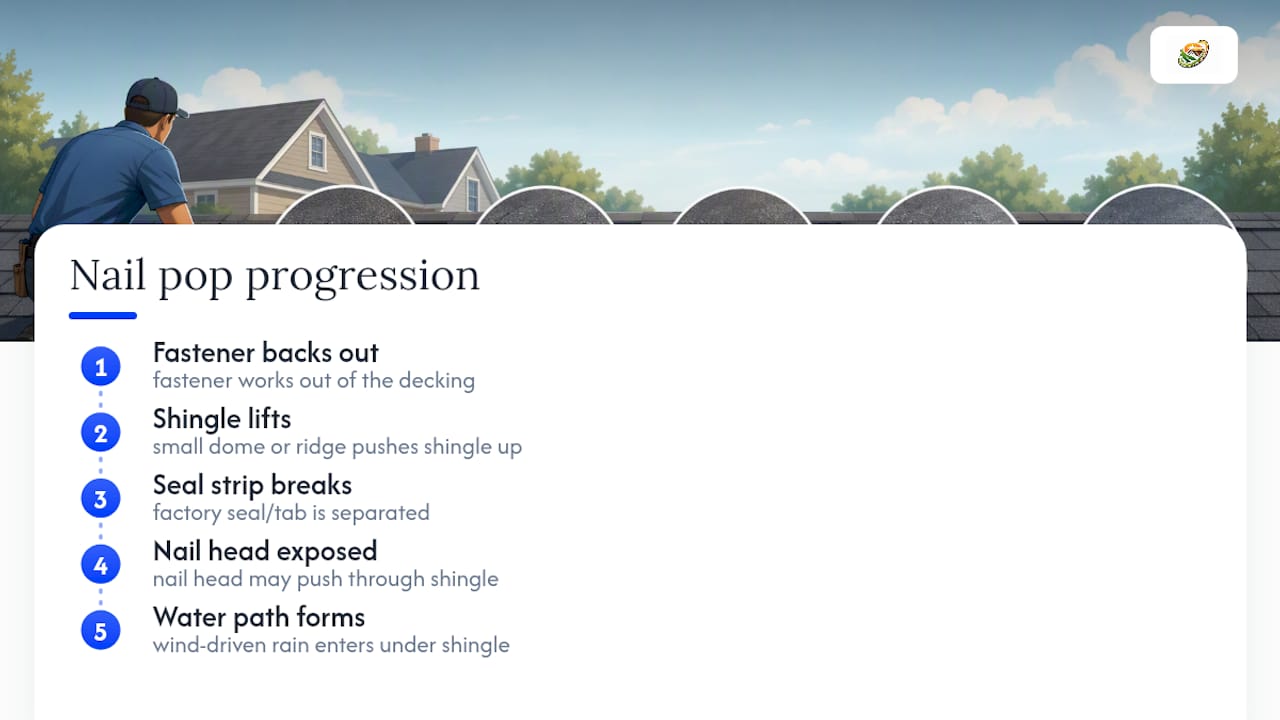
There's a difference between a true nail pop and a simply exposed nail head. A nail pop involves the fastener physically working its way out of the wood, while an exposed nail might just be one that was installed too high or missed the tab seal from day one. Both create the same danger, though: a puncture point where wind-driven rain can work its way under the shingle and onto the decking below. Once that seal breaks, water doesn't need a big opening. A gap the width of a nail shank is enough to start a slow leak that takes months, sometimes years, to show up as a stain on your ceiling.
Why Do Nail Pops Occur?
Roof nail pops rarely have a single cause. Most of the time, you're looking at a combination of the roof's age, the way it was installed, and how it breathes.
- Thermal cycling. Shingles and decking expand in the heat and contract in the cold, and asphalt shingles handle that stress the worst. Over years of daily cycling, nails can slowly work their way outward, a process roofers sometimes call thermal ratcheting.
- Installation errors. Wrong nail type, wrong nail length, or a pneumatic nail gun set at the wrong pressure all cause trouble. Overdriven nails crush the wood fibers around the shank, weakening its grip, while underdriven nails leave the head sitting proud from the start.
- Decking shrinkage or rot. Plywood or OSB sheathing that dries out, shrinks, or begins to decay loses its ability to hold a nail shank tight.
- Poor attic ventilation. Trapped heat and moisture accelerate wood movement and make every other cause on this list worse.
- Roof age and layering. Older roofs, and roofs with more than one layer of shingles installed over each other, tend to show more nail pops simply because there's more material stress to go around.
How to Identify Nail Pops on Your Roof
You don't need to climb onto the roof to start diagnosing the problem, and in most cases, you shouldn't.
- Check from the ground first. Walk the perimeter of your house in the late afternoon when the sun is low. Raking light casts shadows off raised bumps that are nearly invisible at noon.
- Look for granule loss around specific spots. A shingle that's lost its seal often sheds granules faster right at the pop site.
- If you can safely access the roof, lift the shingle edge gently near any bump you spotted from the ground. You're looking for a visible nail head sitting above the shingle surface.
- Check the attic on the same day. Bring a flashlight and probe the decking near roof valleys and ridges for soft spots, dark staining, or a nail tip poking through from the outside.
- Read the pattern before you panic. A handful of scattered, isolated pops spread across different slopes is common on an aging roof. Clusters, straight lines along a seam, or pops concentrated on one slope point to something more serious, like decking movement.
- Stop and call a professional if you're not comfortable on a ladder, if the roof pitch is steep, or if you find soft decking. That's not a DIY situation anymore.
How to Fix a Nail Pop the Right Way
Here's the mistake almost every homeowner makes on their first try: hammering the popped nail back down flush with the shingle. It feels like the obvious fix, and it's almost always wrong. The nail hole in the decking is now oversized and stripped of its grip, so the nail pops right back up within a season, sometimes within weeks.
The correct nail pop repair follows a specific sequence:
- Lift the shingle carefully around the popped nail without cracking it, especially on hot days when asphalt is more pliable and on cold days when it's brittle.
- Remove the popped nail entirely rather than trying to reuse it.
- Seal the old nail hole with roofing cement before doing anything else, so that hole isn't left as an open path into the decking.
- Drive a new ring-shank nail one to two inches away from the old hole, placed correctly within the shingle's nailing zone rather than too high or too low.
- Seal the new nail head with a dab of roofing cement.
- Press the shingle back down and reseal the tab if the adhesive strip has lost its stick.
Ring-shank nails matter here because their ridged shank roughly doubles the withdrawal resistance of a smooth shank nail, which is exactly the holding power you need to prevent a repeat pop. Correct placement within the manufacturer's nailing zone and full penetration through the sheathing matter just as much as the nail type itself. Galvanized nails in the 1.25 to 1.5 inch range are standard for most asphalt shingle applications, though your decking thickness determines the exact length needed for full penetration.
Pro Tip: Keep a small tube of roofing cement and a handful of ring-shank nails in your garage. A same-day fix on one or two pops takes fifteen minutes and costs you almost nothing compared to waiting for the next storm to turn it into a ceiling stain.
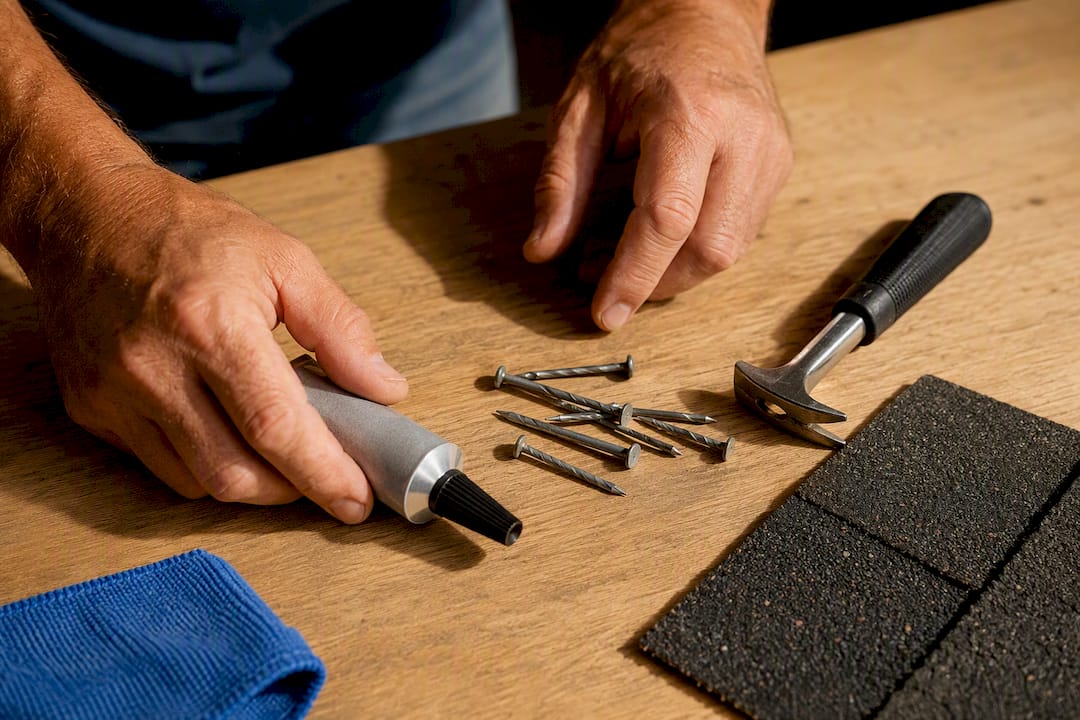
If more than a few shingles around the pop are cracked, curled, or brittle, replace the shingle instead of just re-nailing it. A shingle that's already lost its flexibility won't reseal properly no matter how well the nail is placed. DIY repair is reasonable for one or two accessible, low-slope pops. Anything involving steep pitches, multiple pops, or attic evidence of moisture belongs with a roofing professional.
When Nail Pops Signal a Bigger Problem
Not every nail pop is a quick fifteen-minute fix, and knowing the difference protects your wallet.
- More than five to ten scattered pops across a roof, or any pattern that clusters together, tends to point past a fastener problem and toward decking movement.
- Soft spots, sagging, or visible delamination in the decking mean the plywood itself is failing, not just the nail holding it.
- Nail pops within the first two or three years of a new roof often signal a workmanship issue during the original install, which may fall under the installer's warranty rather than coming out of your pocket.
- Multiple pops along a single seam or ridge line usually means the decking underneath moved as one piece, not that a few nails happened to fail independently.
When you call a contractor for a nail pop that worries you, ask them three specific things: whether they'll probe the decking for soft spots, what nail type and length they plan to use, and whether they'll check your attic ventilation while they're up there. Their answers tell you a lot about how thorough the job will be. For a broader list of red flags worth tracking, this rundown of warning signs of shingle roof failure is worth bookmarking.
What Nail Pop Repairs Typically Cost
Pricing scales pretty directly with how many pops you have and what's underneath them.
- A handful of accessible pops typically runs $50 to $300 for a straightforward removal, re-nail, and reseal job.
- A medium job involving a broader re-strike across a section of roof, or multiple isolated repairs in different spots, usually lands between $250 and $800.
- Decking repair or partial reroofing costs considerably more once rotted sheathing has to come out, since that work involves tear-off labor and new plywood on top of the fastener fix.
- Most contractors price this work either per repair, by the hour, or with a flat service-call minimum for anything under a certain number of pops.
Workmanship warranties from your original installer often cover nail pop repair if the pops appeared early and in volume, so check your paperwork before paying out of pocket. Homeowners' insurance rarely covers nail pops on their own, since insurers treat them as maintenance issues rather than storm damage, unless a documented wind event caused the fastener failure. For a deeper look at what drives repair pricing overall, see this breakdown of roof shingle repair cost factors.
Preventing Nail Pops Before They Start
The fixes that stop nail pops from recurring are the same ones that extend the life of the whole roof.
- Improve attic ventilation. The IRC's R806.2 baseline for net free ventilation area exists precisely because trapped attic heat and moisture accelerate the wood movement that pushes nails loose. Check that your soffit and ridge vents aren't blocked by insulation or debris.
- Insist on ring-shank nails and correct nail-gun pressure any time repair or re-roofing work happens on your house.
- Replace spongy or rotted decking before a contractor does any widespread re-nailing. Nailing into failing wood just guarantees a repeat visit.
- Schedule a routine roof inspection every year or two, and ask specifically about fastener condition, not just shingle wear.
Pro Tip: If your roof is showing scattered nail pops but the decking underneath is still sound, that's often the exact profile of a roof that can be preserved rather than replaced. Catching it at that stage is where the real savings are.
More detail on extending the life of aging shingles is available in this guide to how to extend shingle life on an older asphalt roof, and this partner resource on identifying roof decking damage walks through attic inspection techniques in more detail than we've covered here.
Why We Start Every Nail Pop Call With an Inspection, Not an Estimate
Nail pops get homeowners nervous, and that nervousness is exactly what pushes people toward a full replacement quote before anyone's actually checked whether the decking underneath is sound. Our process at Shingleroofrenewal skips that leap. We inspect the roof, assess its actual condition, and determine whether it qualifies for preservation before anyone talks about tear-off.
Our certified Fresh Roof Green Soy Technology restores flexibility to brittle shingles, locks in loose granules, and extends the roof's usable life when the decking underneath is still structurally sound. That work comes backed by a 6-year transferable warranty. Scattered, isolated nail pops on a roof with solid decking are often exactly the kind of problem preservation solves. Clustered pops with rotted sheathing usually mean actual replacement is the honest answer, and we'll tell you that too. If your roof is showing nail pops in Delray Beach or the surrounding area, schedule your free inspection before you schedule anything else. Call us before you call the roofer.
The Real Lesson in a Popped Nail
Homeowners tend to treat a nail pop as either nothing or a crisis, and both instincts miss the point. A popped nail is data. It's the roof telling you something about how it was built, how it's aged, or how it's breathing, and the pattern matters more than the individual pop.
What gets overlooked most often is how much the fix depends on getting the diagnosis right before touching a hammer. Re-nailing a shingle over rotted decking buys you a few months at best. Ignoring a cluster of pops because "it's just a few nails" is how a $300 repair turns into a $3,000 decking replacement eighteen months later. The homeowners who come out ahead aren't the ones who fix nail pops fastest. They're the ones who read the pattern first, ask the right questions of whoever's doing the repair, and treat an aging roof with scattered fastener issues as a candidate for preservation rather than an automatic tear-off. That distinction is where thousands of dollars either get saved or get spent unnecessarily.
— Daniellison
Sources
- Shingle Nail Pops in Asphalt Shingle Roofs | InspectAPedia
- Nail Pops on Shingles: Causes, Fix & Bigger Trouble Signs | The Roofing Brief
- Roof Nail Pops: Causes, Fixes | R&E Roofing (2026)
- 6 Easy Steps To Fix Nail Pops On Roof Shingles | Koalaty Roofers