
If a roofer has told you your asphalt shingle roof needs to be replaced, get a second opinion before you sign anything. In South Florida, the best person to ask is a company that doesn't need to tear your roof off to make a living. We are a roof preservation company, not roofers, and our free roof assessment tells you whether your shingles still qualify for renewal or whether replacement really is the next step. Call us before you call the roofer.
TL;DR
- Get a second opinion when replacement is recommended without photos, after a rushed inspection, with a sign-today deadline, or after a storm when door-knockers appear.
- A good assessment names what was examined, where each problem is, how widespread it is, and what could not be reached.
- Compare line items, not totals. Two quotes are rarely for the same job.
- Florida's 25% rule depends on when your roof was last permitted, so ask about it before accepting "the code requires a full replacement."
- In Broward and Palm Beach counties, our free assessment checks whether your shingles qualify for preservation and renewal instead of replacement.
Table of Contents
- When a second opinion is worth it
- What a real second opinion looks like
- What the assessment should cover
- Compare the two assessments side by side
- Red flags in a replacement quote
- Florida's 25% rule and what it means for your quote
- Why a preservation company is a useful second opinion
- How to prepare for the visit
- Storm season changes the calculation
- Repair, renew or replace: a quick decision frame
- Get your roof assessed before you decide
- FAQ
- Sources
When a second opinion is worth it
Not every roof quote needs a challenge. A roof that is leaking in several places, soft underfoot, or showing rotted decking may well need replacing. But a replacement is a big decision for most homeowners, and there are clear signs that the first opinion deserves a second look.
A professional association for roof assessment lists the situations that call for one: a full replacement recommended without photographic evidence, an assessment that took only about fifteen minutes, or a free inspection that turns into an urgent quote with a deadline. It adds that this is especially common in the weeks after a storm, when out-of-area crews follow the weather.
Add to that list anything that contradicts what you can see yourself. If the roofer says the whole roof is failing but you have never had a leak and the shingles look intact from the driveway, ask for evidence. The same goes if you have been told that "the insurance will cover it all" before anyone has opened a claim.
In South Florida, one more trigger matters: age. Sun, heat and heavy rain dry out asphalt shingles over time. They become brittle, crack, curl and shed granules. A roof showing those signs often gets labeled "end of life" on sight. Whether it really is depends on how far the deterioration has gone and whether the shingles can still be restored. That is the question most replacement quotes never ask.
What a real second opinion looks like
A second opinion is not a second sales pitch. It is a fresh set of eyes on the same roof, with the goal of answering three plain questions: what is wrong, how much of the roof is affected, and what is the least expensive fix that will hold.
We built our process around those questions:
- We inspect your roof.
- We assess its condition.
- We recommend whether it qualifies for renewal.
The inspection and assessment are free. If your asphalt shingle roof is a good candidate, we can restore its flexibility, lock in granules and extend its life, and you could save up to 80% compared to a full replacement. The work is backed by a 6-year transferable warranty. If the roof does not qualify, you will know that too, and you will know why.
Our work is designed for Broward and Palm Beach County homes, where constant sun, heat and storms wear shingles down. Because we do preservation, not tear-offs, we are not paid more when your roof is replaced. We are the call you make before the roofer.
Three common outcomes
After a good assessment, most roofs land in one of three groups:
- Maintainable. The shingles are aging but still intact. Preservation and renewal can slow deterioration and extend their life.
- Repairable. A localized problem, such as a flashing failure or a few damaged shingles, can be fixed without touching the rest of the roof.
- Replace. The damage is widespread, the deck is compromised, or the shingles are past the point where treatment helps.
A quote that jumps straight to the third group without ruling out the first two has skipped the most useful part of the job. Even a leaking roof is not automatically a lost cause: Consumer Reports notes that most leaks can be stopped when they are limited to a few spots.
What the assessment should cover
Whether you use us or anyone else, a credible roof assessment has a recognizable shape. You should be able to read the report and see exactly what was looked at.
A home inspection standard lists what an inspector is expected to report on the roof: the roof-covering material, gutters, downspouts, vents, flashings, skylights, chimneys and other penetrations, plus the general roof structure and visible attic problems like moisture intrusion or damaged sheathing. That is the baseline.
Beyond the checklist, look for these in the findings:
- Specific locations. "Cracked shingles on the south slope near the ridge" is useful. "Roof is old" is not.
- Extent. One slope, two slopes, or the whole roof? The answer changes the price dramatically.
- Active or cosmetic. Is water getting in, or are granules simply thinning?
- What was not reached. An honest report says which areas could not be examined and why.
- Priority. What needs attention now, what can wait, and what to watch.
A records guide for homeowners suggests asking the second reviewer to address a narrow gap in the evidence, for example whether a specific valley can be repaired and which photos support that answer. It also recommends noting how the roof was accessed, whether from the ground, a ladder, the roof surface, the attic or by drone.
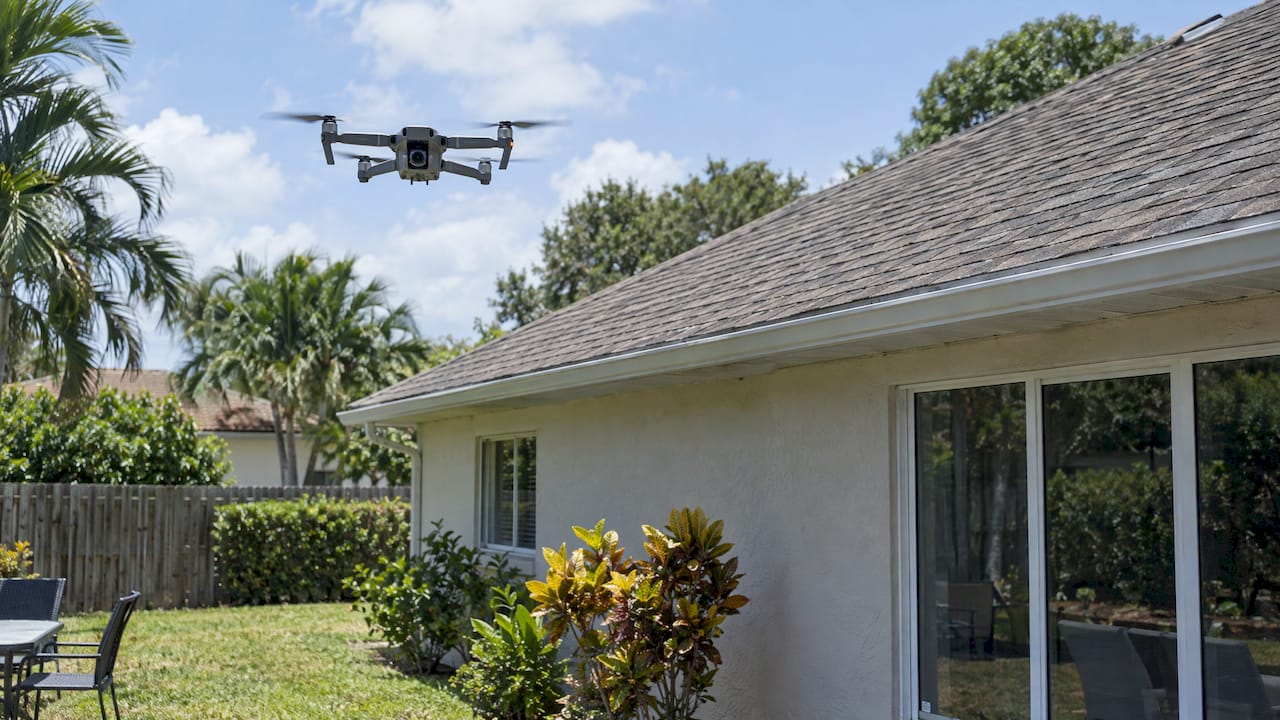
Drone imagery in particular can help document areas that are hard or unsafe to reach, and a guide to drone roof inspection explains how those surveys work, what they typically cost and what rules apply.
A note on age estimates
Any remaining-life number is an estimate. Florida defines a home inspection as a limited visual examination of readily accessible systems, and even insurer roof forms state that they are not a warranty of how long the roof will last. Treat "you have three years left" as informed judgment, not a guarantee, and weigh it against the condition of the shingles you can actually see.
Compare the two assessments side by side
Once you have a second opinion, put both in front of you. The point is not to decide who is lying. Two contractors can honestly disagree because they accessed different areas, assumed different materials or follow different repair philosophies.
Start with line items, not totals. An records-focused guide warns that one estimate may include tear-off, underlayment, flashing, ventilation, gutters, permits, disposal and warranty registration while another leaves them out. Phrases like "decking replacement if needed" or "price subject to inspection" can change the final bill substantially.
A simple comparison table helps:
| Question | First opinion | Second opinion |
|---|---|---|
| What problem was found, and where? | ||
| How much of the roof is affected? | ||
| Are there photos tied to each finding? | ||
| Was the attic checked? | ||
| Recommendation: repair, renew or replace? | ||
| Scope in writing, with exclusions | ||
| Warranty terms | ||
| Payment schedule |
Mark any cell you cannot fill as "unknown." An honest gap is better than a guess.
If the two opinions disagree sharply on the roof's condition, the useful question is why. Ask each party to walk you through the specific photos and measurements behind their conclusion. A recommendation that is solid will hold up when someone else examines it.
Red flags in a replacement quote
Use this list as a screen before you sign:
- A single lump-sum price with no breakdown.
- Pressure to sign today, or a discount that expires tonight.
- Full replacement recommended before any documented inspection.
- A request for full payment upfront.
- A request to sign over your insurance claim rights.
- Urgency with no active leak to justify it.
The first five appear on a consumer cost guide's list of quote red flags, and they line up with the warning signs the roof assessment association describes. Real urgency exists: a leak during a storm should be handled quickly with a temporary fix. But a deadline created to hurry a signature is a different thing.
Before hiring any contractor for a repair or replacement, confirm the state license with the issuing authority, ask for a certificate of insurance, and get the full scope in writing.
Florida's 25% rule and what it means for your quote
South Florida homeowners often hear that "if more than 25% of the roof is damaged, the whole thing has to be replaced." That was once close to how the building code worked. It is no longer the full story.
The Florida Building Code, Existing Building volume, says that no more than 25% of a roof or roof section may be repaired, replaced or recovered in a 12-month period unless the whole section is brought up to current code. But Florida law carves out an exception. Under Section 553.844(5) of the Florida Statutes, if the roof was built, repaired or replaced under the 2007 Florida Building Code or any later edition, then even when 25% or more is being repaired, only the repaired portion must meet current code. Local governments cannot amend that exception by ordinance.
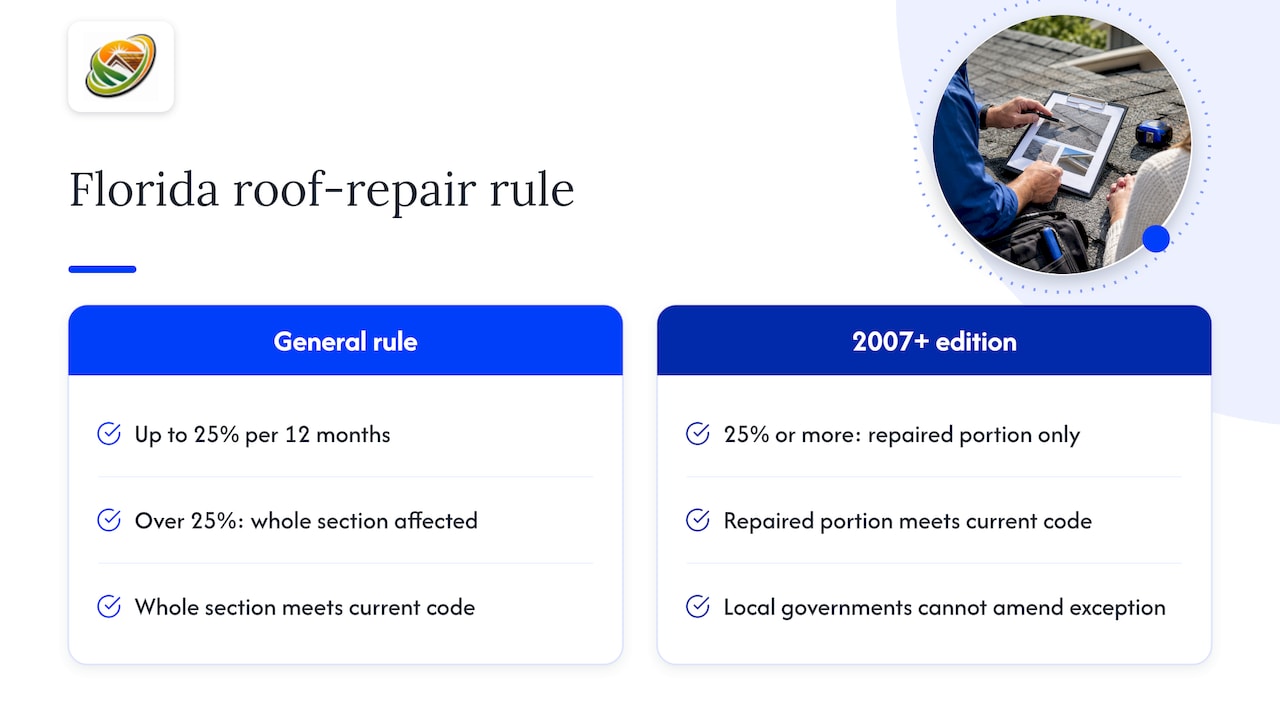
The exception was added in 2022. A Florida roofing market study traces it to a special-session law that took effect on May 26, 2022, and notes that the pivot is the 2007 code date. In practical terms, the first question to ask about your roof is when it was last permitted.
So if a roofer tells you the code forces a full replacement, ask which edition of the code your roof was built under, and ask them to put the reasoning in writing. For many newer roofs, a partial repair may be all that is required. This is a general description of the law, not legal advice for your property. For a specific permit question, your city or county building department is the authority.
Why a preservation company is a useful second opinion
Most second opinions come from another roofer, and another roofer earns money from the job they are assessing. That is not a criticism of anyone's honesty. It is simply how the work is paid for: a replacement is a larger job than a repair or a renewal.
We are a different kind of company. We are not roofers, roof cleaners or a construction company. Our work starts with one question: can this roof still be maintained? If it can, we are the right call, and our certified Fresh Roof Green Soy Technology is designed to restore flexibility, slow deterioration, lock in granules and extend the life of qualifying asphalt shingle roofs. In lab testing, our process restored about 50% of shingle flexibility, compared with roughly 20% for standard rejuvenation oils. You can read how the two approaches differ on our page on Fresh Roof versus roof rejuvenation.
If your roof is a candidate, you avoid the $15,000 to $30,000 many homeowners spend on a full replacement, and you keep tons of shingles out of the landfill. That saving is why we say: call us before you call the roofer.
How to prepare for the visit
A little preparation makes any roof assessment sharper. Pull together:
- The first estimate exactly as you received it, with photos, scope, exclusions, warranty terms and payment schedule.
- Roof history: the age of the roof, past repairs, permits, invoices and warranties.
- Notes on any leaks or stains, with dates and photos taken during storms if you have them.
- Any insurance paperwork, such as a claim or a roof form from your carrier.
- A list of the questions you still have.
Stay off the roof yourself. Photos from the ground and from inside the attic or ceilings are enough. If the first contractor gave you a report, set it aside until the second review is done. A roof inspection explainer points out that seeing the first report too early can anchor the second reviewer's conclusions.
Then ask the inspector, in plain language:
- What is most urgent?
- How much life does the roof have left?
- Is this a repair, a renewal or a replacement, and why?
- Which areas did you not examine?
- What will the written report include, and when will I get it?
If you do not understand something in the report, call and ask. A report you cannot follow will not help you decide.
Storm season changes the calculation
Before hurricane season, a worn roof feels like a bigger risk, and that is when pressure sales are most effective. After a storm, the pressure peaks. If you want a calm, structured way to look at damage, our post-storm roof inspection checklist walks through what to check from the ground and inside the house. Our roof damage assessment workflow lays out the sequence from first look to decision.
If your concern is wind, our guide to wind mitigation and shingles in Florida explains what an inspection should confirm first. We also cover how lab-backed treatment can improve shingle wind resistance on qualifying roofs.
Repair, renew or replace: a quick decision frame
General rules of thumb can help you sanity-check a recommendation, as long as you remember they are rough guides:
- Age. A South Florida roofing guide suggests about 15 years for three-tab shingles and 20 for architectural shingles as the point to start planning. Age alone does not decide anything, since condition varies widely.
- Damaged area. Widespread damage across a large share of the roof points toward bigger work. Localized damage points toward targeted work.
- Repair cost versus replacement cost. When a repair estimate approaches a large fraction of replacement cost, it is worth asking whether renewal or replacement makes more sense.
We go deeper on this in our guides on repairing or replacing a roof in South Florida, whether to replace a 20-year-old roof, and what shingle repairs typically cost. If you are weighing preservation against a tear-off on an aging roof, our piece on extending shingle roof life shows how the savings add up.
Our perspective
Most homeowners we talk to have already been told the roof has to come off. Very few have been told it might not.
We think that is backwards. A roof is the most expensive thing on your house that you rarely look at, and in Broward and Palm Beach counties the sun does steady work on it every day. Shingles dry out, curl and lose granules. That is a maintenance problem before it is a replacement problem, and maintenance is cheaper.
That is why our assessment is free and why it comes first. We inspect, we assess, and we tell you whether your roof qualifies for renewal. If it does, our certified Green Soy Technology is designed to restore flexibility and lock in granules, and the work carries a 6-year transferable warranty. If it does not, you will have an honest answer before you spend anything on a replacement.
Call us before you call the roofer.
Daniellison
Get your roof assessed before you decide
If you have a replacement quote in hand and an asphalt shingle roof in Broward or Palm Beach County, bring it to us. We will inspect the roof, assess its condition and tell you whether it qualifies for preservation and renewal. The assessment is free.
You can see what the work involves on our services page, or schedule your free roof assessment directly. We also serve homeowners in cities such as Boca Raton, Delray Beach and Plantation.
FAQ
Is it rude to get a second opinion on a roof?
No. A second opinion makes the first recommendation reviewable, and a contractor who is confident in the findings should be comfortable with that. For a project that can cost five figures, comparing assessments is ordinary due diligence.
Does a second opinion cost anything?
Our roof assessment is free for homes in Broward and Palm Beach counties. We have not published a price for renewal work, because it depends on the inspection and on whether your roof qualifies.
Can a roof that looks old still be saved?
Sometimes. If the asphalt shingles are aging but still intact, with no widespread cracking or deck damage, they may qualify for renewal. That is exactly what our inspection determines, and we tell you honestly if the roof does not qualify.
Should I sign a replacement contract before a storm hits?
Not under pressure. A deadline invented to hurry your signature is a warning sign. If there is an active leak, get it stopped temporarily, then take the time to have the roof properly assessed before committing to a replacement.
Sources
- How to get an unbiased roof damage assessment, NRCIA
- Roofing Buying Guide, Consumer Reports
- How to Perform Roof Inspections, InterNACHI
- Roof Contractor Second Opinion Records
- Roof Leak Repair Cost guide, Read Like Pro
- The 25% Rule for Roofing, The Roofing Brief
- Florida Statutes, Section 553.844
- Florida Roofing Market Study, HyreRoof
- How to Get a Roof Inspection, The Roofing Brief